About Symphyotrichum falcatum (Lindl.) G.L.Nesom
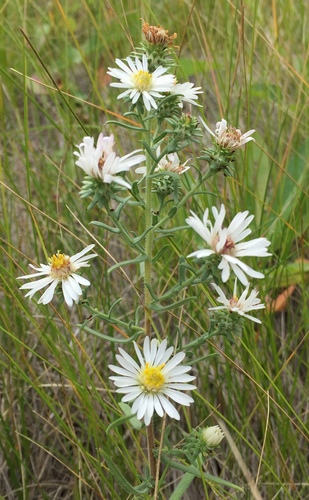
Symphyotrichum falcatum, commonly called white prairie aster, blooms from July to November, with timing varying by variety and location. This plant is colonial or cespitose, and grows to a height of 10 to 80 centimeters (4 to 31 inches). It has hairy stems, plus hairy, firm, entire grayish-green leaves. Like all members of the Asteraceae family, its flower heads are surrounded by small specialized leaves called phyllaries, which together form an involucre that protects the individual flowers inside the head before opening. For S. falcatum, the involucres are bell-shaped (campanulate) and usually 5–8 mm (1⁄4–3⁄8 in) long. The outer phyllaries range from spreading to sharply bent backwards (reflexed), and are shaped oblanceolate to spatulate. The inner phyllaries are linear-lanceolate, and arranged in 3–4 unequal, staggered rows that do not end at the same point. Each flower head holds 15–35 ray florets; these are most often white, sometimes blue or pink, and typically 18–30 millimeters (3⁄4–1+1⁄8 inches) long. The ray florets surround a center of roughly the same number of disk florets, which start yellow and turn brown as they age. S. falcatum var. falcatum is native to Alaska, Yukon, and the Northwest Territories in northern North America, western Canada from British Columbia to Manitoba, the United States from Idaho east to Minnesota, west to Wyoming, south to New Mexico and Arizona, and north to Utah. It is also native to northern Mexico. S. falcatum var. commutatum does not occur in the subarctic, extends further east into Ontario, the South Central and upper Midwestern United States, and further south in Mexico. The Zuni people refer to S. falcatum var. commutatum as ha'mopiawe, and mix ground blossoms of this variety with yucca suds to wash newborn infants. American ethnologist Matilda Coxe Stevenson recorded: "The blossoms, ground to a fine meal, are sprinkled into a bowl of yucca suds used for bathing a new-born infant. This medicine is said to make the hair grow on the head and to give strength to the body. The remedy belongs to all women." The Ramah Navajo use the plant to prepare a decoction that is made into a lotion for treating snake bites.