About Symphyotrichum cordifolium (L.) G.L.Nesom
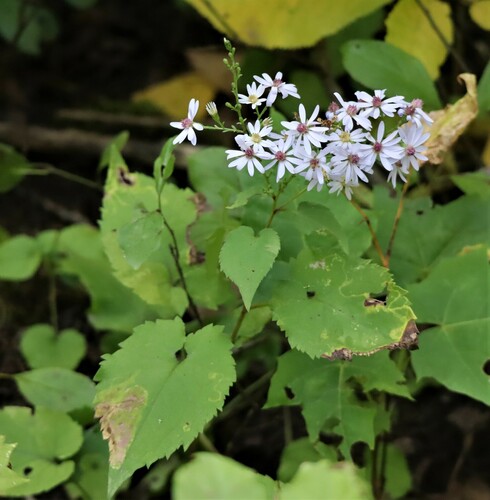
Symphyotrichum cordifolium (L.) G.L.Nesom can grow up to 1.2 meters (4 feet) tall. Its lower leaves are heart-shaped, while leaves higher on the stem are typically sessile with more rounded bases. Its composite flowers, which have bluish (and rarely white) ray florets and light yellow disc florets that eventually turn purple, bloom starting in August and last through October. This species is distributed from Manitoba east to Nova Scotia and Maine, south to Georgia and Alabama, and west to Oklahoma. It was once introduced to British Columbia but did not establish a persistent population there. It is an introduced species in Great Britain and Norway. It grows primarily in mesic locations with rocky to loamy, generally rich soils, at elevations from sea level along the coastal plain up to 1,200 m (3,900 ft) in the Appalachian Mountains. Habitats where it grows include open wooded slopes, stream banks, moist ledges, swampy woods, borders of beech–maple forests and oak–hickory forests, clearings, thickets, roadsides, and ditches. It can also grow in urban areas, where it is sometimes considered a weed. Symphyotrichum cordifolium reproduces both vegetatively via short rhizomes and sexually via wind-dispersed seeds. For all species in the Symphyotrichum genus, ray florets are exclusively female, each with a pistil and no stamen, while disc florets are bisexual, containing both male and female reproductive parts. The Ojibwe people have used Symphyotrichum cordifolium to create incense that attracts deer.