About Symphorus nematophorus (Bleeker, 1860)
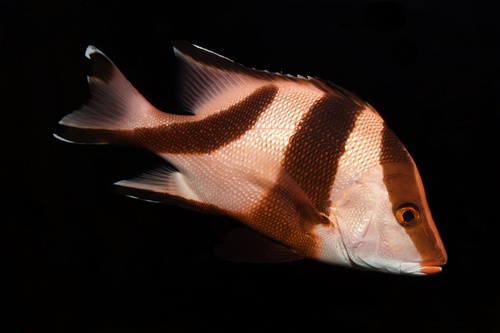
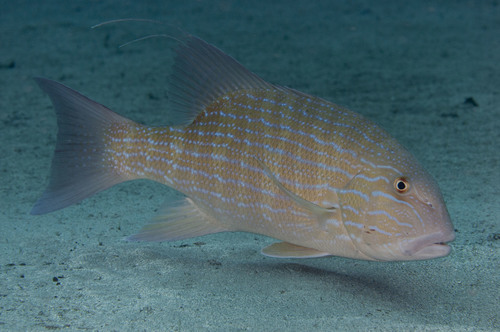
The Chinamanfish, Symphorus nematophorus, has a deep, laterally compressed body with a steep dorsal head profile. It has a deep slit between its eyes and nostrils, and its mouth extends back to the centre of the eye. There is no incision or protuberance on the preoperculum. The jaws hold thin bands of teeth; the outer band has enlarged teeth that are canine-like at the front of the upper jaw. This species has no patch of vomerine teeth, and has a patch of granular teeth on the tongue. Its dorsal fin has 10 spines and 15 to 16 soft rays, while its anal fin has 3 spines and 9 soft rays. In juveniles and sub-adults, at least one of the anterior dorsal fin rays extends into a long filamentous thread. The pectoral fins are long, reaching as far as the level of the anus, and contain 16 fin rays. The caudal fin is emarginate. This species reaches a maximum total length of 100 cm (39 in), with 35 cm (14 in) being more typical, and has a maximum published weight of 13.2 kg (29 lb). The overall body colour of this snapper ranges from greyish-brown to reddish, and is often interrupted by thick, irregular light and dark vertical bars on the flanks. Juveniles are light orange to brownish, with irregular bluish lines and spots on the head and flanks, and have more numerous long filamentous dorsal-fin rays than adults. This species is widely distributed in the West Pacific Ocean, ranging from the Andaman Sea and western Thailand east to Fiji and Tonga, and from northern Australia and New Caledonia north to the Ryukyu Islands. It occurs at depths of less than 50 m (160 ft), and lives on coastal reefs.