About Symphorichthys spilurus (Günther, 1874)
This species is the sailfin snapper, with the scientific name Symphorichthys spilurus (Günther, 1874).
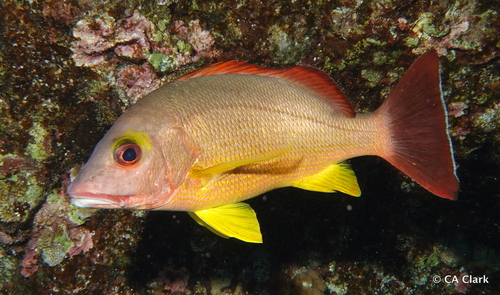
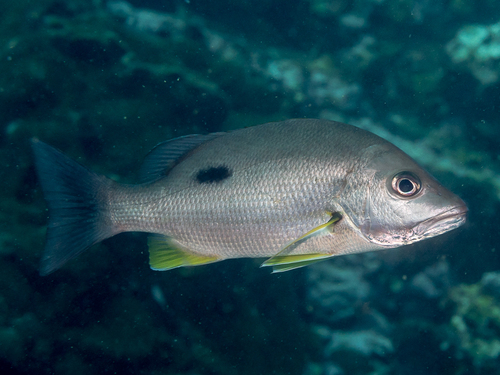
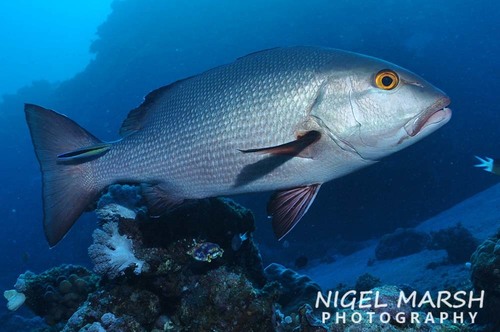
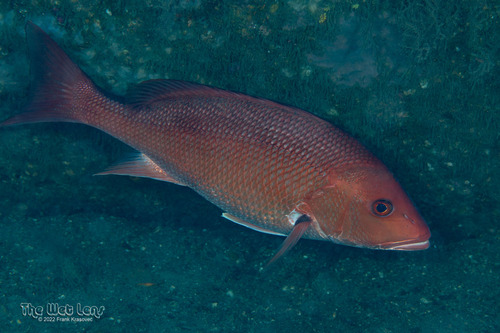
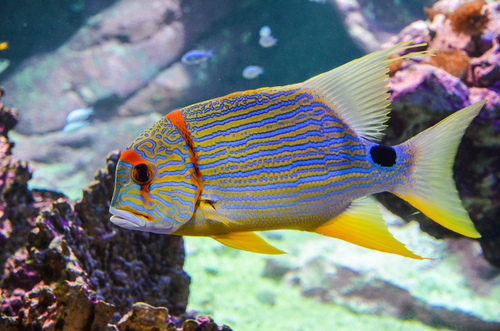
Description: The sailfin snapper has a deep, laterally compressed body. Its head has a rounded dorsal profile, an angular forehead, and a steeply sloped snout. The mouth reaches back as far as the anterior edge of the eye. The preoperculum has no incision or protuberance. The upper jaw has a row of small, flattened teeth; the lower jaw has roughly 3 rows of small, flattened teeth. Both jaws have an outer row of short conical teeth that are slightly larger than the other teeth. There is no patch of vomerine teeth. The dorsal fin has 10 spines and 14–18 soft rays, while the anal fin has 3 spines and 8–11 soft rays. At least one of the anterior soft rays in both the dorsal and anal fins extends beyond the fin membrane to form a long filament. The pectoral fins are long, sometimes extending past the level of the anus, and contain 16 fin rays. The caudal fin is emarginate. This species reaches a maximum total length of 60 cm (24 in), with 50 cm (20 in) being more typical. Adult bodies are yellowish, with blue horizontal stripes along the flanks. There is a large black spot with pale margins on the upper caudal peduncle, an orange bar over the eye, and a second orange bar to the rear of the head. Juveniles have an overall pale greyish colour, marked by a wide black stripe with a white border that runs along the middle of the flanks from the snout to the rear margin of the tail. Juveniles also have the elongated filaments on the dorsal and anal fins, and these filaments are yellowish.
Distribution and habitat: The sailfin snapper occurs in the eastern Indian Ocean and the western Pacific Ocean. In the Indian Ocean, it is found at the Rowley Shoals and near Broome, Western Australia. In the Pacific Ocean, it ranges east as far as Tonga and Fiji, north to the Ryukyu Islands, and south to New Caledonia and the Great Barrier Reef. There are also recorded occurrences at the Mentawai Islands off western Sumatra, and off the west coast of Thailand. It lives at depths between 5 and 60 m (16 and 197 ft), and inhabits sandy areas adjacent to reefs in lagoons, as well as areas over outer reefs.