About Symphoricarpos albus (L.) K.Koch
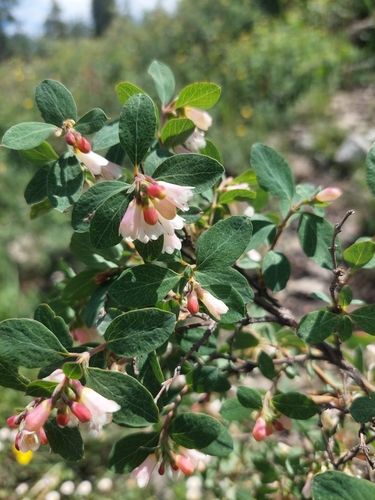
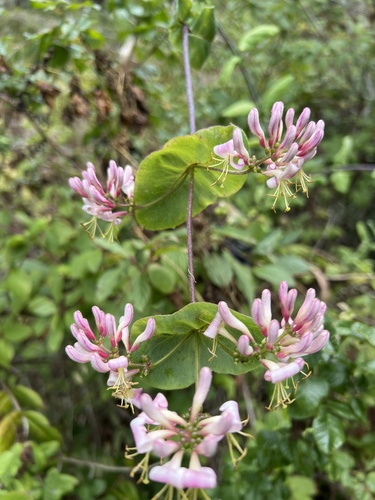
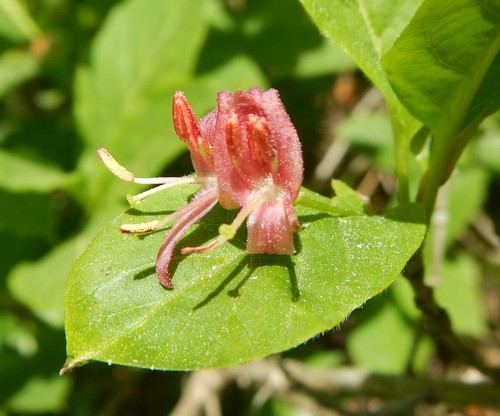
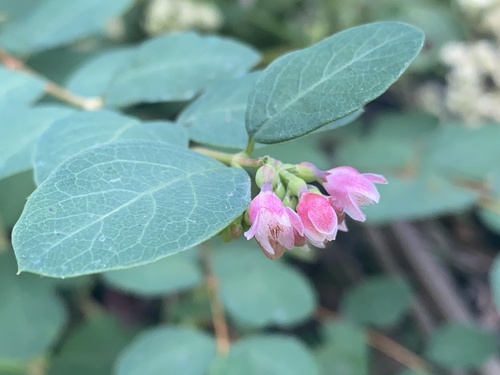
Symphoricarpos albus (L.) K.Koch is an erect, deciduous shrub. It produces a stiff, branching main stem and often several smaller shoots growing from a rhizome. It can spread and colonize an area to form a dense thicket, reaching a maximum height of 1–2 metres (3+1⁄2–6+1⁄2 feet). Its leaves are arranged oppositely on spreading branches; they are generally oval in shape and vary in size, growing up to 5 centimetres (2 inches) long, and can be slightly larger on shoots. Its inflorescence is a raceme holding up to 16 flowers. Each flower has a small, five-toothed calyx of sepals. The bell-shaped, rounded corolla is approximately 0.5 cm (1⁄4 in) long, bright pink in colour, with pointed lobes at the mouth, and its interior is filled with white hairs. The fruit is a fleshy white berry-like drupe measuring around 1 cm in diameter that contains two seeds. The plant mainly reproduces vegetatively by sprouting from its spreading rhizome, but can sometimes reproduce via seed. Birds disperse the seeds after eating the fruit. Symphoricarpos albus occurs across much of Canada, and the northern and western United States. It grows in shady and moist mountain and forest habitats, including woodlands, floodplains, and riverbanks, and it can grow in a wide variety of habitat types. It is naturalized in parts of Britain, where it has been planted as an ornamental plant and cover for game animals. This shrub is an important food source for a number of animals, including bighorn sheep, white-tailed deer, and grizzly bears. Livestock such as cattle and sheep readily browse it. Many birds and small mammals use it for food and cover. Pocket gophers dig burrows underneath it during the winter. The fruit and the entire shrub are poisonous to humans, and consumption causes vomiting. Native Americans used the plant to make medicine and soap, and its wood was suitable for arrow shafts. In Russia, crushed berries are rubbed on the hands as a soothing folk remedy hand lotion. This shrub is used for erosion control in riparian areas, and it is planted in ecological restoration projects on disturbed sites such as abandoned mines. Its white fruits and blue-green foliage made it a popular ornamental plant planted around old houses from the 1890s to the 1920s, similar to Vanhoutte spirea, also called bridal wreath. It is still sold by some large, diverse conventional nurseries and native plant nurseries, and is occasionally found in modern landscapes. It thrives in full sun or partial shade, and in well-drained soil with a pH range of approximately 6.0 to 8.5. It is easy to transplant due to its fibrous, shallow root system. It grows well in U.S. Department of Agriculture hardiness zones 2 to 7. In Germany, it is popular with children who play with its ripe berries, because the berries make a popping sound when thrown on the ground. For this reason, the plant and specifically its berries are called Knallerbsen in German.