About Symphodus melops (Linnaeus, 1758)
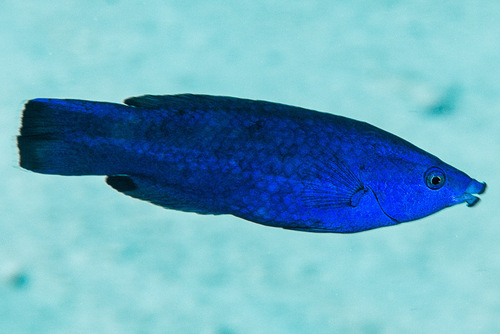
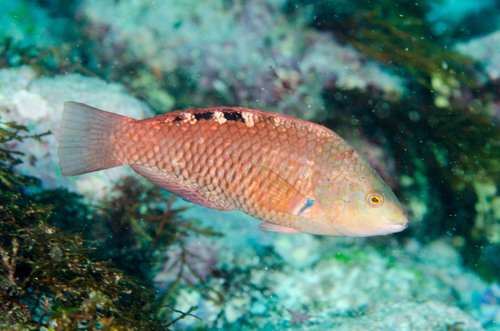
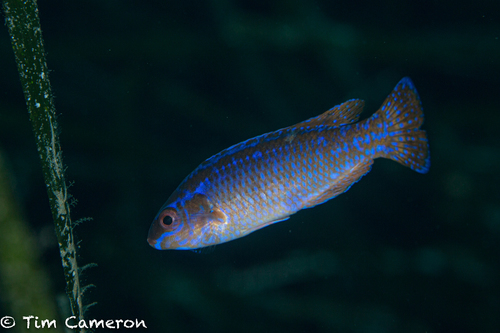
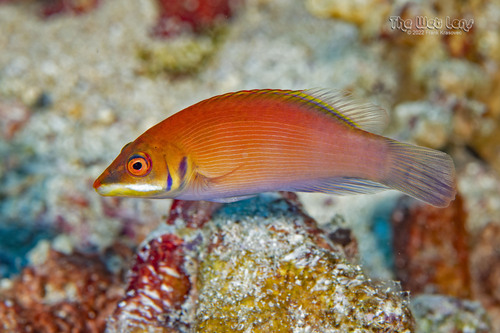
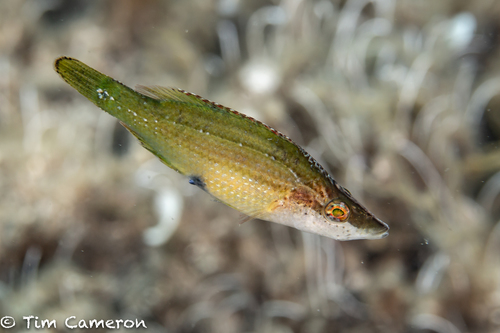
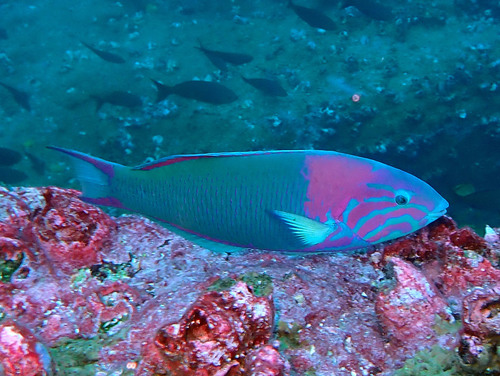
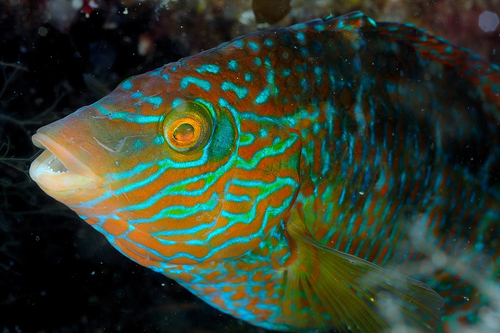
Symphodus melops, commonly called the corkwing wrasse, has a deep, laterally compressed body and a single long dorsal fin. Adults are usually around 15 cm (5.9 in) in length, though individuals can grow as large as 25 cm (9.8 in). Its body colouration is highly variable, changing with both the fish's age and surrounding environment. The corkwing wrasse has a distinct black spot at the center of its caudal peduncle (tail stalk), and a second comma-shaped spot positioned just behind the eye. Females and juvenile fish are typically brown or greenish-brown, while adult males are generally more brightly coloured. Both sexes have patterned lines on their heads and gill covers; these lines are brown and pale blue in females, and bright green or blue in males. This species feeds on a wide variety of prey, with bivalves and copepods making up the bulk of its diet. Male corkwing wrasses exhibit reproductive dimorphism. Territorial males construct ball-shaped nests from seaweed, located in rock crevices or sedimentary areas surrounded by seaweed or seagrass. These nests have a single entrance hole, which the territorial male guards aggressively. A second male morph, called sneakers, mimics females to sneak in and fertilize eggs. Sneaker males are much smaller than territorial males, and cannot be visually told apart from females. Due to a trade-off between reproductive investment and growth, sneakers have proportionally much larger gonads for their body size than territorial males. Sneaker males also have longer-lived, higher-quality sperm than territorial males. Approximately 5 to 20 percent of all males in a given population are sneakers.