About Symmorphus cristatus (de Saussure, 1856)
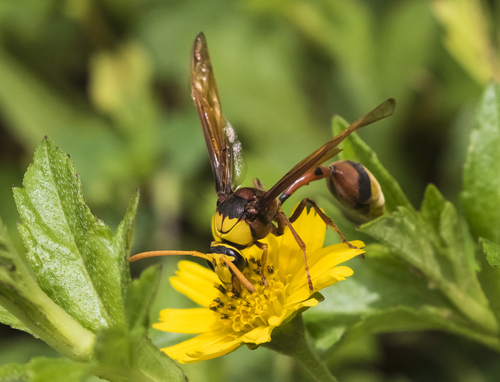
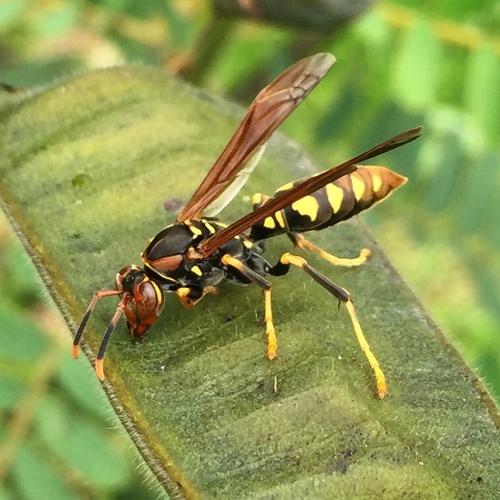
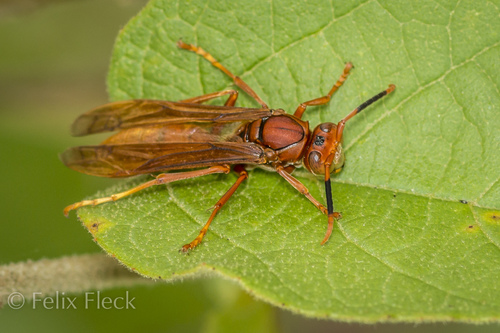
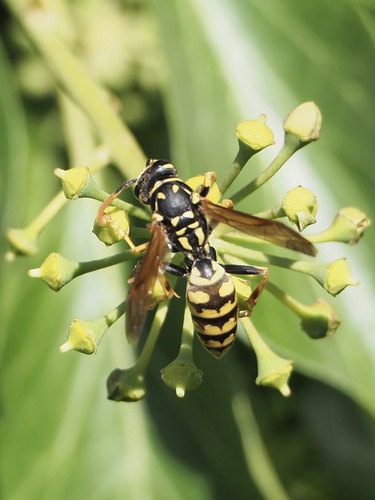
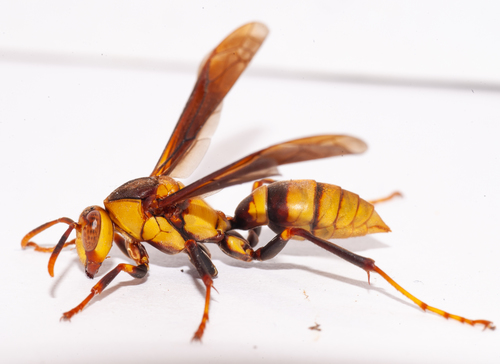
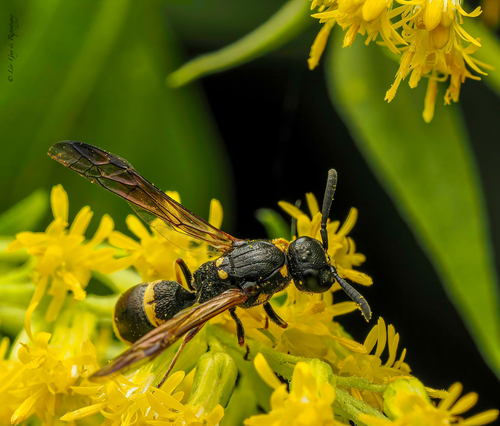
Symmorphus cristatus (de Saussure, 1856) is one of three Symmorphus species found in North America. When viewed from above, its metasomal tergum is narrower than that of S. albomarginatus or S. canadensis. It also has smaller cephalic foveae (depressions) adjacent to the simple eyes (ocelli), which are spaced closer together than those of S. canadensis. The femur section of its hind legs has conspicuous hairs, a feature that S. canadensis lacks. The wing length of S. cristatus ranges from 5.0 to 9.0 mm, and its body markings range from pale to yellow. Males are typically around 20% smaller than females; males usually have a large pale spot on the ventral part of the face (clypeus) just above the mandibles, while females have a small spot or no spot at all. This species is widely distributed across Canada from the west to the east coast. It is also found in northern and mountainous regions of the United States. In California, confirmed populations occur in the Sierra Nevada from Inyo to Siskiyou County, and in the San Francisco Bay Area. These wasps are most likely to occur in areas that have enough floral resources for adult wasps, sufficient dead trees or logs for nesting, and chrysomelid beetle larvae to feed their own larvae. In Illinois, adult S. cristatus have been recorded on flowers of a wide variety of plants. In the eastern Sierra Nevada mountains, adults can be seen feeding on nectar from Apiaceae plants, including fennel (Foeniculum vulgare), Queen Anne's lace (Daucus carota), cow parsnip (Heracleum maximum) and swamp whiteheads (Angelica capitellata, also called ranger's buttons). Females usually build nests in holes approximately 5 mm wide; in the eastern Sierra Nevada, they are frequently found nesting in lodgepole pine (Pinus contorta) trees or logs. S. cristatus is part of a lineage of trap-nesting solitary wasps, in which adult females hunt immature insects to provision nests located in pre-existing holes in trees or logs. This nesting behavior, sometimes described as "renting" a pre-existing space, may have evolved from wasps that build or burrow their own nests. Most species in the subfamily Eumeninae are either renters or builders, and most provision their nests with immature Lepidoptera (butterflies or moths) or beetles. Like other Eumeninae, S. cristatus uses mud or clay to build the nest cells where its larvae develop. Worldwide, Symmorphus wasps hunt chrysomeline beetle larvae as prey. These beetle larvae typically have external secretion glands that release volatile anti-predator defensive compounds, but S. cristatus has no difficulty capturing them. The wasp stings prey to immobilize it, and provides each of its larvae with multiple prey individuals inside a nest cell sealed with a layer of clay or mud. Documented prey species of S. cristatus include Gonioctena americana, Chrysomela scripta, Chrysomela crotchi, Chrysomela aeneicollis, Chrysomela schaefferi, and Plagiodera californica. The wasp's prey choice shows it is not deterred by either host-plant derived secretions from Chrysomela larvae or the self-synthesized defensive secretion produced by P. californica. Nests of S. cristatus may experience brood parasitism by the cuckoo wasp Chrysis nitidula; this has been observed by Krombein in eastern North America and also documented in Eastern Sierra Nevada populations in California. Symmorphus wasps are major sources of mortality for populations of multiple leaf beetle species. One ecological study examining the relative impact of different predators on Chrysomela aeneicollis found that S. cristatus and specialist fly predator Parasyrphus melanderi have complementary effects on beetle larval survival. P. melanderi exerts more predation pressure on beetle eggs and young larvae, while S. cristatus has a larger effect on mature (third instar) beetle larvae, which it specializes on hunting.