About Symmetrischema tangolias (Gyen, 1913)
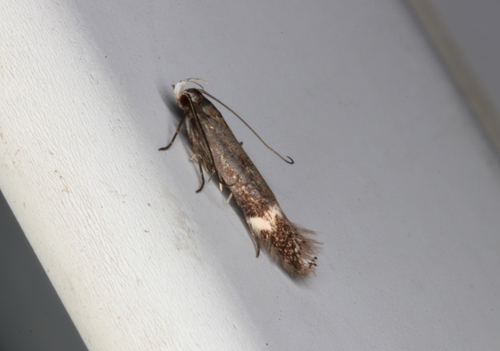
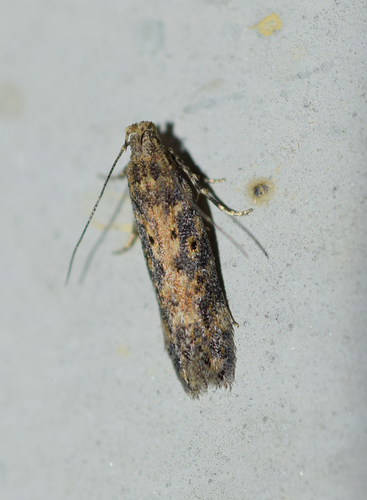
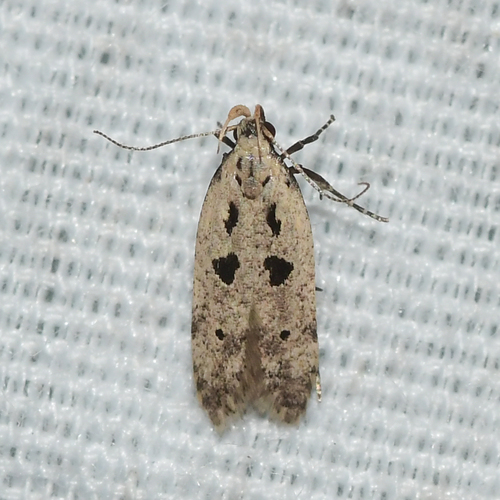
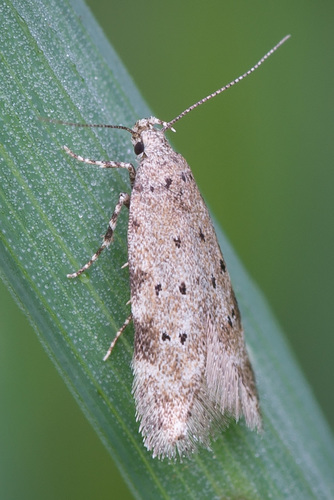
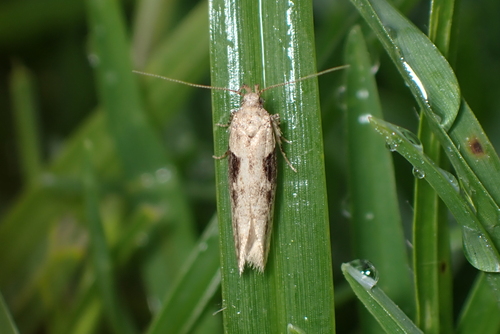
Symmetrischema tangolias, commonly called the tomato stemborer, has oval freshly laid eggs that measure 0.7 by 0.4 mm. As eggs develop, their color changes to orange-yellow, and they turn dark gray just before hatching. Little information is currently available about the species' full caterpillar stage. Where described, the larva is slender and cylindrical, with a pinkish dark head capsule, distinct body segments, and small bristle-like structures across its body. Adult moths lay their eggs on infested plants during nighttime. The pupal stage takes place inside a dark brown cocoon that forms a protective shell. Adult moths have distinctive black triangular patches along the lateral edges of their forewings, giving the moth an overall brownish-gray, or silver-gray, appearance. The margins of the forewings are edged with hairs. The hindwings are narrower and shorter than the forewings, and are ringed with pale-colored scales. Adult moths have a body length of 6 to 9 mm, measure around 9 to 12 mm when at rest, and have a wingspan of approximately 18 to 19 mm. Females can be distinguished by their broader abdomen with a blunt end, while males have a smaller abdomen with a cone-shaped structure. This species is native to the Andean mountain region of South America, specifically the area surrounding Peru and Bolivia. It is a widespread pest of tomatoes and potatoes found across the world. Its presence has been recorded in the United States, Australia, New Zealand, northern South American countries Ecuador and Colombia, Chile, and Indonesia. Tomato stemborer is thought to have been introduced to New Zealand from South America via human activity. The first larvae were found burrowing into the stem of the native plant Solanum aviculare on 4 October 1979 in Waitara, Taranaki. On 14 February 1980, small caterpillars were confirmed to be tomato stemborers, and were found associated with dark lesions on plant stems near leaf nodes. The species has since been recorded feeding on S. aviculare in Takaka Hill, Riwaka, Nelson, Pukekohe, and the Mount Albert Research Centre in Auckland. Larval tomato stemborers live inside the leaves, petioles, stems, and tubers of host tomato and potato plants. The species favors a sub-temperate climate, where temperatures are optimal for its survival. After emerging as an adult, female moths live up to 3 to 4 nights. Tomato stemborer produces 12 overlapping generations per year, with each generation lasting 4 to 7 weeks. During the larval stage, the species feeds on stems, tubers, and other parts of solanaceous plants. Eggs are deposited into slits in host plant stems, and newly hatched larvae enter the plant through leaf axils. This feeding activity leaves frass at the entry hole on the host plant. Severe stem damage can cause the host plant to wilt, or can cause infested stems to break off. Larvae most often enter the plant through stem buds (the host's immature growth points), often through existing wounds, which can also introduce microorganisms that cause secondary plant infections. Pupae develop within plant debris, and exit through a hole approximately 2 to 3 mm in diameter around one day before emerging as an adult. Adult females lay roughly 140 to 185 eggs in the leaf axils of host plants, after which the life cycle repeats.