About Symbrenthia hippoclus Cramer, 1782
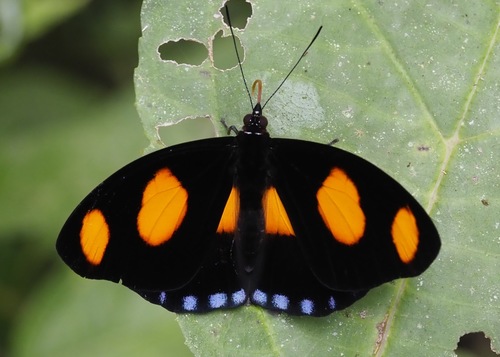
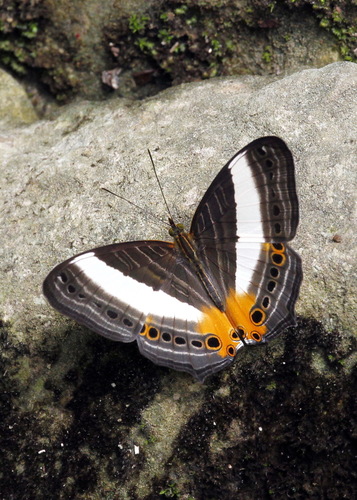
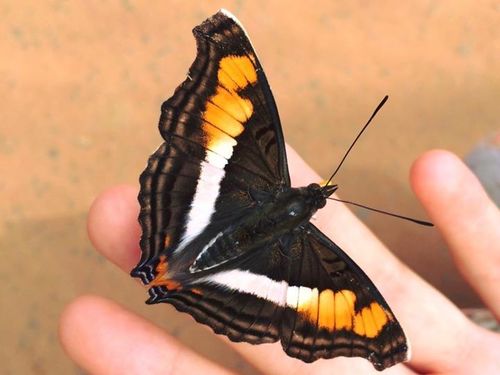
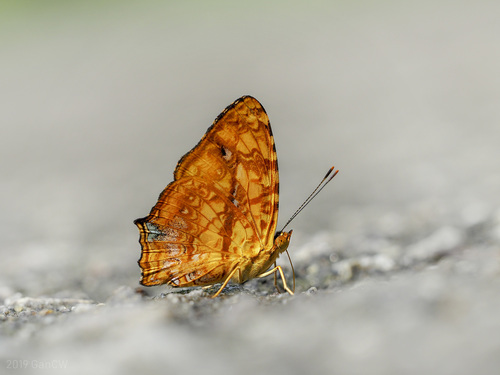
This description covers Symbrenthia hippoclus Cramer, 1782, including characteristics of wet-season and dry-season forms of both sexes, and its known distribution. Wet-season form male: Upperside is black with the following orange-yellow markings. On the forewing: the discoidal streak is club-shaped, with two indentations on the upper edge; there is a contiguous spot at the base of interspace 3; a short, outwardly oblique band from the middle of the dorsum is contracted in the middle; another outwardly oblique, somewhat spot-like, short, broad preapical band runs from beyond the middle of the costa to interspace 4, with two small spots above it in interspaces 5 and 6. On the hindwing: there is a very broad sub-basal transverse band that is narrow at the costal margin, a postdiscal narrower similar band that contracts into a line towards the costal margin, which is sometimes traversed by a line of black spots, and a very slender subterminal line. Underside is ochraceous orange, with numerous ferruginous spots and lines. These markings form a short, outwardly oblique streak on the forewing that does not extend beyond the interspaces, and a sub-basal transverse streak on the hindwing that is continuous with the streak on the forewing. Both wings also have a series of obscure postdiscal cone-shaped marks. These marks are irrorated and made indistinct on the hindwing by a large patch of pink scales that becomes a bluish lunule in interspace 3. The forewing has a ferruginous subterminal line, while the hindwing has a pale yellow subterminal line. Antennae are black, and ochraceous at the apex; the head has ferruginous pubescence; the thorax and abdomen are black on the upperside, and ochraceous beneath. The female is similar to the male, but its orange upperside markings are broader and somewhat paler. The dry-season form differs from the wet-season form in both sexes as follows: The orange markings on the upperside are broader and paler in the middle, and the short bands on the anterior and posterior portions of the wing coalesce. The underside is paler, and all dark markings are less clearly defined than in the wet-season form. This species is distributed across the Himalayas from Hazara division, Pakistan to Sikkim; Assam; Burma; Tenasserim, and extends into the Malayan subregion.