About Sylvilagus palustris (Bachman, 1837)
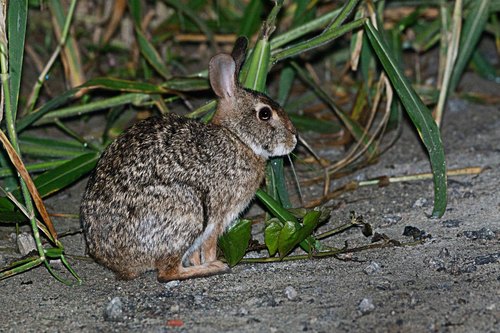
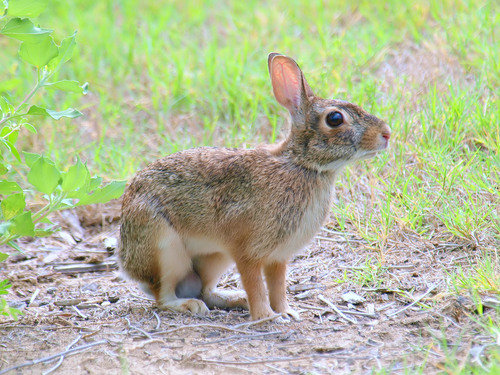
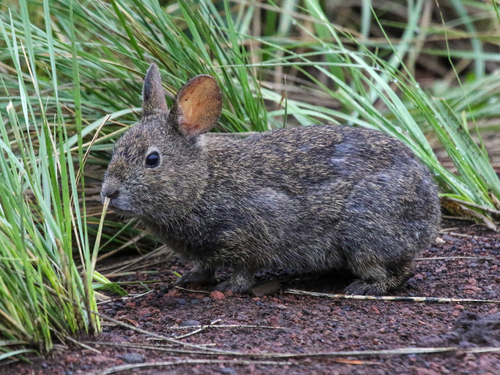
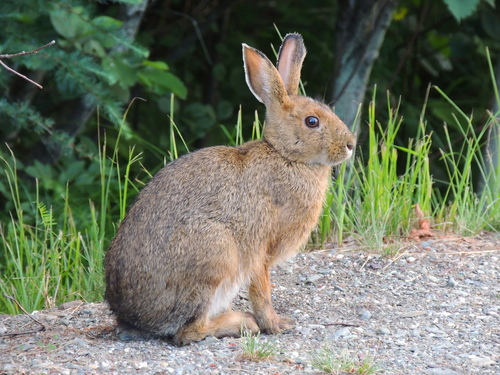
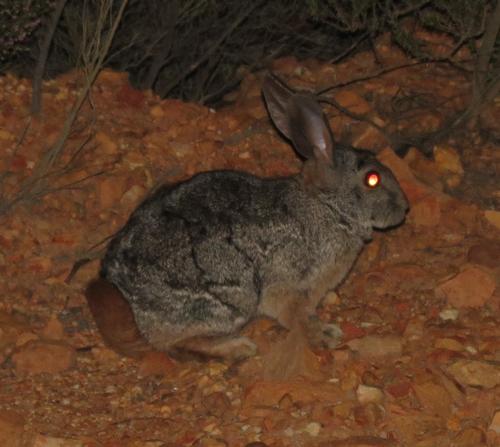
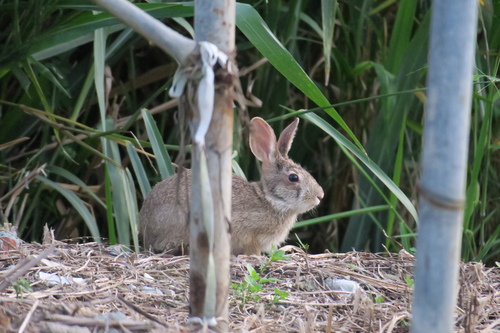
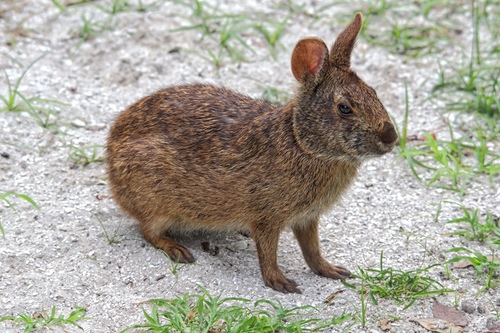
Marsh rabbits (Sylvilagus palustris, first described by Bachman in 1837) have blackish brown or dark reddish fur covering their back, head, and upper body. Most individuals have a dingy brownish gray belly, though mainland marsh rabbits may also have a dull white belly. Small black tufts sit along the leading edges of their ears, with ochre coloring on the ear insides. The rough fur on their back may be fringed with black hairs. The dark-colored upper parts of the coat often fade to a dull grayish buff during spring and summer, turn reddish or ochre in fall, and darken back to black in winter. Marsh rabbits from peninsular Florida are typically darker and redder overall, with cinnamon-rufous coloration on the nape, feet, and legs. Juveniles have much darker, duller colors than adult marsh rabbits. Marsh rabbits are generally smaller than eastern cottontail rabbits (Sylvilagus floridanus), and are otherwise similar in general appearance. Adult marsh rabbits from the Florida peninsula weigh approximately 2.2–2.6 pounds (1.00–1.18 kg), and reach a total length of up to 17 inches (43 cm). Adults from mainland regions typically grow larger, weighing up to 3.5 pounds (1.6 kg) and reaching more than 17.5 inches (44 cm) in length. Average hind feet are also larger in mainland marsh rabbits, measuring 3.6 inches (9.1 cm) compared to 3.5 inches (8.9 cm) for typical Florida peninsula specimens. Melanism, a completely black year-round phenotypic coloration, is another observed trait in southern Florida marsh rabbit specimens. The most recognizable feature that sets marsh rabbits apart from swamp rabbits and cottontails is that the underside of the tail is almost never white, and is instead usually brownish gray. Marsh rabbits have much shorter ears and legs than swamp rabbits, and their tail is far less bushy than the tail of other cottontails. The front of the marsh rabbit's skull also tapers more quickly than that of the swamp rabbit. Both marsh rabbits and swamp rabbits have long toenails adapted for digging, but the marsh rabbit's toenails are 13% longer on average when comparing the two species. The marsh rabbit has a dental formula of 2.0.3.3/1.0.2.3 × 2 = 28, meaning it has two pairs of upper incisors, one pair of lower incisors, no canines, three upper premolars and two lower premolars per side, and three upper and three lower molars on each side of the jaw. The marsh rabbit lives in low-elevation wetland habitats, ranging from southeast Virginia through Florida to the Florida Keys. Populations are also found across eastern North Carolina and South Carolina, southeast Georgia, and southeast Alabama. Each subspecies occupies a specific section of this broader range. The Carolina marsh rabbit (S. p. palustris) ranges from Virginia's Dismal Swamp along the eastern coast to northern Florida, and extends along the Gulf Coast into Alabama's Mobile Bay. It lives in coastal lowland areas, swamps, and rivers, and is rarely found more than forty miles from the coast. The Florida marsh rabbit (S. p. paludicola) occupies peninsular Florida, from south of the Florida Panhandle to the upper Florida Keys; it is absent from a region north of Miami along Florida's east coast. The endangered Lower Keys marsh rabbit (S. p. hefneri) occurs only in the southern Florida Keys. Marsh rabbits most commonly live in brackish and freshwater marshes dominated by cattails and cypress. In southern Florida, they often occupy sandy islands and mangrove swamps. Unlike most rabbit species, they are restricted exclusively to areas with easy access to water. They often enter tidal marshes, but stay close to high ground for protection. Common hiding spots include dense thickets of magnolia, blackgum (Nyssa sylvatica), sweetgum (Liquidambar styraciflua), briers, and cattails. Major predators of marsh rabbits include birds of prey such as the great horned owl and northern harrier. Additional predators are alligators, snakes, bobcats, foxes, and coyotes. However, human activities including fire and domestic dogs pose the greatest threats to marsh rabbits. In the wild, marsh rabbits are thought to live approximately three to four years. Multiple parasites affect marsh rabbits: external parasites include ticks (particularly the rabbit tick Haemaphysalis leporispalustris), chiggers, fleas, and botflies, while internal parasites include trematodes, tapeworms, and nematodes. Diseases affecting marsh rabbits are not well researched, but they can contract tularemia and mange. Marsh rabbits breed year-round. Gestation lasts 30 to 37 days, and typical broods contain 2 to 4 young. Adult females can produce up to 7 litters per year, with an average of 3 to 5 young per litter. Female marsh rabbits reach full sexual maturity at 9 months of age, but can begin reproductive activity as early as 6 months. Females build nests from rushes, grasses, and leaves, lining the well-concealed nest with fur from their own body. Nests are often placed in dense thickets or swampy areas completely surrounded by water for protection. Young marsh rabbits are born with well-developed fur but closed eyes, and remain in the nest for several days after weaning. They disperse away from their birth range once they reach 8 to 10 months of age, and males typically travel further from the natal nest than females.