About Sylvilagus obscurus Chapman, Cramer, Deppenaar & Robinson, 1992
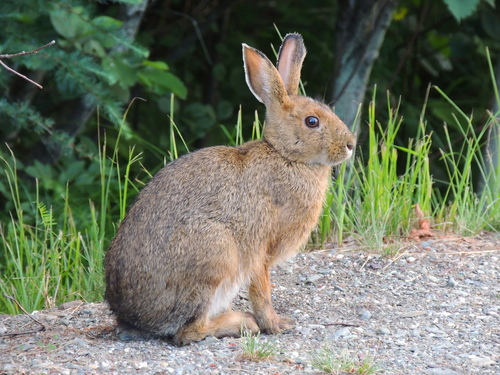
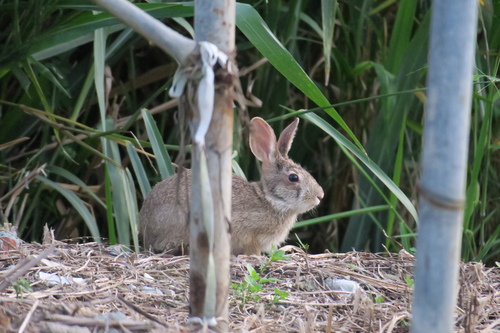
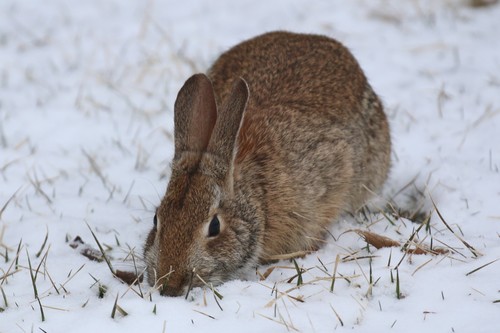
Sylvilagus obscurus, commonly called the Appalachian cottontail, is a small rabbit that mostly inhabits mountainous regions of the eastern United States, ranging from Pennsylvania to South Carolina and being most common in the Appalachians. It is better adapted to colder climates than its distant relative, the eastern cottontail S. floridanus. Its dorsal side is light yellow-brown mixed with black, with a mixed patch of brown and red on the neck, and its ventral side is mostly white. It is often visually very similar to the eastern cottontail; distinguishing features include a black spot between its ears and the absence of a white spot on the forehead. The Appalachian cottontail and the New England cottontail S. transitionalis cannot be easily distinguished in the field, and are most easily identified by their geographic range: cottontails found south or west of the Hudson River are considered Appalachian cottontails, while those found north and east are considered New England cottontails. Otherwise, this species can be identified by chromosome number and skull measurements. Female Appalachian cottontails are typically larger than males, with reproductive requirements being the most likely cause of this size difference. The weight of the Appalachian cottontail ranges from 756 grams (1.667 lb) up to 1,153 grams (2.542 lb), and its average length is 408 mm (16.1 in). The lifespan of S. obscurus is quite short, and can be less than a year in some cases. Appalachian cottontails occupy mountainous habitats, typically at elevations between 610 and 762 m (2,001 to 2,500 ft). The Appalachian Mountains provide this species with habitat that offers cover and vegetation including blackberry, greenbriar, and mountain laurel. These plants, along with the bark and twigs of trees such as red maple, aspen, and black cherry, are common foods for the Appalachian cottontail. In general, its diet consists of twigs, leaves, and fruits. Like most other species in the genus Sylvilagus, S. obscurus practices coprophagy, eating its own feces to absorb additional vitamins and nutrients that were not fully digested during the first pass of digestion. Little is known about the specific reproductive habits of the Appalachian cottontail, so most information is extrapolated from what is known about the wider genus Sylvilagus and rabbits in general. Appalachian cottontails are typically inactive reproductively during midwinter. As nights shorten and days lengthen, strong sexual activity develops among Sylvilagus. This pattern occurs because day length directly correlates with the stimulation of follicle-stimulating hormone (FSH) in the female’s blood, which in turn stimulates follicles to develop ova. This puts the female into a receptive, pre-estrus state until reproduction occurs; there is no strict fixed seasonal cycle, as females can remain in this pre-estrus state for an extended period of time. The confirmed breeding season for the Appalachian cottontail falls between February and October. After fertilization, the gestation period lasts around 28 days. Before giving birth, the female digs a nesting depression. She pulls fur from her underbelly, and gathers berries and leaves to line the nest. Pulling her fur also exposes her nipples so the offspring can nurse. After birth, the young stay in the vegetation-lined nest until they become independent at around 3 to 4 weeks of age. Mother rabbits in the genus Sylvilagus care for their young and visit the nest twice a day to nurse them. An adult female Appalachian cottontail can breed up to 3 to 4 times per breeding season, and has roughly 3 to 4 offspring per litter.