About Sylvilagus nuttallii (Bachman, 1837)
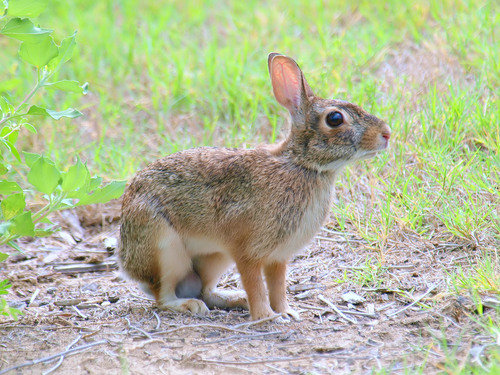
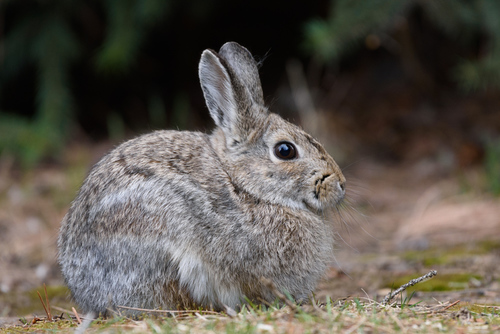
Sylvilagus nuttallii, commonly called the mountain cottontail, is a rabbit species first described by Bachman in 1837. It is a small to medium-sized rabbit, with a head and body length of 11 to 15 inches (29 to 39 cm), and is relatively large among cottontail rabbits. It has long hind legs, and its feet are densely covered in long hair, measuring 3.1 to 4.1 inches (80 to 103 mm). Its relatively short ears, measuring 2.1 to 3.9 inches (54 to 100 mm), have rounded tips and are densely furred on the inside. The tail is dark on top, white underneath, and measures 1.2 to 2.4 inches (3 to 6 cm).
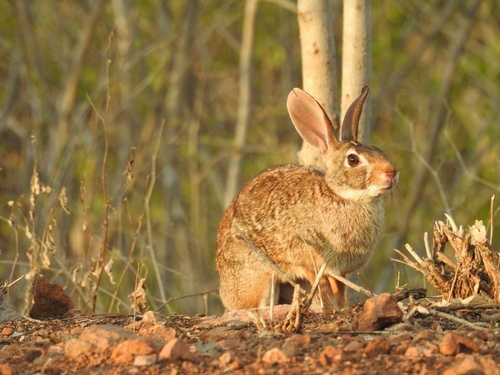
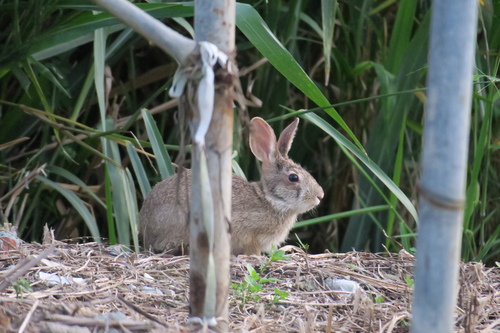
Its fur coloring is distinct: pale brown on the back, black-tipped ears, a white-grey tail, white underside, orange fur on the back of the head, rusty outer legs, a characteristic cinnamon-colored ring around the eyes, and whiskers that can be fully or partially white. Like other leporids, the mountain cottontail has a dental formula of 2.0.3.3/1.0.2.3 × 2 = 28: this means it has two pairs of upper incisors, one pair of lower incisors, no canines, three upper premolars, two lower premolars, and three upper and three lower molars on each side of the jaw.
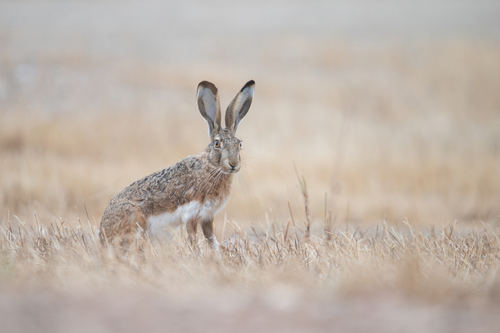
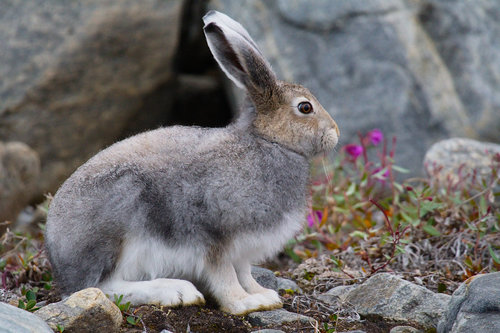
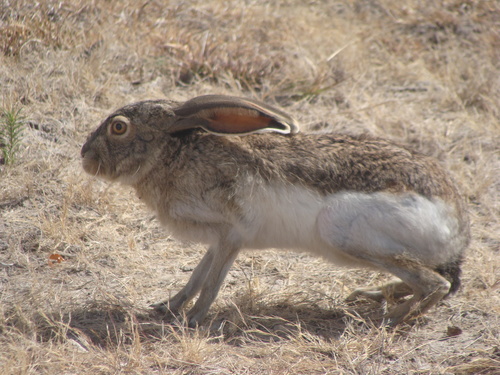
The mountain cottontail can be told apart from co-occurring rabbit species by its size and ear shape. It is larger than the pygmy rabbit (S. idahoensis) and smaller than the eastern cottontail (S. floridanus). Compared to the desert cottontail, it has shorter, more rounded ears that are more densely covered in hair. Snowshoe hares share much of the mountain cottontail’s geographic range, but snowshoe hares have a gray fur coat that turns entirely white in autumn and winter, while the mountain cottontail’s coat does not change seasonally for camouflage. The mountain cottontail takes characteristically short leaps, unlike the snowshoe hare’s long hops. In snow, snowshoe hare tracks are much larger and splayed, differing from mountain cottontail tracks.
This species is distributed across the Western United States and parts of Canada. Its range extends from the Canadian provinces of Alberta and Saskatchewan, just north of the U.S.-Canada border, south to northern Arizona and New Mexico. From east to west, it occurs from the foothills of the eastern Rocky Mountain slopes west to the eastern slopes of the Cascade-Sierra Nevada. It was once common in southwestern North Dakota, but has since been mostly replaced by the eastern cottontail. It was previously found as far south as Texas, but climate-driven habitat change has pushed the species’ range northward; desert cottontails and robust cottontails (S. holzneri robustus) are now more common in these southern former areas. The species’ three recognized subspecies generally remain geographically separated from one another.
The mountain cottontail occupies a wide range of habitats at varying elevations and with different vegetation types. It can be found in coniferous forests including the subalpine zone, among rocky areas in sagebrush, in shrublands, and in wooded areas. In the northern part of its range, it is more closely associated with sagebrush, while it is more associated with forests in the southern part of its range. It occupies habitats at higher elevations than lowland leporids, but lower elevations than most pikas and the snowshoe hare (Lepus americanus). Its preferred elevation varies by location: 3,900 to 11,320 ft (1,190 to 3,450 m) in California; 3,900 to 10,400 ft (1,190 to 3,170 m) in Nevada; 6,000 to 11,480 ft (1,830 to 3,500 m) in Colorado; 591 to 5,495 ft (180 to 1,675 m) in Oregon; and above 7,500 ft (2,300 m) in Arizona. It is particularly abundant at the Hanford Site, a decommissioned nuclear production complex in Washington, where it is monitored for contamination by caesium-137 and strontium-90.
The mountain cottontail is not a social species and typically lives alone, though groups may gather at popular feeding sites. Most feeding takes place at dusk and dawn in clearings near cover or in brush. This species has been observed climbing juniper trees to feed, and spends approximately half of its waking time feeding. Most social interactions occur during reproduction and courtship, as the species is not territorial. Males usually have larger home ranges than females.
When dense vegetation provides plenty of cover, the mountain cottontail rests in shallow ground depressions or nests called forms for shelter. When vegetation is sparse, it will use burrows dug by other animals for shelter, and does not dig burrows of its own. It remains active year-round. When startled, it will run a short distance (a couple of meters) then freeze in hiding with its ears held erect; if pursued further, it will hop away along a semicircular path to confuse predators. Known predators include coyotes, bobcats, lynxes, martens, crows, ravens, hawks, owls, and rattlesnakes. Though it has been replaced in some regions by eastern and desert cottontails, it is largely sympatric with the widespread snowshoe hare (Lepus americanus) and the Northern Idaho ground squirrel.
Multiple parasites are known to infect the mountain cottontail, including nematodes, cestodes, and Coccidia species. It can be infected by Francisella tularensis, the bacterium that causes tularemia, and Rickettsia rickettsii, the pathogen that causes Rocky Mountain spotted fever. It is notably susceptible to rabbit hemorrhagic disease virus type 2, a virus that primarily affects European rabbits (Oryctolagus cuniculus) and some Lepus hare species.
For reproduction, the female mountain cottontail builds a nest that is a shallow ground cavity lined with rabbit fur and dried grass, and covers the top of the nest with grass, fur, and sticks. Population sex ratios vary by location: the average fetal sex ratio is 1 male to 1.05 females, while a measured ratio in Oregon was 1 male to 1.18 females. The breeding season falls in spring and summer, varying by location from February to July, and may extend later in warmer climates. Average gestation length is 28 days, and each litter produces 3 to 4 young. On average, females produce 3.5 litters per year within a 4-month breeding season. Mountain cottontails reach sexual maturity at around 3 months old. Litter size and number of litters vary geographically: average litter size is around 6.1 in California and Nevada, 4.7 in Washington and Oregon, and 2.0 in British Columbia. The young are altricial, meaning they are born helpless and blind, and are weaned after one month.