About Sylvilagus floridanus (J.A.Allen, 1890)
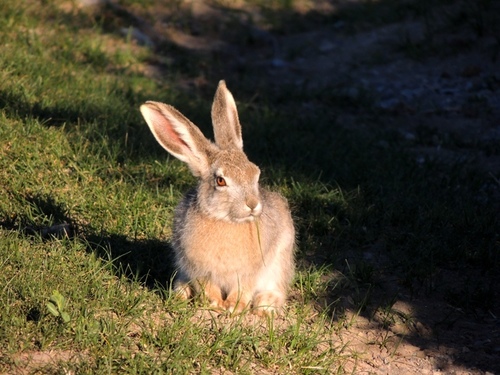
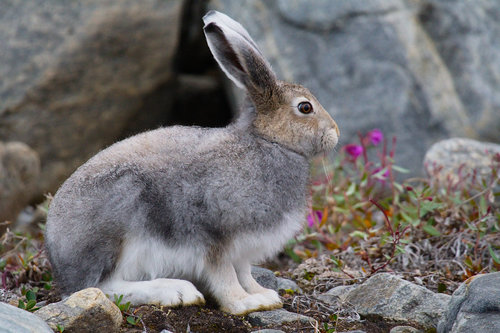
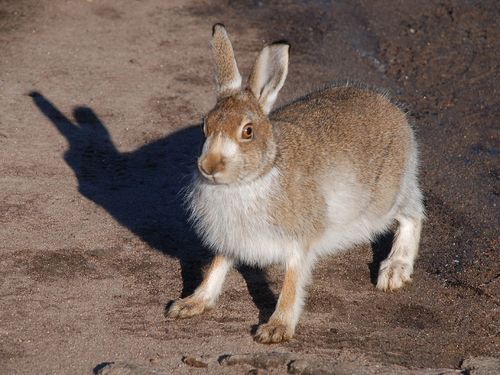
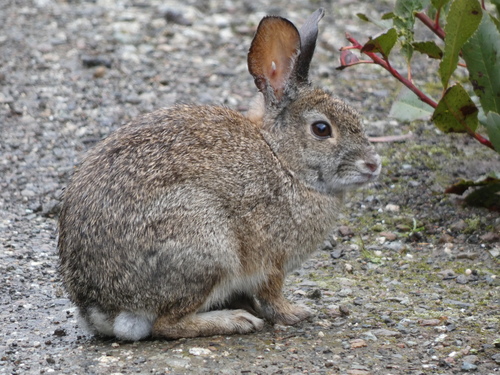
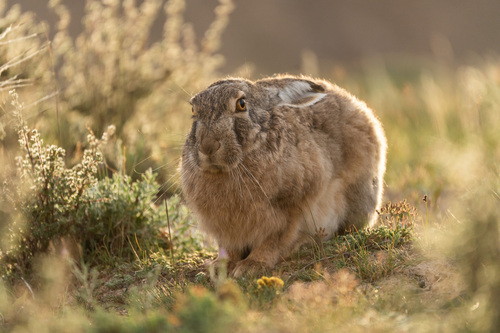
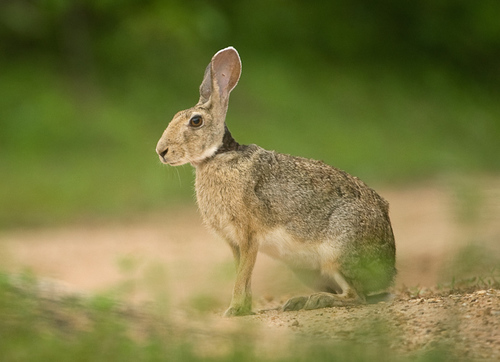
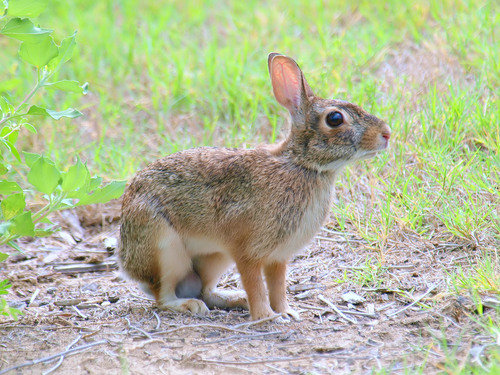
The eastern cottontail, Sylvilagus floridanus, can be recognized by a distinctive white spot on its forehead, with fur ranging from reddish-brown to grayish-brown. It has large hind feet, long ears, a short fluffy white tail, a white underside, and a rusty patch near the tail. Compared to hares, it is smaller overall, has brownish-gray coloring on the head and neck, a lighter-colored body, and a white underside to the tail. It also has large brown eyes and long ears adapted for detecting predators. In winter, the eastern cottontail's coat becomes more gray than brown. Young rabbits, called kits, develop similar adult coloring after a few weeks, but they are born with a white blaze running down their forehead that fades as they mature. This is a medium-sized rabbit, with a total length of 36–48 cm (14–19 in), including a tail that averages 5.3 cm (2.1 in) long. Adult eastern cottontails typically weigh between 1.8 and 4.4 lb (800 and 2,000 g), with an average weight of around 2.6 lb (1,200 g). Females are usually slightly heavier than males, though the sizes of the two sexes broadly overlap. The species shows slight geographic variation in body size: individuals generally increase in mass from southern to northern latitudes, matching Bergmann's rule. For example, adult specimens held by the Florida Museum of Natural History have a mean weight of 2.24 lb (1.018 kg), while a study of 346 adults from Michigan found an average mass of 3.19 lb (1.445 kg).
The eastern cottontail lives in meadows, shrubby areas, and edge habitats across the eastern and south-central United States, southern Canada, eastern Mexico, Central America, and the northernmost part of South America. It is also found on Margarita Island in the Caribbean. The species is especially abundant across the Midwest of North America, and its range expanded northward as settlers cleared forests. It was originally not present in New England, but has since been introduced there, where it now competes with the native New England cottontail (Sylvilagus transitionalis). It has also been introduced to parts of Oregon, Washington, and British Columbia. In the 1950s and 1960s, the species was introduced to France and northern Italy, where it has undergone rapid territorial expansion and population growth. Populations that once belonged to this species in the mountainous regions of the southwestern United States and western Mexico are now classified as a separate species, the robust cottontail (S. holzneri).
Optimal habitat for the eastern cottontail includes open grassy areas, clearings, and old fields that support abundant green vegetation, with shrubs or hedgerows providing cover. Key habitat features are dense, well-distributed escape cover mixed with open foraging areas such as pastures or grasslands. In the western United States, eastern cottontails occupy diverse habitats including ponderosa pine, mixed conifer, and pinyon (Pinus spp.)–juniper (Juniperus spp.) woodlands, where woody debris, shrubby understories, and patchy cover are important for survival. Eastern cottontails also thrive in agricultural and suburban environments, especially near fencerows, forest edges, and thickets. They can be found in swamps and marshes, but generally avoid dense forests.
In open and uniform habitats, eastern cottontail home ranges are roughly circular. Most individuals stay within the same home range for their entire lives, though shifts can happen due to changes in weather or vegetation. In New England, average home ranges are 1.4 acres (0.57 hectares) for males and 1.2 acres (0.49 hectares) for females, but home ranges can vary between 0.5 to 40 acres (0.20 to 16.19 hectares) depending on habitat quality and season. Male home ranges expand during the breeding season: in southwestern Wisconsin, spring ranges average 6.9 acres (2.8 hectares), peak at 10 acres (4.0 hectares) in early summer, then decrease again in late summer. Daily movements usually only cover 10–20% of an individual's total home range. In southeastern Wisconsin, male home ranges overlapped by up to 50%, while female home ranges overlapped by less than 25%. Females defend the immediate area around their nest, while males compete aggressively for dominance and access to mates.
The eastern cottontail is a territorial species that relies on speed and agility to escape predators. When chased, it typically escapes in a zigzag pattern and can reach speeds of up to 18 mph (29 km/h). Cottontails prefer habitats where they can feed in the open but quickly retreat to cover when threatened. Their preferred environments include forest edges, swamps, brushy thickets, hedgerows, and open fields with nearby shelter. Eastern cottontails do not dig their own burrows; instead, they rest in a form, which is a shallow depression scratched out in grass or beneath dense vegetation. They may also use burrows dug by groundhogs (Marmota monax) during severe weather or heavy snow. Eastern cottontails are mostly crepuscular and nocturnal, and forage primarily at dawn, dusk, and night. However, they can be seen during the day, particularly in overcast or foggy conditions. They spend most of the daytime resting under vegetative cover, and often stay motionless for long periods to avoid being detected. The species does not hibernate, so it is active year-round.
Eastern cottontails reach sexual maturity at 2–3 months of age. The timing of the breeding season varies with latitude and climate: it begins as early as January in the southern United States, around March in New England, and continues through late summer. Mating is promiscuous, with males competing for access to females. The nest is typically a slanted hole dug in soft soil, lined with fur and grasses, and measures about 7.1 in × 4.9 in × 4.7 in (18 cm × 12 cm × 12 cm). Gestation lasts 25–35 days, with an average of 28 days. Kits are born blind, covered in fine hair, and have a white blaze on the forehead that fades as they mature. Their eyes open at 4–7 days old, and they start leaving the nest at 12–16 days old. Weaning is complete by 4–5 weeks of age, and dispersal from the natal area begins around 7 weeks old. Females can have 1–7 litters per year, averaging 3–4, with 3–8 kits per litter, averaging 5. In southern U.S. states, breeding occurs nearly continuously, while northern populations have shorter breeding seasons but produce larger litters.