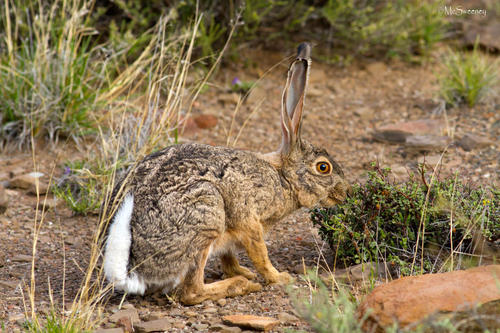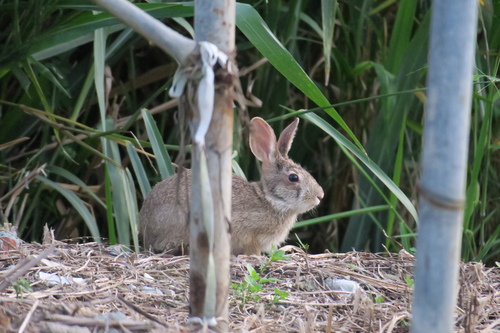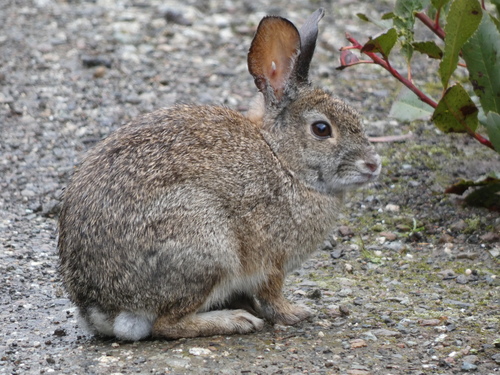
About Sylvilagus bachmani (Waterhouse, 1839)
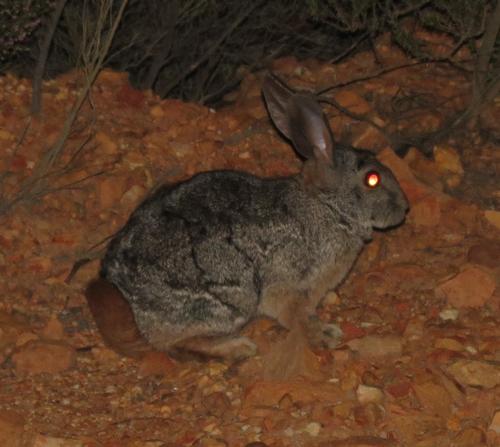
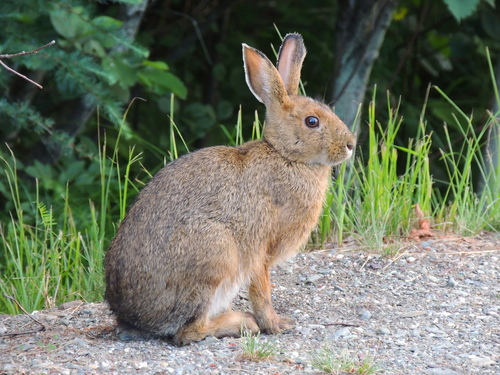
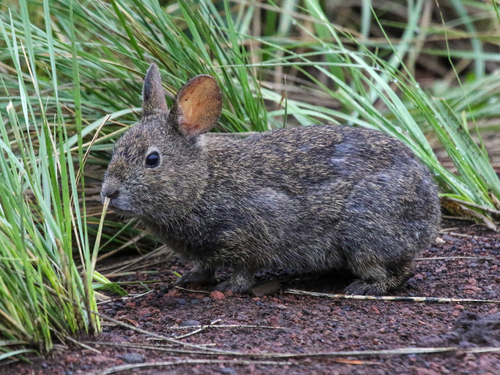
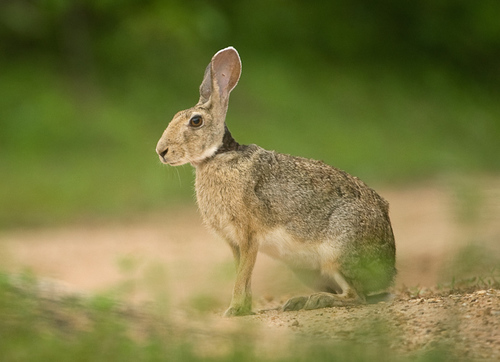
Description and taxonomy: The brush rabbit (Sylvilagus bachmani) is a small rabbit with short legs and a short tail. Its sides and back are dark gray, while its belly and the underside of its tail are pale gray. Most of its whiskers are black, though some have white tips. Adult brush rabbits measure 30.3 to 36.9 cm (11.9 to 14.5 in) in total length, and weigh between 511 and 917 g (1.127 to 2.022 lb). Many geographically limited subspecies have been proposed: ubericolor in Oregon; cinerascens, mariposae, riparius, tehamae and trowbridgii in California; and cerrosensis, exiguus, howelli, peninsularis and rosaphagus in Baja California. The subspecies bachmani, macrorhinus and virgulti are less geographically restricted. Of all proposed subspecies, only S. b. ubericolor, S. b. cinerascens, S. b. bachmani, S. b. exiguus, S. b. howelli, and S. b. cerrosensis are currently recognized; all other proposed subspecies are treated as synonyms. It has been recorded that large numbers of eastern cottontails were brought west to reproduce and serve as a food source for settlers. The two species have interbred in some areas: in parts of Oregon, interbreeding has resulted in brush rabbits that have a white cottontail, while still retaining their smaller size. Habitat and ecology: Brush rabbits require dense bramble clumps or other thick, brushy habitat. These bramble clumps typically have extensive networks of trails and runways. The species occasionally uses burrows dug by other species, but does not dig burrows of its own. Brush rabbits have very small home ranges, less than 2,000 m² (22,000 sq ft). They most commonly live in chaparral vegetation, but are also found in oak and conifer habitats. In the San Francisco Bay Area, brush rabbits concentrate their activity along the edge of brush areas, and use grassy areas much less often. They also use the interior brush of wilderness areas, and this environment may be better for them than chaparral. Studies of brush rabbits in Oregon also show that the species rarely leaves the brushy areas it inhabits. Brush habitat tends to be used more during drier seasons, while grasses are used more during wetter seasons, matching the growth of annual vegetation. Habitat use also likely varies with the breeding season. Distribution: The brush rabbit is restricted to the Pacific Coast, ranging from the Columbia River in the north to the southern tip of Baja, Mexico in the south. It is not found east of the Sierra Nevada and Cascade Mountain ranges. Reproduction: The brush rabbit's breeding season varies between northern and southern parts of its range. In Oregon, breeding runs from February to August, while in California it runs from December to May or June. Average litter size also varies by region: studies record an average of 2.8 kits per litter in Oregon, 3.5 in northern and central California, and 4.0 in west central California. The brush rabbit is one of the less fecund species in its genus, producing approximately 15 young per year across five to six litters. Its gestation period is about 27 days, and newborn kits are altricial. Male brush rabbits breed from around October-November through June-July. Most reproductive activity occurs between January and April. In areas around San Francisco, pregnant female brush rabbits can be found from the first week of December through the end of June. Female brush rabbits have around four litters per year.