About Sylvia sarda Temminck, 1820
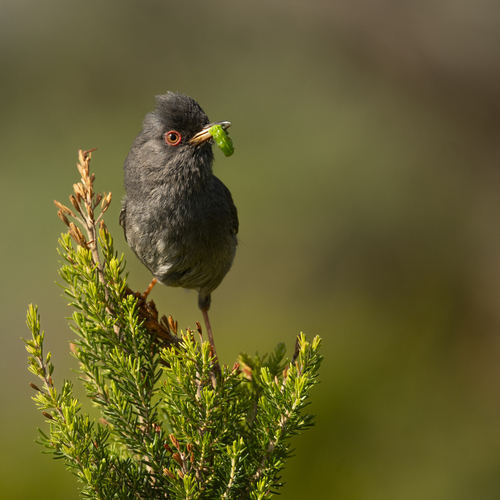
Sylvia sarda Temminck, 1820, commonly known as Marmora's warbler, is a small bird species with a long tail and large head. It is overall very similar to its close relatives in the Dartford warbler group. Marmora's warblers are grey on both their upper and underparts, and lack the brick-red underparts that characterize Dartford warblers. Adult males have darker patches on the forehead and between the eye and the pointed bill. They have red legs and red irises, and their song is a fast rattle. Immature Marmora's warblers can be confused with young Dartford warblers, which are also grey on the underparts, but Marmora's warblers have a paler throat and dark irises. This species breeds on Mediterranean islands, most notably Corsica and Sardinia. The population found on the smaller Balearic Islands is recognized as a separate species, the Balearic warbler Curruca balearica. These two species appear to form a superspecies, which groups further with Tristram's warbler and the Dartford warbler. Marmora's warblers are generally resident, but some individuals migrate south to winter in north Africa. They are rare vagrants to northern and western Europe. These small passerine birds inhabit open country with thorny bushes and heather. They lay 3 to 5 eggs in a nest built in a bush. Like most warblers, they are insectivorous.