About Sylvia nana (Hemprich & Ehrenberg, 1833)
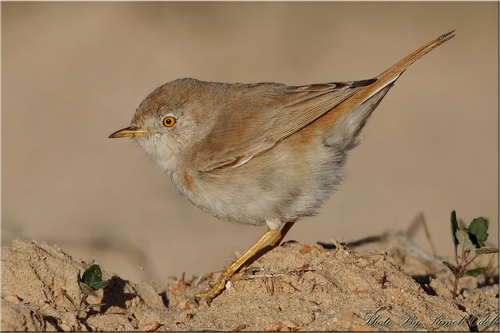
The Asian desert warbler (Curruca nana, with the scientific name Sylvia nana published by Hemprich & Ehrenberg in 1833) is an Old World warbler. It breeds in the deserts of central and western Asia and the extreme east of Europe, with its breeding range stretching from the Volga Delta area east to western Inner Mongolia in China. It migrates to habitats similar to its breeding range in southwestern Asia, ranging from Arabia to northwestern India, and the far northeast of Africa's Red Sea coastal regions for the winter. Until recently, this species was considered conspecific with the African desert warbler, and the combined group was simply called "desert warbler". Now, the Asian desert warbler is recognized as a separate species. The two species remain each other's closest living relatives, and their relationship to other typical warblers is not fully understood. They may be fairly closely related to the common whitethroat; in particular, female common whitethroats look very similar to richly coloured Asian desert warblers. It appears that all three of these taxa are fairly basal members of their genus. The Asian desert warbler is a small bird; it is the second-smallest species in the genus, only larger than the African desert warbler, and measures 11.5–12.5 cm in total length. The sexes are almost identical in colouration: they are pale grey-brown on their upperparts, with browner wings and tail, and whitish underparts; their bill and legs are yellowish, and they have a yellow iris. Like its close relatives, the Asian desert warbler is mainly insectivorous, but it will also eat small berries. Unlike most other warblers, it commonly feeds on the ground. Its song is a distinctive jingle, often performed during an advertising display flight, and it includes a mix of clear and harsher notes. This species breeds in semi-desert and dry steppe environments, so long as there are bushes available for nesting. It builds its nest in low shrub, and lays a clutch of 4–6 eggs. It has been recorded as a rare vagrant as far west as Great Britain. The specific epithet nana is Latin for "dwarf", derived from the earlier Ancient Greek word nanos.