About Sylvia mystacea Ménétriés, 1832
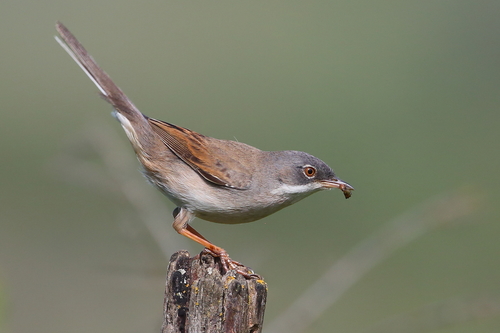
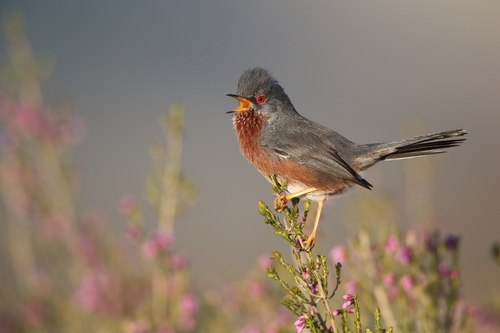
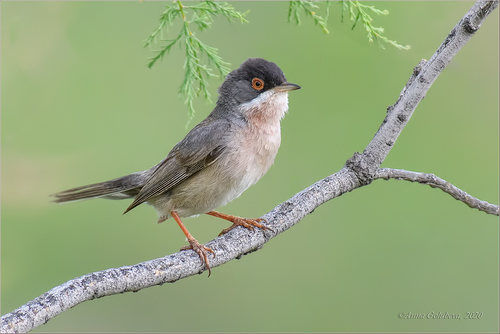
Menetries's warbler (Sylvia mystacea, originally published as Sylvia mystacea by Ménétriés in 1832) measures 12 to 14 cm in length, has a wingspan of 15 to 19 cm, and weighs approximately 9 to 11 grams. Its fairly long tail is blackish with white coloring on the outer feathers; this tail is often held cocked, and is frequently wagged up and down or from side to side. Its bill is fairly heavy and dark, with a pinkish patch at the base. A pale bare ring surrounds the eye. For the nominate subspecies, the male is dark greyish on its upperparts and whitish on its underparts, with a white submoustachial stripe and pink coloring on the throat and breast. It has a dark cap that is dull black at the front, becomes paler further back, and merges into the grey nape — this differs from the Sardinian warbler, which has an entirely jet-black cap. Menetries's warblers also have rather plain tertial feathers, while Sardinian warblers have tertials with more obvious dark centers and pale edges. The western subspecies S. m. rubescens is paler grey on the upperparts than the nominate subspecies, and the pink coloring on its underparts is paler or absent entirely. The eastern subspecies S. m. turcmenica is paler grey on the upperparts and paler pink on the underparts than the nominate, and has longer wings than both of the other two subspecies. Outside of the breeding season, male Menetries's warblers become browner and their caps are less dark. The female is sandy grey-brown on the upperparts and buff-white on the underparts. It is similar to female Sardinian and eastern subalpine warblers, but has plainer tertial feathers and more contrast between its pale back and dark tail. First-winter males are similar to females, but may have some pink coloring on the throat and breast. This species has a harsh, buzzing call, as well as a sparrow-like chattering call. The male's song is a quiet chattering that mixes musical and harsh notes, and is often sung while in flight. This is a migratory bird species that nests in Southwest Asia and winters westwards in Northeast Africa. The nominate subspecies S. m. mystacea breeds from the Caspian Sea region of Russia down through Georgia, Armenia, Azerbaijan and easternmost Turkey to northern Iran. S. m. rubescens breeds locally in southeast Turkey, Syria, Iraq, western Iran, and possibly in Lebanon. S. m. turcmenica occurs from northeast Iran eastward to the Syr Darya valley in Central Asia and the Balochistan region in Pakistan. Its winter range covers southern Iran, the Arabian Peninsula and Northeast Africa, from Sudan to Somalia. A small number of birds pass through Israel and Jordan during migration, and vagrant individuals have been recorded from Portugal, Nigeria and Niger. Menetries's warbler lives in scrub, thickets, open woodland, cultivated areas and gardens in regions with dry, continental climates. It is typically found in steppe regions, on mountain slopes and along rivers, and is often associated with tamarisk bushes. It forages for insects and other invertebrates among leaves and branches, starting at the top of a bush and moving downwards. It also feeds on fruit and seeds. It builds a cup-shaped nest in low vegetation, up to 90 cm above the ground. The nest is constructed from twigs, stems and grass leaves, with feathers and hair used for lining. Females lay four or five glossy white eggs marked with brown spots. The eggs are incubated for 11 to 13 days. Young birds fledge after 10 or 11 days. Both sexes take part in incubating the eggs and caring for the young. Pairs usually raise two broods during a single breeding season.