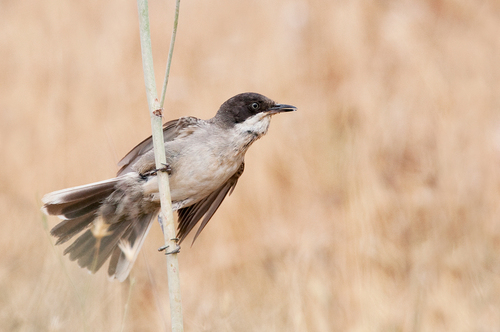
About Sylvia crassirostris Cretzschmar, 1830
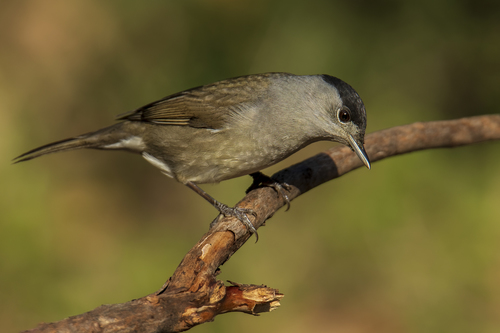
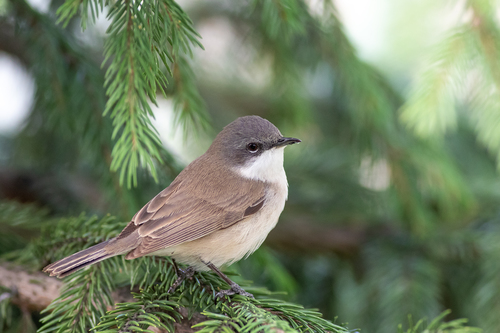
The eastern Orphean warbler, scientifically known as Curruca crassirostris (previously Sylvia crassirostris Cretzschmar, 1830), is an Old World warbler belonging to the genus Curruca. This migratory species breeds in summer across the Mediterranean region, extending through the Balkans, Turkey, the Caucasus and surrounding areas to Central Asia, and winters in sub-Saharan Africa. Measuring 15 to 16 cm in length, this is one of the largest species of typical warblers, and is somewhat larger than a blackcap. Adult males have a plain grey back, a long pointed bill, and black legs. Males also have a dark grey head, a black eye mask, a white throat, and a white iris. Females and immature individuals have a paler head, reddish underparts, and a grey back with a brownish tinge; young birds have a dark iris. This species is difficult to visually distinguish from the Western Orphean warbler. The eastern Orphean warbler's song consists of a sequence of warbling liroo-liroo and scolding notes. Its song is more varied than that of the western Orphean warbler, and approaches the nightingale in richness. These small passerine birds inhabit open deciduous woodland. Females lay 4 to 6 eggs in a nest built in a bush or tree. Like most warblers, the eastern Orphean warbler is a nectarivore.