About Sylvia borin (Boddaert, 1783)
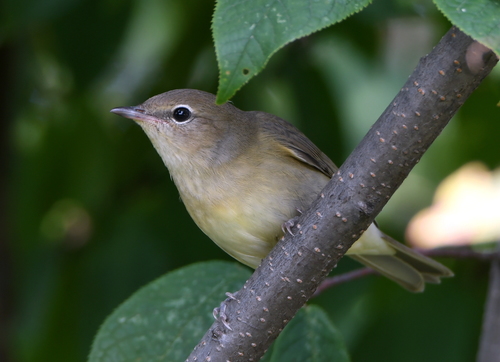
The garden warbler, Sylvia borin (Boddaert, 1783), measures 14 cm (5.5 in) in total length, with a wing length ranging from 7.6–8.4 cm (3.0–3.3 in). Its typical weight is 16–22 g (0.56–0.78 oz), though individuals preparing for migration can reach a maximum weight of 35.5 g (1.25 oz). It is a plain warbler with long wings and a long tail, with unstreaked olive-brown upperparts and dull white underparts. It has a whitish eyering, a faint pale supercilium, and a buff tint to the throat and flanks. It has black eyes, bluish-grey legs, and a strong bill: the upper mandible is grey, while the lower mandible is a paler grey. Males and females cannot be told apart by external appearance, including body size. Juveniles have looser plumage than adults, along with paler, greyer upperparts and a buff tone to the underparts. The eastern subspecies S. b. woodwardi is slightly larger and paler than the nominate subspecies, with greyer upperparts and whiter underparts. Where the two subspecies overlap in Africa, they are difficult to distinguish by sight, but trapped individuals with a wing length over 80 mm (3.1 in) are confirmed to be S. b. woodwardi. The garden warbler's plain appearance means it can be confused with several other warbler species. Melodious and icterine warblers usually have long bills and a yellowish tint to their plumage. Booted warblers are similar in color, but are smaller, more delicately built, and have a flesh-coloured bill. Western and eastern olivaceous warblers are also relatively small, and have white outer tail feathers along with a pinkish bill. Juvenile barred warblers, which lack the clear barring seen on adult barred warblers, are much larger than garden warblers and have a pale double wingbar. Prior to their first migration, juvenile garden warblers undergo a partial moult between June and September, which mainly affects their body plumage. Adults also have a similar partial moult in late summer that is sometimes more extensive, followed by a complete moult in their African wintering grounds before they begin their return migration. The garden warbler breeds across most of Europe between the 12–28 °C (54–82 °F) isotherms, and extends east across temperate Asia to the Yenisei River in Siberia. Its breeding range reaches further north than that of any other Sylvia warbler. All populations are migratory, and winter in sub-Saharan Africa as far south as South Africa. Birds from central Europe first migrate southwest, then reorient to travel south or southeast once they reach Africa, while Scandinavian migrants may travel south through the Alps and across the Mediterranean Sea. S. b. woodwardi takes a more easterly route to Africa, with many individuals passing through the Arabian Peninsula. When crossing the Sahara, garden warblers fly at night, and rest without moving or feeding in suitable shade during the day. During this crossing journey, they can metabolize not just stored body fat, but also up to 19% of their breast and leg muscle mass and 39% of their digestive tract. Many birds pause for several days to feed after crossing the desert before continuing further south. The nominate subspecies occupies the western and central parts of the winter range, though some individuals occur as far east as Kenya. S. b. woodwardi winters in eastern and southern Africa. Movements of garden warblers within Africa are not well studied, but at least some individuals return to the same wintering location in consecutive years. There are only a handful of records of garden warblers overwintering in Europe, from Corsica, the UK, and Ireland. Spring migration routes are poorly understood, but appear to run more directly across the Mediterranean. This warbler has been recorded as a vagrant in Afghanistan, Djibouti, Iceland, São Tomé and Príncipe, Somalia, Yemen, Svalbard, Jan Mayen, and Madeira. The garden warbler's breeding habitat is open areas with dense bushes, including thickets and woodland edges. It prefers shady areas with bushy or herbaceous undergrowth, as well as woodland adjacent to rivers or reed beds; in Ireland, it favours thickets on the shores of small lakes. Its tolerance for willow, alder, and birch allows it to breed further north and at higher altitudes than any other European Sylvia warbler. It avoids mature conifers and dense plantations, though young conifer plantations with thick undergrowth are suitable for nesting. Despite its common name, it is not a garden bird. In Africa, it uses a wide range of habitats with trees, and again avoids closed forests and arid areas. It occurs at altitudes up to 2,600 m (8,500 ft) in suitable mountain woodland, though in East Africa it is usually found at a lower altitude than the blackcap, and in moister areas than the common whitethroat.