About Sylvia atricapilla (Linnaeus, 1758)
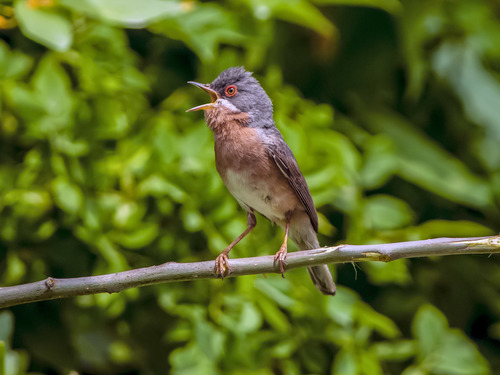
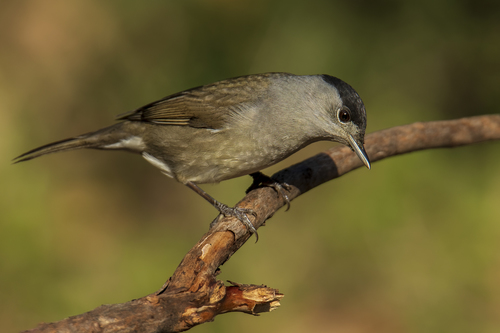
The blackcap (Sylvia atricapilla) is a primarily grey warbler with distinct plumage for males and females. The nominate subspecies measures around 13 cm (5.1 in) in length, has a wing length of 7–8 cm (2.8–3.1 in), and typically weighs 16–25 g (0.56–0.88 oz); individuals preparing for migration can weigh up to 31 g (1.1 oz). Adult males have olive-grey upperparts, aside from a paler grey nape and a distinct neat black cap on the head. Their underparts are light grey, turning silvery white on the chin, throat, and upper breast. The tail is dark grey, with an olive tint on the outer edge of each feather. The bill and long legs are grey, and the iris is reddish brown. Females resemble males, but have a reddish-brown cap and a slightly browner tone to the grey of their upperparts. Juveniles are similar to females, but have a slight rufous tinge on their upperparts and a more olive tone on the breast and flanks; young males have a darker brown cap than females of the species. This species can be easily distinguished from other dark-headed Sylvia warblers: Sardinian and Orphean warblers have extensive black across the head rather than a small cap, are larger, and have white edges on the tail. Blackcaps undergo a complete moult in their breeding areas during August and September, before migration begins. Some birds, most often those that migrate the longest distances, go through an additional partial moult between December and March. Juveniles replace their loosely structured body feathers with adult plumage, starting this moult earlier but taking longer to complete than adults. Blackcaps that breed in the northern part of the species' range have an earlier and shorter post-juvenile moult than blackcaps breeding further south, and cross-breeding experiments with captive birds show this moult timing is genetically controlled. The continental breeding range of the blackcap falls between the 14–30° July isotherms, and this area is occupied by the nominate subspecies; other subspecies are restricted to islands or fringe areas in the Caucasus and eastern Iberia. Birds living on Mediterranean and Atlantic islands, and in the milder west and south of the main Eurasian distribution, often winter within their nesting range, while other populations are migratory. The blackcap is a leap-frog migrant: birds from the north of the breeding range travel the furthest south, while Mediterranean breeding blackcaps move much shorter distances. Wintering areas overlap with the breeding range, and also include large areas in West Africa, East Africa as far south as Lake Malawi, and areas further north in Ethiopia, South Sudan and Eritrea. The vast majority of blackcaps wintering in eastern Africa belong to the southwest Asian subspecies S. a. dammholzi. A migratory divide exists in Europe at longitude 10–11°E. Birds west of this line travel southwest toward Iberia or West Africa, while populations east of the divide migrate to the eastern Mediterranean and continue on to East Africa. Captive cross-breeding between blackcaps from the resident Canary Islands population and migratory blackcaps from Germany showed that the urge to migrate is genetically controlled, with offspring showing intermediate restlessness behaviour during migration season. Similar experiments with birds from southern Germany and eastern Austria, from opposite sides of the migratory divide, demonstrated that migration direction is also genetically determined. Climate change appears to be altering the migration patterns of blackcaps and garden warblers. Both species now arrive in Europe earlier than they did historically, and blackcaps, plus juvenile but not adult garden warblers, depart nearly two weeks later than they did in the 1980s. Modern birds of both species have longer wings and are lighter than in the past, suggesting longer migration routes as the breeding range expands northward. In recent decades, large numbers of continental European blackcaps have begun wintering in gardens in Great Britain, and to a smaller extent Ireland, where the blackcap was formerly only a summer visitor. Although the British climate is not ideal for wintering blackcaps, compensating factors include easily accessible food (especially from bird tables), a shorter migration distance, and avoiding crossing the Alps and the Sahara Desert. It was originally thought that most of these wintering birds came from Germany, and isotope analysis (which allows wintering location to be determined) showed that continental blackcaps wintering in Britain tend to mate only with one another, and do not usually interbreed with blackcaps that winter in the Mediterranean or western Africa. This occurs because British wintering migrants return to breeding grounds earlier than blackcaps that winter around the Mediterranean, and form pairs before southern-wintering birds arrive. Mixed pairings are also selected against because hybrid offspring would migrate in an intermediate direction that would take them into the Bay of Biscay. It is now known that blackcaps wintering in the United Kingdom come from a much wider range of origins than previously thought. The majority come from France, and some individuals originate from as far away as Spain and Poland. A consistent supply of winter food in gardens even allows Spanish-breeding blackcaps to gain weight more quickly than they would in their native range. A 2021 study showed that blackcaps, particularly adults, wintering in Britain and Ireland have high site fidelity and low movement between wintering sites, which differs from blackcaps wintering in the species' traditional winter ranges. Adult blackcaps that regularly visit gardens have better body condition, smaller fat stores, longer bills, and rounder wing tips. These bill and wing tip shapes reflect a more generalist diet compared to blackcaps in traditional wintering sites. Blackcaps do not feed exclusively in gardens; visits are linked to harsher weather. Individuals generally remain at garden sites until immediately before spring departure, and supplemental feeding may benefit winter survival. When preparing for migration, abundant supplemental food can help blackcaps reach better body condition and may support earlier, more successful breeding attempts. On the Iberian Peninsula, migratory blackcaps (and European robins) follow similar climatic conditions across the seasons, while sedentary individuals must tolerate large annual climate variation. This indicates a trade-off between the long-distance travel cost for migrants, and the flexibility required for sedentary individuals to tolerate a wide range of environmental conditions. The blackcap's main breeding habitat is mature deciduous woodland with abundant scrub cover below the tree canopy. It also uses other habitats such as parks, large gardens, and overgrown hedges, as long as these sites meet the core requirements of tall trees for songposts and an established understory. Where other Sylvia warblers also breed, blackcaps tend to use taller trees than related species, preferring trees with a good canopy such as pedunculate oak. In prime habitat, breeding densities reach 100–200 pairs per square kilometre (250–500 pairs per square mile) in northern Europe, and 500–900 pairs per square kilometre (1,250–2,250 pairs per square mile) in Italy. Densities are much lower in poorer habitats such as conifer forests. Breeding occurs in Europe at altitudes up to 2,200 m (7,200 ft). The preferred winter habitat around the Mediterranean is scrub and olive orchards, where densities approach levels seen in the best breeding areas. The British wintering blackcap population is atypical: 95% of these birds are found in gardens, mostly in towns at altitudes below 100 m (330 ft). In Africa, blackcap habitats include cultivated land, acacia scrub, mangroves and forest, and the species occurs at altitudes up to 3,600 m (11,800 ft) in eastern Africa. Wintering blackcaps wander to find good supplies of fruit, but often remain in good feeding areas and return to these areas in subsequent winters. Migrants can be found in a wide variety of habitats, such as reed beds and fens, but show a preference for shrubland.