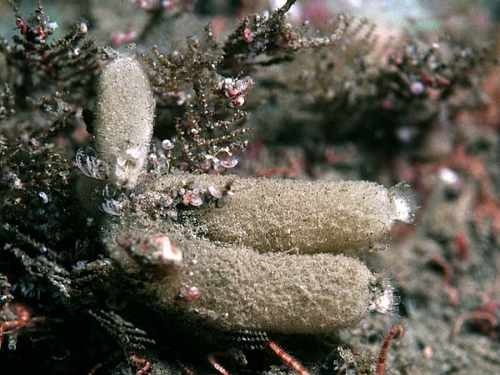
About Sycon ciliatum (Fabricius, 1780)
Sycon ciliatum, commonly known as the small purse sponge, grows either singly or in small groups attached by a single holdfast. It reaches up to five centimeters in length, has a fairly stiff texture, is greyish-white in color, and has a spindle-shaped body. The osculum located at the tip of the sponge is fringed with fine spicules. A covering of fine papillae gives the surface of this sponge a furry appearance. Its skeleton is made up of two layers: one tangential layer of triactines and a second layer of tetractines. This species can be told apart from the closely similar Sycon raphanus by the structure of its choanocyte chambers, which are separate and free from one another rather than fused. Sycon ciliatum is a common sponge along European coasts. It occurs along the eastern edge of the Atlantic Ocean, ranging from Scandinavia in the north down to Portugal in the south. It inhabits lower shore areas and the neritic zone, where it lives among seaweed, under stones, or in rock pools in locations that do not experience strong wave action.

