About Swietenia mahagoni (L.) Jacq.
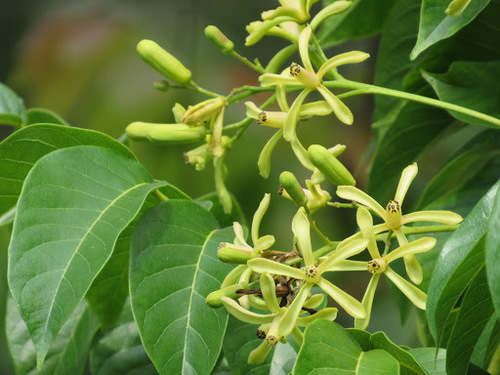
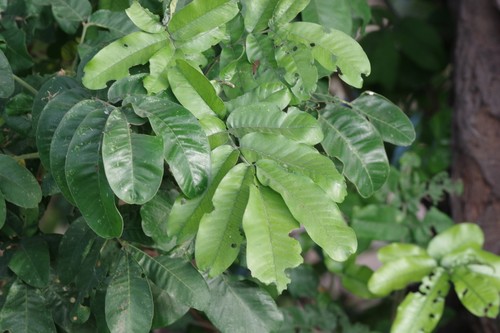
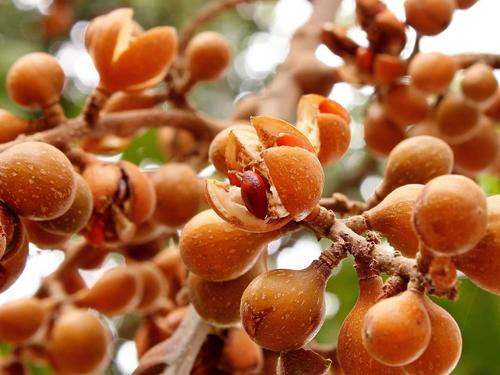
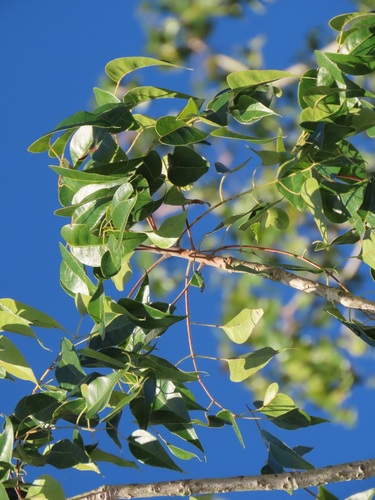
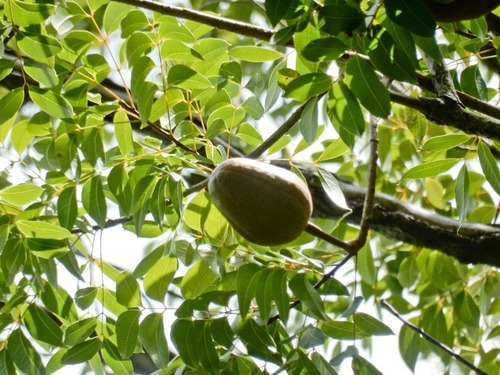
Swietenia mahagoni, commonly called West Indian mahogany, is a medium-sized semi-evergreen tree that reaches 30–35 metres (98–115 ft) tall at full growth. Its leaves are pinnate, 12–25 centimetres (4.7–9.8 in) long, and hold four to eight leaflets. Each individual leaflet is 5–6 centimetres (2.0–2.4 in) long and 2–3 centimetres (0.79–1.18 in) broad, and there is no terminal leaflet at the end of the leaf structure. The tree produces small flowers arranged in panicles. Its fruit is a woody capsule 5–10 centimetres (2.0–3.9 in) long and 3–6 centimetres (1.2–2.4 in) broad, which contains numerous winged seeds. Young specimens have smooth, grayish bark; as the tree ages, the bark becomes darker and develops furrows. In the United States, mahoganies of this species act as semi-deciduous: they lose all or most of their leaves over winter, or shed old leaves when new growth flushes in spring. Newly emerged leaves range from blood red to pinkish, quickly shift to a bright light green, then darken as they mature. Where the species grows at the northern edge of its range, in the Florida Keys and south Florida, individuals only reach 10–15 metres (33–49 ft) tall. S. mahagoni shows strong wind resistance, and frequently survives major hurricanes. This species is native to West Indian islands including the Bahamas, Cuba, Jamaica, the Cayman Islands, and Hispaniola which spans the Dominican Republic and Haiti, and it is also native to South Florida in the United States, the northernmost point of its native range. It has been widely introduced to all other Caribbean islands. The earliest recorded use of S. mahagoni dates to 1514. This year was carved into a rough-hewn cross placed in the Basilica Cathedral of Santa María la Menor in Santo Domingo, now the capital of the Dominican Republic, at the start of the cathedral's construction. The building was completed around 1540, making it the oldest church in the West Indies. Its interior is decorated with carved mahogany woodwork that remains in almost perfect condition after 500 years in a tropical climate. Other records document mahogany use between 1521 and 1540, when Spanish explorers used the wood to build canoes and complete ship repair work in the West Indies. The next major recorded use came in 1597, for repairs to Sir Walter Raleigh's ships in the West Indies. The first documented use of West Indian mahogany for major building structures in Europe before 1578 took place in Spain. The wood was specified for construction and interior decoration of El Escorial, one of the grandest Renaissance royal residences built in Europe. It is likely that the valuable properties of mahogany were already well known and the wood was already widely used, as advisors to King Philip II of Spain requisitioned it to make interior trim and elaborate furniture for this set of high-cost European buildings. A contemporary account notes that when the king ordered rot-resistant, high-quality woods including cedar, ebony, mahogany, acana, guayacan, and iron wood sent to embellish El Escorial in 1578, the woods had to be transported long distances by enslaved people. Shipments of these woods began in summer 1579, and additional shipments continued for at least ten years after that. Supplies of S. mahagoni are very rare today due to historic over-harvesting. Most mahogany sold commercially now comes from other related species, which typically grow faster but produce lower quality wood. S. mahagoni is grown as an ornamental tree in subtropical and tropical regions. In Florida, it is commonly planted as a street tree and a shade tree.