About Suta suta (Peters, 1863)
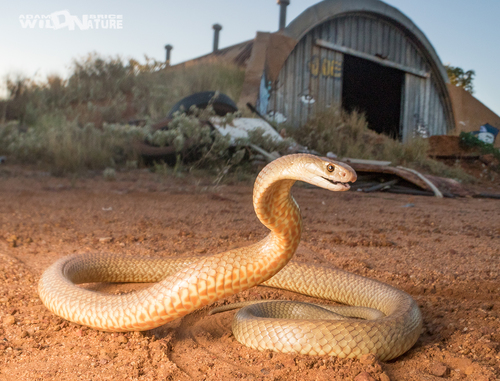
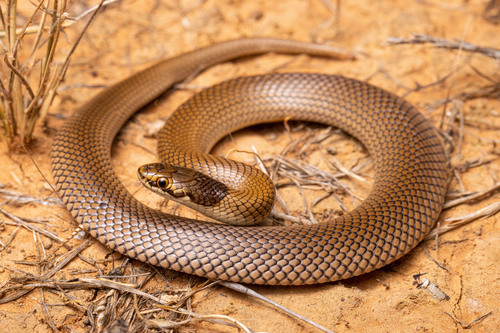
The curl snake (Suta suta) typically reaches 40 cm (16 in) in length, though individuals are known to grow to 60 cm (24 in) or longer. It has a wide head, and its body is dark brown or reddish brown, with a distinctly darker head and paler coloration under the flanks. Its light-colored iris and small pupil are key distinguishing features of the species. S. suta also has a temporal dark-edged stripe, which is typically orange, that stretches from each eye around to the snout. Sometimes the edges of its vertebral scales are darker, creating a reticulated pattern that gives the species its Latin name suta, meaning "stitched". Scale counts used for identification are as follows: dorsal scale rows at mid-body number 19 to 21, most commonly 19 rows and only rarely 21; ventral scales number 150 to 170 with a single cloacal scale; subcaudal scales number 20 to 35 and are single, undivided scales. The curl snake is found in every Australian state and territory except Tasmania. It mainly occurs in arid eastern and central Australia. In Victoria, it is found only in northern and central regions, and in Western Australia it is restricted to the far north-eastern border areas. It most commonly lives in grasslands, scrublands, and open woodlands, and forages at night among leaf litter and under rocks. It shelters in old burrows, soil cracks, under woody debris, and under leaf litter. The conservation status of this species is considered secure in all Australian states except Victoria, where it is classified as vulnerable. As a nocturnal forager, it is threatened by the loss of ground cover across its range. S. suta is viviparous (producing live young) rather than oviparous (laying eggs). A typical litter contains five young, though litter size can range from one to seven. Newborn hatchlings average 15 cm in length. S. suta venom is neurotoxic and is considered dangerous, especially to small children. Bites from large specimens are regarded as particularly dangerous. If bitten, you should seek immediate medical attention, immobilize the patient, and apply a pressure bandage.