About Suta nigriceps (Günther, 1863)
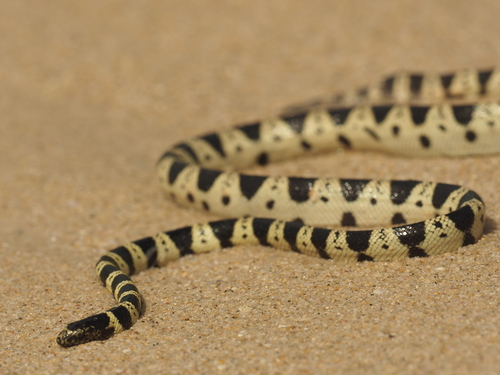
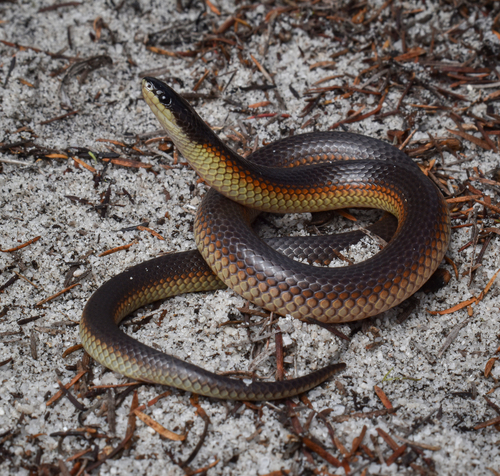
Suta nigriceps, commonly called the Mallee black-backed snake, has a total length ranging from 16 to 53 cm. Its average snout-vent length (SVL) is approximately 33 cm, and its tail length makes up between 9 and 15% of its total SVL. The head and nape of this species are glossy black, with a continuous, broad black vertebral stripe running along the back that extends all the way to the tail; this stripe is about five scales wide. Lateral scales are pale brown, with black or reddish-brown bases. The lips and ventral surface of the snake are cream or white. Scale color deepens as it approaches the vertebral stripe along the back, creating a smooth blending effect. At mid-body, this species has smooth scales arranged in 15 rows. It has between 147 and 175 ventral scales, and between 18 and 35 subcaudal scales. This snake is found across the southern mainland of Australia, occurring in New South Wales, South Australia, Victoria, and Western Australia. It is widespread and one of the most common snake species in southern Australia. It can be found in coastal dune, heath, and semi-arid habitats, including mallee, banksia, and jarrah woodlands. Its preferred habitats are temperate semi-arid plains, slopes, and ranges in woodlands and hummock grasslands. Mallee black-backed snakes are live-bearing rather than egg-laying; this reproductive mode is classified as viviparous. Unlike mammalian viviparity, embryos of this species are nourished by yolk rather than the female parent’s bloodstream, so this live-bearing method is sometimes also called ovoviviparous. The average litter size for this species is four, but females have been recorded giving birth to up to seven live young.