About Suricata suricatta (Schreber, 1776)
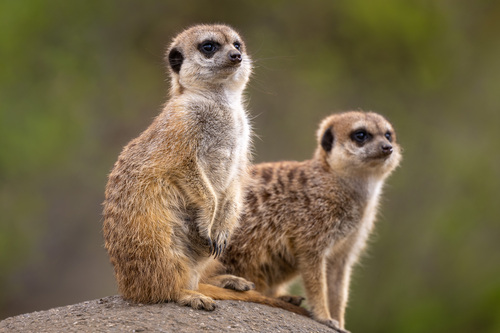
The meerkat (Suricata suricatta) is a small, slim-bodied mongoose species. It has a broad head, large eyes, a pointed snout, long legs, a thin tapering tail, and a brindled coat pattern. It is smaller than most other mongooses, with the exception of dwarf mongooses (genus Helogale) and possibly members of the genus Galerella. Its head-and-body length ranges from 24 to 35 cm (9.4 to 13.8 in), and its weight falls between 0.62 and 0.97 kg (1.4 and 2.1 lb), with little size difference between sexes, though some dominant females may be heavier than other group members. The meerkat’s soft coat ranges from light grey to yellowish brown, with alternating, poorly defined light and dark bands across the back; individuals from the southern part of the species’ range tend to be darker. Individual guard hairs are light at the base, have two dark rings, and are tipped with black or silvery white; aligned together, these hairs create the meerkat’s characteristic coat pattern. Guard hairs are typically 1.5 to 2 cm (0.59 to 0.79 in) long, but reach 3 to 4 cm (1.2 to 1.6 in) on the flanks. Most of the meerkat’s head is white, and its underparts are sparsely covered in dark reddish-brown fur that allows the dark skin beneath to show through. The meerkat’s eye sockets make up over 20% of the skull’s length, and its eyes are capable of binocular vision. Unlike the bushy tails of many other mongooses, the meerkat’s slim, yellowish tail is 17 to 25 cm (6.7 to 9.8 in) long and tipped with black. Females have six nipples. The meerkat resembles two sympatric species: the banded mongoose and the yellow mongoose. It can be distinguished from the banded mongoose by its smaller size, shorter tail, and larger eyes relative to its head. It differs from the yellow mongoose, which has a bushy tail and a lighter coat with an inner layer of yellow fur beneath the outer brown fur. The meerkat has 36 teeth with a dental formula of 3.1.3.2 / 3.1.3.2. It is well adapted for digging, moving through tunnels, and standing erect, but is not as capable at running or climbing. Its large, sharp, curved foreclaws, which are slightly longer than its hindclaws, are highly specialized among feliforms and allow for efficient digging. The meerkat’s black, crescent-shaped ears can be closed to keep dirt and debris out while digging. Its tail provides balance when the meerkat stands upright. A digitigrade species, the meerkat has four digits on each foot with thick pads underneath the feet. The meerkat has a specialized thermoregulation system that helps it survive in its harsh desert habitat. Studies show its body temperature follows a diurnal rhythm, averaging 38.3 °C (100.9 °F) during the day and 36.3 °C (97.3 °F) at night. When body temperature drops below the thermoneutral zone, which is 30 to 32.5 °C (86.0 to 90.5 °F), heart rate and oxygen consumption drop sharply. Perspiration increases dramatically at temperatures above this range. Additionally, the meerkat has a basal metabolic rate that is remarkably lower than that of other carnivores, which helps it conserve water, survive on less food, and reduce heat produced by metabolic processes. During winter, the meerkat balances heat loss by increasing metabolic heat generation and using other methods such as sunbathing. Meerkats are found in southwestern Botswana, western and southern Namibia, and northern and western South Africa; their range extends just slightly into southwestern Angola. They inhabit areas with stony, often calcareous ground in a range of arid, open habitats with little woody vegetation. They are common in savannas, open plains, and rocky areas beside dry rivers in biomes such as Fynbos and the Karoo, where mean annual rainfall is below 600 mm (24 in). Average annual precipitation drops to 100 to 400 mm (3.9 to 15.7 in) in the northwestern parts of the meerkat’s range. Meerkats prefer areas with short grasses and shrubs typical of velds, such as areas with camelthorn in Namibia and Acacia in the Kalahari. They are not found in true deserts, montane regions, or forests. Population density varies widely across locations, and is significantly affected by predators and rainfall. For example, a study in Kgalagadi Transfrontier Park (where predation pressure is high) recorded a lower mean meerkat density than on a ranch with fewer predators; after a 10% annual decrease in rainfall, meerkat density fell from 0.95 to 0.32 individuals per km² (2.46 to 0.83 per sq mi). The meerkat is a social mammal that forms packs of two to 30 individuals. Packs have nearly equal numbers of males and females, and contain multiple family units made up of breeding pairs and their offspring. Pack members take turns performing tasks such as caring for pups and watching for predators. Meerkats are a cooperatively breeding species: typically, dominant breeders in a pack produce offspring, while nonbreeding, subordinate helpers provide altruistic care for the young. This division of labor is not as strictly defined as it is in specialized eusocial species, such as the clear breeder-worker divide in ants. Meerkats also have a clear dominance hierarchy, with older individuals holding higher social status. Studies have found dominant individuals contribute more to offspring care when fewer helpers are available, while subordinate members increase their contributions if they are able to forage more effectively. Packs live in rock crevices in stony areas and in large burrow systems on plains. A pack generally occupies an average home range of 5 km² (1.9 sq mi), though some ranges reach up to 15 km² (5.8 sq mi). Ranges contain many burrows placed 50 to 100 m (160 to 330 ft) apart, some of which are never used. A 2019 study found large burrows near the center of a range are preferred over smaller burrows near the periphery, especially for packs that are raising pups. A pack may move to a new burrow if the dominant female has little success finding prey in the current area. Dominant individuals most often scent mark areas near the periphery of home ranges using anal gland secretions, and communal latrines covering 1 km² (0.39 sq mi) are located close to burrows. Packs may migrate together to search for food, escape high predator pressure, or avoid floods. Meerkats are highly vigilant, and frequently survey their surroundings by turning their heads from side to side; some individuals always stand sentry to watch for danger. They use vocal communication frequently in different contexts; for example, repetitive, high-pitched barks are used to warn other pack members of nearby predators. Meerkats generally retreat to their burrows for safety, and remain there until danger has passed. They will stick their heads out of burrows to check the area outside while continuing to bark. Groups of meerkats will fiercely attack snakes that come near their group. Major aerial predators of meerkats include raptors such as bateleurs, martial eagles, tawny eagles, and pale chanting goshawks. On the ground, meerkats may be threatened by bat-eared foxes, black-backed jackals, and Cape foxes. Meerkats breed year-round, with seasonal peaks typically occurring during months of heavy rainfall; for example, the most births occur from January to March in the southern Kalahari. Generally only dominant individuals breed, though subordinate members may also mate in years with high resource productivity. Females reach sexual maturity at two to three years of age. Dominant females can produce up to four litters per year (subordinate females produce fewer), and litter number depends on precipitation. Mating behavior has been studied in captive meerkats. Courtship behavior is limited; the male fights with his partner, grasping her by the snout. If she resists mounting, he will grip the nape of her neck, and holds her down by grasping her flanks during copulation. After a gestation period of 60 to 70 days, a litter of three to seven pups is born. Pups weigh around 100 g (3.5 oz) in their first few days after birth; the average growth rate for the first three months is 4.5 g (0.16 oz) per day, with the fastest growth occurring in the first month. A 2019 study found that pup growth and survival rates may decrease as temperatures rise. Newborn meerkats make continuous sounds resembling bird-like tweets, which develop into a shrill contact call as they get older. Young pups are kept safely in the den, emerge after around 16 days, and begin foraging with adult pack members by 26 days. Nonbreeding pack members contribute substantially to juvenile care: they feed pups and huddle with them to provide warmth. One study found nearly half of the litters of dominant females, especially those born later in the breeding season, are nursed by subordinate females, most often those that were or recently had been pregnant. Sex biases have been observed in feeding: female helpers feed female pups more often than male pups, while male helpers feed both sexes equally. This may occur because the survival of female pups is more beneficial to female helpers, as females are more likely to remain in their natal pack. Some helpers contribute more to all care activities than others, but no helpers are specialized in any single care task. Sometimes helpers prioritize their own needs over those of pups and choose not to share food; this behavior, called "false-feeding", is more common when the prey is more valuable to the meerkat. The father stays on guard and protects his offspring, while the mother spends most of her time foraging to produce enough milk for her young. Mothers give out shrill, repetitive calls to keep their pups following and staying close to them. Unable to forage on their own, young pups vocalize frequently to request food from their carers. Like many species, meerkat pups learn by observing and copying adult behavior, but adults also actively teach pups. For example, adult meerkats teach pups how to eat venomous scorpions by removing the stinger and showing pups how to handle the creature. The mother runs with prey in her mouth to encourage her pups to chase and catch it. Pups become independent enough to forage on their own at around 12 weeks of age. Meerkats are estimated to live 5 to 15 years in the wild; the maximum recorded lifespan in captivity is 20.6 years. Female meerkats can distinguish the scent of their kin from the scent of unrelated individuals. Kin recognition helps facilitate cooperation among relatives and avoids inbreeding. Mating between related meerkats often results in negative fitness effects called inbreeding depression, which impacts a range of traits including pup mass at emergence from the natal burrow, hind leg length, growth until independence, and juvenile survival. These negative effects are likely caused by increased homozygosity (higher genetic similarity between individuals from inbreeding) and the resulting expression of harmful recessive mutations.