About Suncus murinus (Linnaeus, 1766)
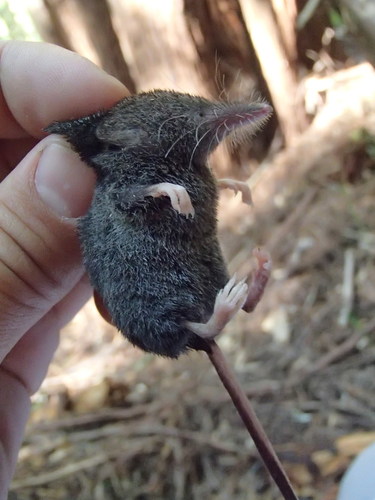
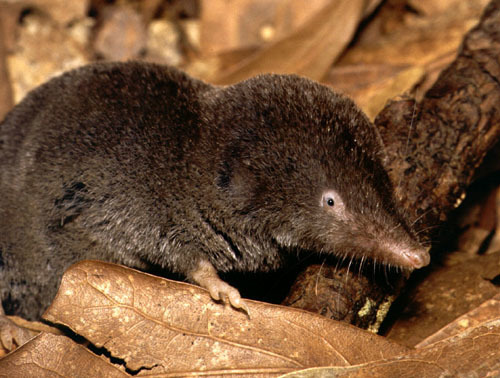
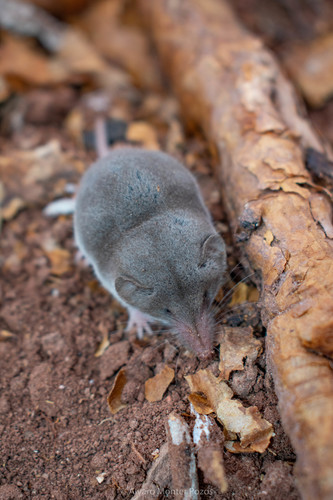
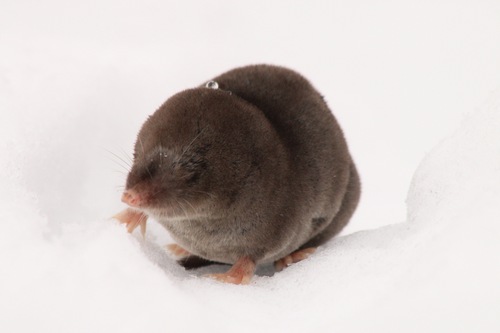
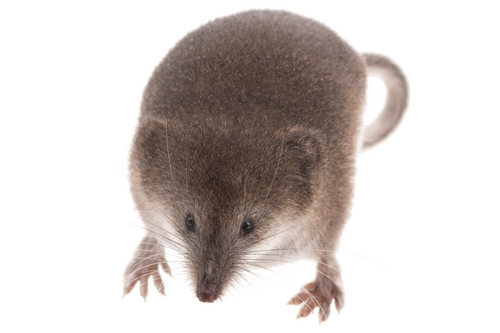
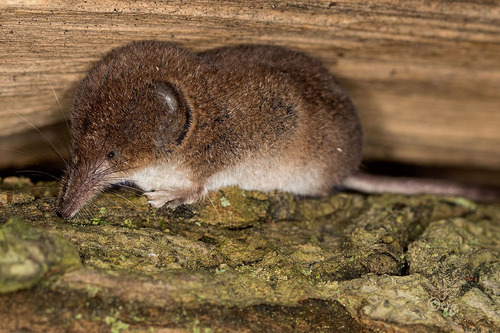
This species, the house shrew (also called the Asian house shrew), has uniform, short, dense fur that ranges in color from mid-grey to brownish-grey. Its tail is thick at the base, slightly narrower at the tip, and has thin, scattered long, bristle-like hairs. It has short legs with five clawed toes, small external ears, and an elongated snout. Musk glands on each side of its body (which are sometimes visible) produce a strong musky odor, which is particularly noticeable during the breeding season. Like all shrews, the Asian house shrew is plantigrade and long-nosed. Its teeth are a row of sharp points that let it poke holes in insect exoskeletons. It is the largest shrew species, weighing 50 to 100 grams and measuring around 15 centimeters long from snout to tail tip. The Asian house shrew is native to South and Southeast Asia, and was introduced by humans to eastern Africa, Arabia, Madagascar, the Philippines, and other islands in the Indian and Pacific Oceans. It is a voracious insectivore with very little resistance to starvation. It is nocturnal, and spends the day in a burrow or a hiding spot inside human habitations. It breeds year-round, with each female producing an average of two litters per year. Gestation lasts one month, and each litter has one to eight young, most often three. Both parents build a nest that the young stay in until they are nearly fully grown. Asian house shrews reach breeding age at around one year old. Research has found this shrew to be suitable for laboratory studies of reproduction and nutrition. It is widespread across all habitat types, including deserts and human habitations. When inside human habitations, house shrews habitually run quickly along wall edges. As they run, they make a chattering noise that sounds like jingling money, which earned them the common name "money shrew" in China. When alarmed, the house shrew lets out an ear-piercing, high-pitched shriek that sounds like nails scraping a chalkboard or a metal fork scraping glass; this sound repels house cats. Predators also avoid house shrews because of their musky smell, and even if they catch one by accident, they rarely eat it. Like European white-toothed shrews, when a mother house shrew travels with her young, the first young grips the mother's fur with its teeth, and each subsequent young grips the fur of the sibling in front of it the same way. House shrews are often mistaken for rats or mice and killed as vermin. They are generally beneficial to humans because their diet is mostly made up of harmful insects such as cockroaches, and they even eat house mice, so they can act as a biological pesticide. Unlike rat populations, house shrew populations stay at low levels. Even though they help control insects, they are often unpopular because their droppings have a strong odor, which they may leave in human homes behind kitchen cupboards and other similar spots. They may also eat human food such as kitchen meat, or pet food for dogs or cats. They are known to occasionally kill young chicks, which makes them unpopular with farmers, although rats likely kill more chicks, and do it more quickly. The house shrew's reported method of attacking chicks — biting a tendon first to immobilize the chick before killing and eating it — may indicate it has a venomous bite that causes paralysis, a trait seen in at least two other shrew species: the Eurasian water shrew and the Northern short-tailed shrew.