About Sumampattus quinqueradiatus (Taczanowski, 1878)
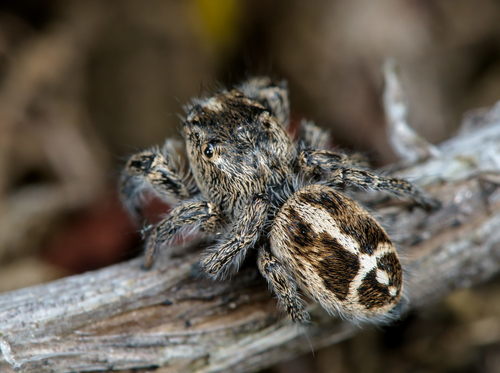
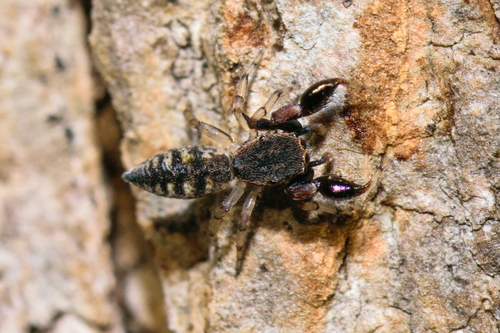
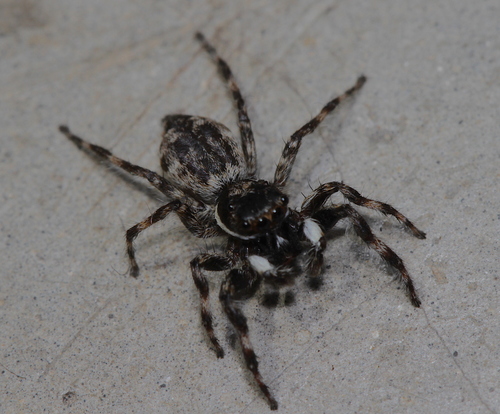
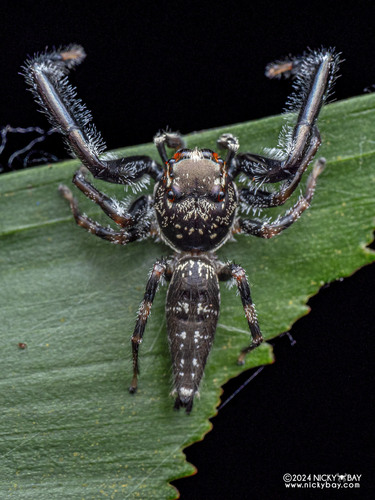
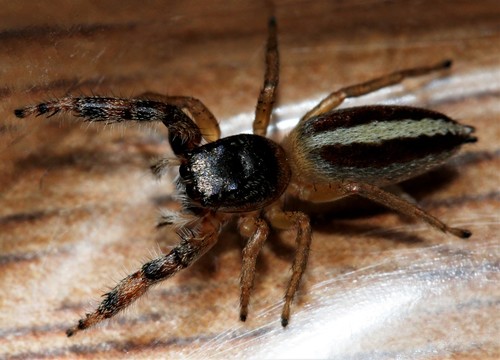
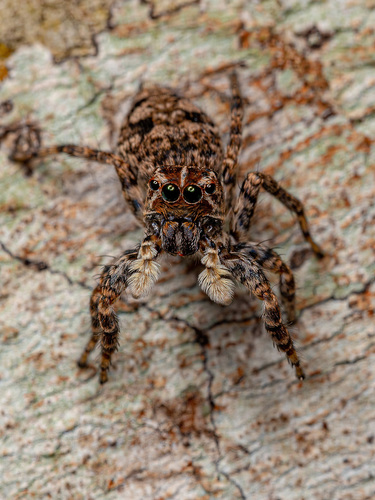
Sumampattus quinqueradiatus (Taczanowski, 1878) is a medium-sized species of jumping spider. Females of this species reach approximately 6.0 mm in total body length, while males are slightly smaller, averaging about 5.4 mm. This species has distinct, recognizable coloration patterns. Females have a dark brown cephalothorax, with a blackish head region covered in reddish-brown hairs. The head has five characteristic white hair bands: one runs longitudinally down the center, two on each side extend from the posterior lateral eyes, and one on each side (visible from a frontal view) extends from between the anterior lateral and median eyes. The female abdomen is brown, with yellow markings that form an irregular median band, bordered by patches of brown and black hairs. Males are generally darker overall than females. They have a very dark brown prosoma, with reddish hairs covering the head region. The male thoracic region has two broad pale brown bands that contain white hairs. The male abdomen follows the same basic pattern seen in females, but it is much darker, and has brown patches instead of the yellow patches found on female abdomens. Male legs are yellow, with blackish rings and patches. In both sexes, the femur has a broad basal ring (which is incomplete on the dorsal side) and a complete apical ring, the patella has its distal half darkened, and the tibia has broad basal and apical rings. S. quinqueradiatus is distributed across South America, with confirmed records from Peru’s Junín Department, Brazil’s Bahia and Mato Grosso states, Paraguay’s Amambay Department, and Argentina’s Salta, Jujuy, and Misiones Provinces. Specimens collected from Argentina’s Iguazú National Park were found in September and October, in vegetation that borders paths in fairly open, sunny areas. Laboratory observations have shown that female S. quinqueradiatus can produce multiple egg sacs, and juveniles of the species can be successfully reared to maturity in captivity.