About Sula nebouxii Milne-Edwards, 1882
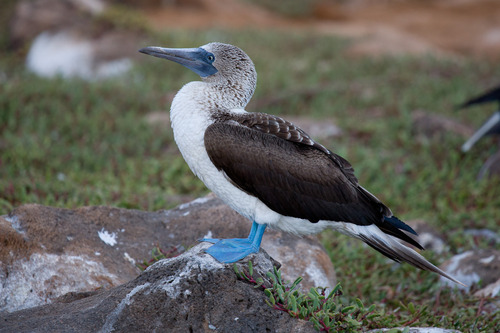
Description: On average, the blue-footed booby measures 81 cm (32 in) long and weighs 1.5 kg (3+1⁄4 lb), and females are slightly larger than males. It has long, pointed, brown wings. Its neck and head are light brown with white streaks, while its belly and underside have completely white plumage. Its eyes sit on either side of its bill and face forward, giving it excellent binocular vision. The eyes are a distinct yellow, and males have more yellow in their irises than females. Blue-footed booby chicks have black beaks and feet, and are covered in a layer of soft white down. The subspecies S. n. excisa, which breeds on the Galápagos Islands, is larger than the nominate subspecies and has lighter plumage, particularly around the neck and head.
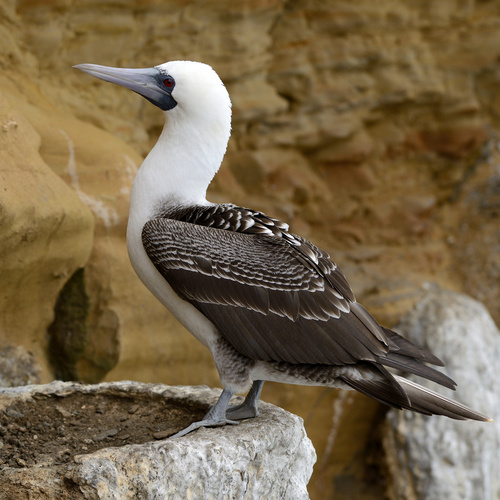
The Peruvian booby has a similar appearance to the blue-footed booby, but it has grey feet, a whiter head and neck, and white spots on its wing coverts. The ranges of these two species overlap in the waters of northern Peru and southern Ecuador. Because the blue-footed booby hunts fish by diving headlong into water, its nostrils are permanently closed, and it must breathe through the corners of its mouth.
The blue-footed booby's most well-known characteristic is its blue-colored feet, which can range in shade from pale turquoise to deep aquamarine. Males and younger birds have lighter feet than females. Its blue feet are a key part of courtship rituals and breeding; males visually display their feet to attract mates during the breeding season.
Distribution and habitat: The blue-footed booby is found along the continental coasts of the eastern Pacific Ocean, ranging from California in the north, through the Galápagos Islands, and south into Peru. It is an entirely marine bird. It only comes to land to breed and rear young, which it does along the rocky coasts of the eastern Pacific. An individual blue-footed booby may use and defend two or three nesting sites, which are made of bare black lava in small depressions in the ground, until it develops a preference for one site a few weeks before laying eggs. These nests are built as part of large colonies. While nesting, the female turns to face the sun throughout the day, which results in the nest being surrounded by excrement.