About Sula granti Rothschild, 1902
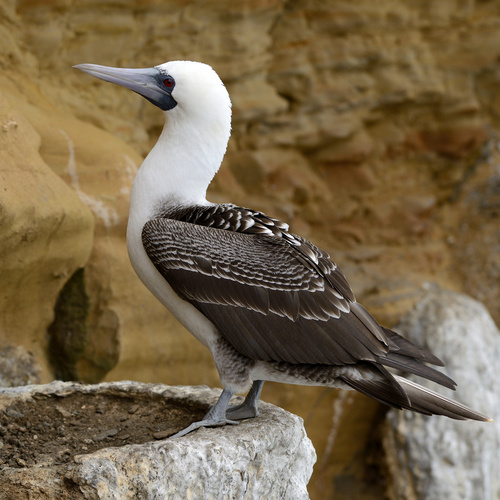
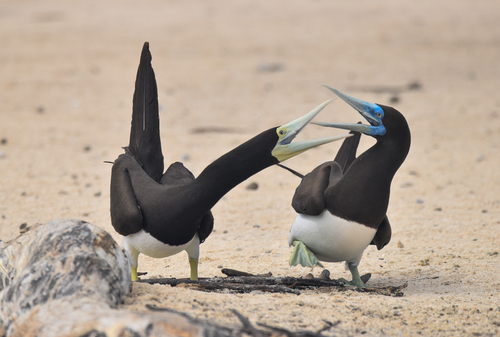
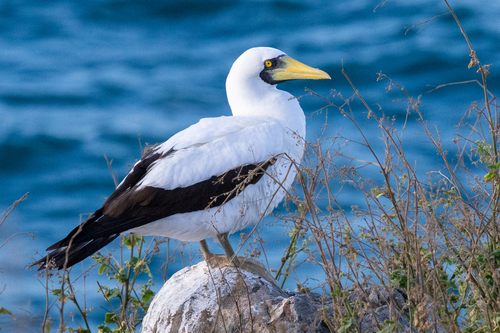
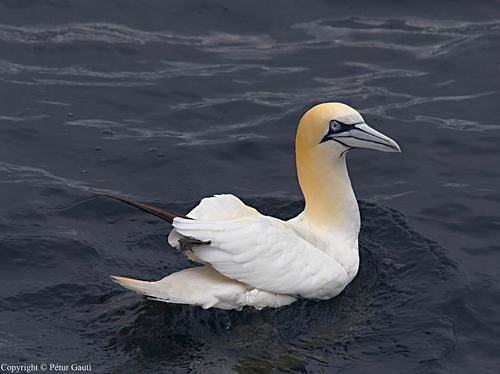
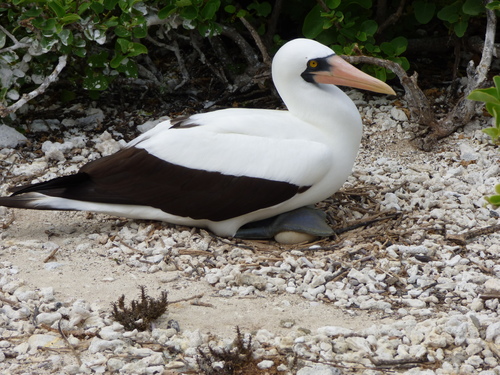
Description: This species has a yellow iris, an orange and pinkish beak, black facial skin forming a mask, and grey feet. Adult individuals have white plumage with black tips on the wings and tail. Females are larger and heavier than males, have a slightly differently colored beak, and produce squawk calls, while males produce whistle calls. Newly hatched chicks are snow white and fluffy; when they fledge, their plumage, beak, and feet all turn grey. Distribution and habitat: This species is found in the eastern Pacific, ranging from islands off Baja California to the Galápagos Islands, Isla de la Plata (Ecuador), and Malpelo (Colombia). Individual vagrants have been recorded in the western Pacific, including near Waigeo in Indonesia and off north-western Australia. Reproduction: The Nazca booby nests near cliffs on bare ground with little to no vegetation. Males first choose and defend a territory, then perform courtship displays to attract females. Like many other seabirds, this species has a long lifespan, low annual reproductive output, and long developmental periods for young. Clutch size is one or two eggs, with low overall hatching success. If two eggs are laid and both hatch, usually only one chick will survive, almost always the first to hatch. Unlike many bird species that regulate egg temperature using an incubation patch (a layer of bare skin that transfers heat to eggs), members of Suliformes (the order this species belongs to) use heat from their heavily vascularized webbed feet in addition to heat transferred from the breast; foot vascularization is especially pronounced during the nesting season. Both males and females provide parental care. The first-hatched chick is usually larger, and becomes aggressive toward its younger sibling, excluding it from feeding and eventually starving it to death. Parental energy investment during nesting is very high, so parents experience changes to their metabolic rates during the nesting season. This leads to both parents losing similar amounts of body weight and having reduced immune system activity. This metabolic adjustment does not occur when parents choose not to nest, a decision that is mostly driven by food availability. Food availability for this species depends on ocean currents and climate patterns, including those driven by the El Niño oscillation. Siblicide has been well studied in this species. The first chick hatches around five days earlier than the second, and is already larger and stronger when the second chick hatches; it will drag its younger sibling out of the nest. Field experiments conducted in the Galápagos have shown that Nazca booby parents are actually able to feed two chicks without significant difficulty, which has raised new questions about the evolutionary origin of this species' obligate siblicide.