About Sula dactylatra Lesson, 1831
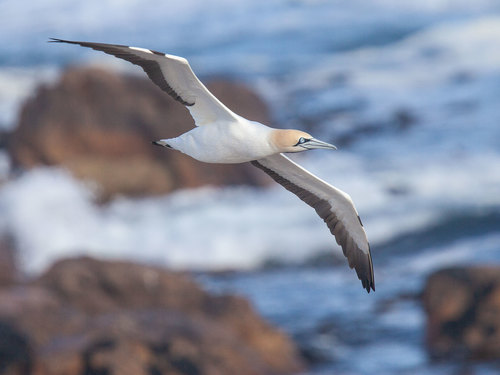
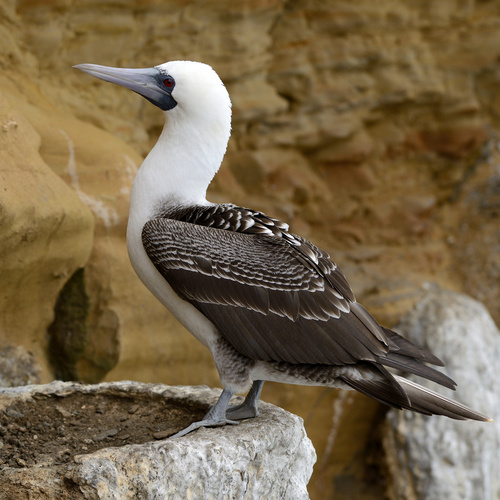
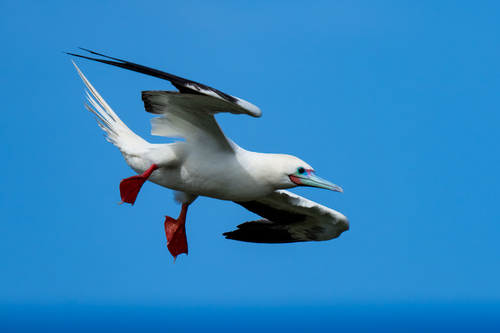
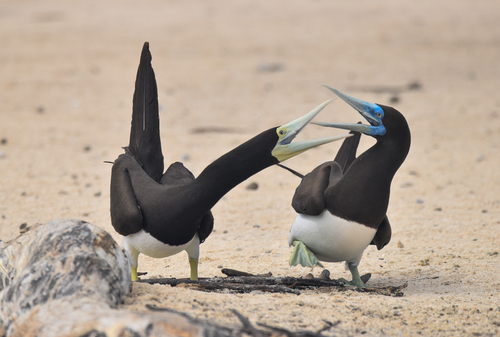
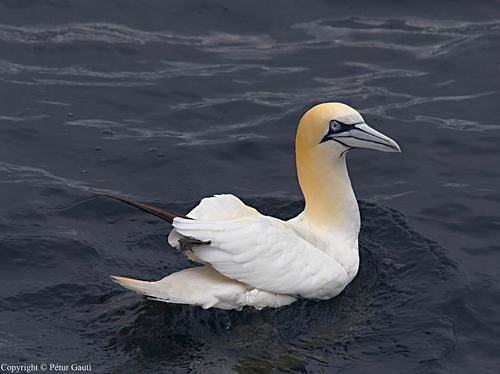
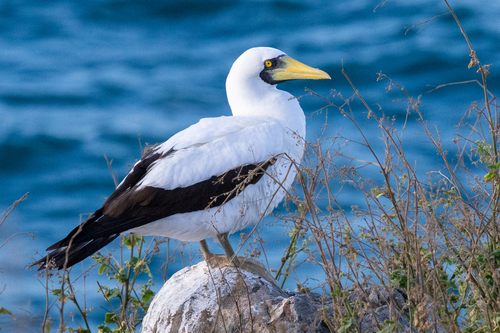
Masked booby (Sula dactylatra Lesson, 1831) is the largest booby species. Adults measure 75 to 85 cm (30 to 33 in) in length, have a wingspan of 160–170 cm (63–67 in), and weigh 1.2–2.2 kg (2.6–4.9 lb). It has the typical body shape of a sulid: a long pointed bill, long neck, aerodynamic body, long slender wings, and a pointed tail. Adult masked boobies have bright white plumage with dark wings and a dark tail. Males and females have similar plumage with no seasonal variation, but females are on average slightly heavier and larger than males. The bare skin around the face, throat, and lores is black or blue-black, contrasting with the white plumage to create a mask-like appearance that gives the bird its name. The bill of the nominate subspecies is pale yellow with a greenish tinge, sometimes greyish at the base. It is conical, longer than the head, and tapers to a slightly downcurved tip, with backward-pointing serrations along the mandibles. The primaries, secondaries, humerals, and rectrices are brown-black; the inner webs of the secondaries are white at the base. The underwing is white except for the brown-black flight feathers that are not covered by white coverts. Legs are yellow-orange or olive, and the iris is yellow. Subspecies differ slightly in size and sometimes in the color of the iris, bill, legs, and feet. The melanops subspecies has an orange-yellow bill and olive-grey legs; the tasmani subspecies has dark brown irises and dark grey-green legs; the personata subspecies has olive to bluish-grey legs. For the tasmani subspecies and the nominate dactylatra subspecies, the leg color of males during breeding season has more yellow-red than that of females. Juvenile masked boobies have streaked or mottled grey-brown plumage on the head and upperparts, with a whitish neck collar, dark brown wings, and white underparts. Their bill is yellowish, their face is blue-grey, and their iris is dark brown. Older immature birds have a broader white collar and rump, and gain more and more white feathers on the head until the head is fully white at 14 to 15 months of age. Full adult plumage is obtained three to four months before the bird turns three years old. Masked boobies are usually silent at sea, but are noisy at nesting colonies. The main call of males is a descending whistle, while females produce a loud honk. Adult masked boobies can be distinguished from the closely related Nazca booby by their yellow rather than orange bill, larger size, and less distinct sexual dimorphism; Nazca boobies also nest on steep cliffs instead of flat ground. The white morph of the red-footed booby is similar in appearance but smaller. Abbott's booby (Papasula abbotti) has a more fully black upperwing, a longer neck and tail, and a larger head. Cape gannets (Morus capensis) and Australasian gannets (Morus serrator) have a buff-yellow crown, shorter tail, white humerals, and a grey rather than yellowish bill. Juvenile masked boobies resemble brown boobies (Sula leucogaster), though adult brown boobies have clearly demarcated brown and white plumage. The masked booby lives across tropical oceans between the 30th parallel north and 30th parallel south. In the Indian Ocean, it ranges from the coastlines of the Arabian Peninsula and East Africa across to Sumatra and Western Australia, and is not found off the coast of the Indian subcontinent. Off the Western Australian coastline, it occurs as far south as the Dampier Archipelago. In the Pacific, it ranges from Brisbane eastwards. It is found in the Caribbean and Atlantic Ocean south to Ascension Island. In the eastern Pacific off the coast of Colombia and Ecuador, the masked booby is replaced by the Nazca booby. A vagrant individual was rescued in 2015 in Newport, Oregon. In the Atlantic, Caribbean birds occasionally wander north to warm southern Gulf Stream waters off the eastern seaboard of the United States, with single records from Island Beach in New Jersey and New York. There are summer records from Delaware Bay, Worcester County, Maryland, and waters off the coast of Spain. During the midyear monsoon season, masked boobies are occasional vagrants along the western coast of India, with records from Kerala, Karnataka, and Maharashtra states. They are also vagrants to the Caroline Islands north of New Guinea.