About Suiriri suiriri (Vieillot, 1818)
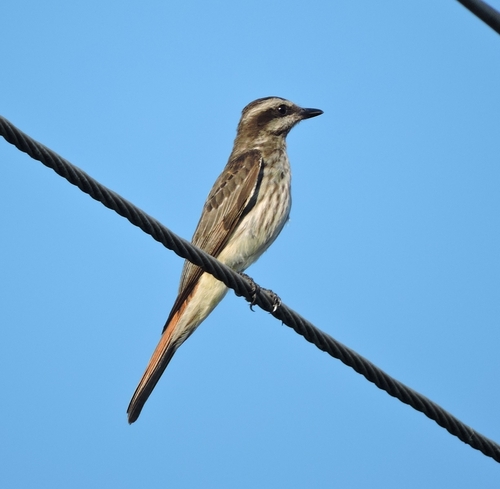
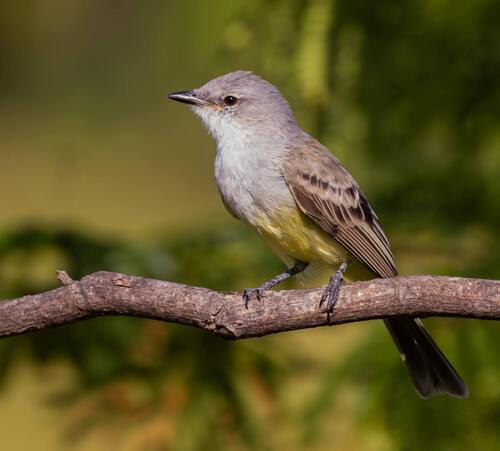
Suiriri suiriri, commonly called the suiriri flycatcher, measures 15 to 16 cm (5.9 to 6.3 in) in total length. The nominate subspecies weighs 11.5 to 16 g (0.41 to 0.56 oz), while subspecies S. s. burmeisteri weighs 18.5 to 21 g (0.65 to 0.74 oz). It is a medium-sized flycatcher, and both sexes share identical plumage across all subspecies. Adults of the nominate subspecies have a gray crown and nape. They have a white spot behind the lores and a short white supercilium on an otherwise whitish face. Their upperparts are gray, and their wings are a darker gray with paler outer edges and tips on the flight feathers. Their wing coverts have grayish white tips that form two distinct bars on the closed wing. Their tail is darker gray than their back. Their throat and underparts are whitish, with the breast a slightly darker shade than the rest of the underparts. Subspecies S. s. burmeisteri is larger than the nominate subspecies, with more olive coloration on its back, a buffy-yellowish rump, more yellowish wing markings, a white throat, pale gray breast, and pale yellow belly and crissum. Subspecies S. s. bahiae is mostly similar to burmeisteri, differing only by having a brownish rump. Both sexes of all three subspecies have a dark brown iris, a stubby black bill, and black legs and feet. The three subspecies of suiriri flycatcher have separate ranges, with the nominate subspecies occurring the farthest south. The nominate subspecies is found in eastern and southern Bolivia, most of Paraguay, northern and eastern Argentina south to Río Negro Province, adjacent southern Brazil, and western Uruguay. Subspecies S. s. burmeisteri is found in Suriname, northern Bolivia, northeastern Paraguay, and a broad area of Brazil roughly bounded by Amapá, western Pará, southern Amazonas, Piauí, Mato Grosso do Sul, and São Paulo state, with scattered small populations also present in Amazonian Brazil. Subspecies S. s. bahiae is found in northeastern Brazil, ranging from Paraíba to northeastern Bahia. The suiriri flycatcher generally inhabits semi-open to open landscapes, including Gran Chaco dry forest, open woodlands, and dry cerrado savanna. Subspecies S. s. burmeisteri lives exclusively in cerrado and campo ecosystems, including small pockets of these ecosystems within the Amazon rainforest.