About Suillus tomentosus Singer, Snell & E.A.Dick
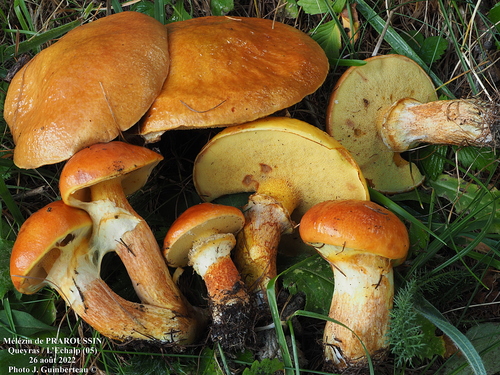
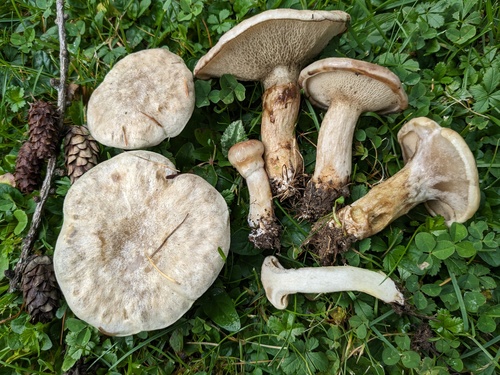
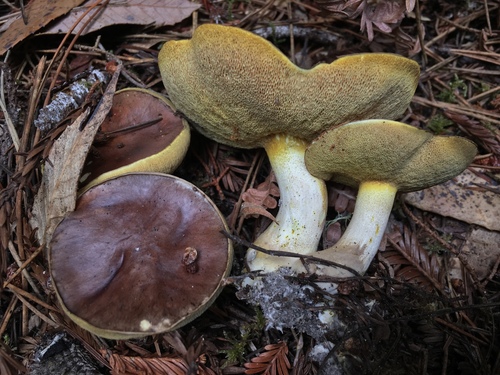
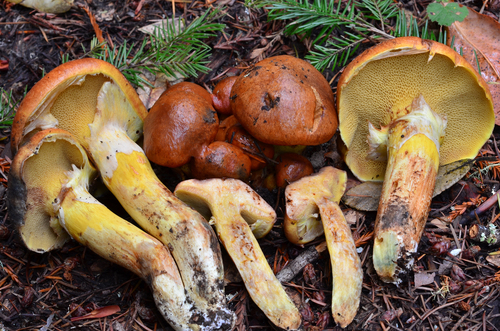
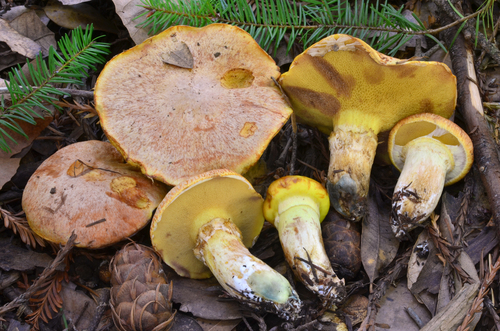
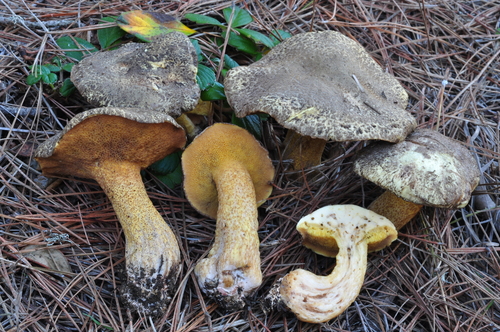
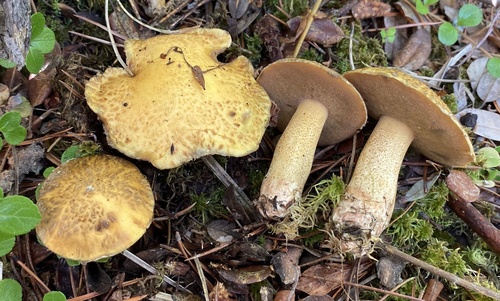
The cap of Suillus tomentosus measures 5–12 cm (2–4+3⁄4 inches) wide. It is pale to orange-yellow, covered in grayish, brownish, or reddish tomentum, and is viscid when fresh. Its fibrillose-scaly cap surface distinguishes this species from other members of the genus Suillus. The tubes are yellow, and turn blue when bruised. There is no veil present. The stipe grows 3–11 cm (1–4+1⁄2 inches) tall and 1–3 cm wide; it is covered in glandular dots, and matches the cap in color. The spore print is dark olive brown to brown. Young spores are brownish. Handling this species stains fingers blue. When cut open with a knife, the mushroom's yellow interior slowly turns green-blue. This species is commonly found in the Rocky Mountains of Idaho and the Pacific Northwest, and is less common in the lake states. It fruits in summer in the Rockies, and in autumn along the Pacific coast and in the lake states. Fruiting bodies grow alone or scattered in mixed forests. It is commonly found under lodgepole pines or other two-needle pines, and rarely found under jack pines. Suillus tomentosus forms nodular tuberculate ectomycorrhizae with lodgepole pine (Pinus contorta var. latifolia). Recent research shows the nodules reduce acetylene, indicating bacteria inside the nodules fix nitrogen. This system functions similarly to the root nodules found in legumes like clover. Lodgepole pines can grow on gravel pits and other extremely nitrogen-deficient soils. With its Suillus tomentosus symbiont, lodgepole pine is one of the most common pioneer species in northern forests. It colonizes highly disturbed soils and creates an environment that is suitable for other species to colonize.