About Suillus spraguei (Berk. & M.A.Curtis) Kuntze
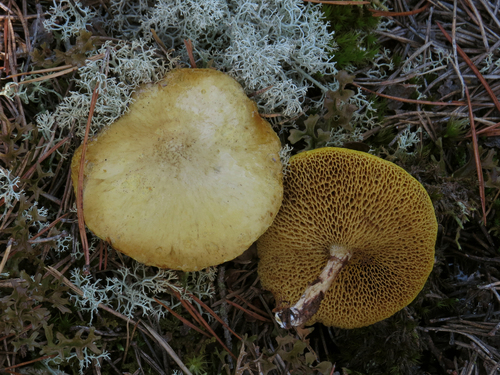
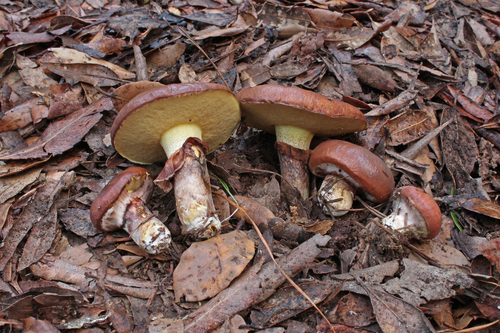
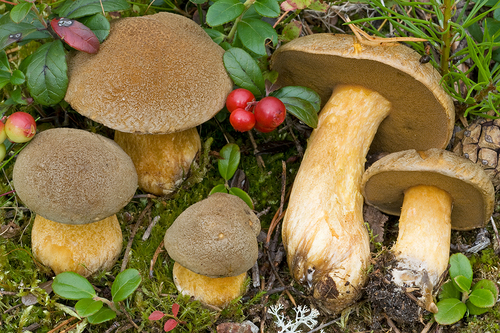
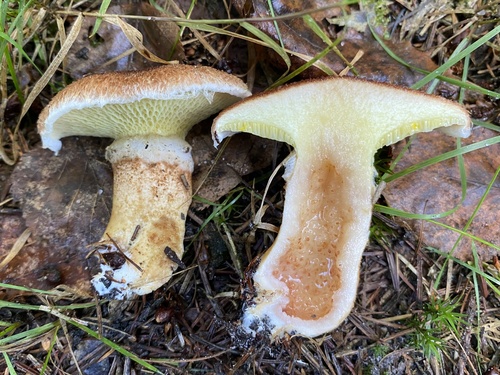
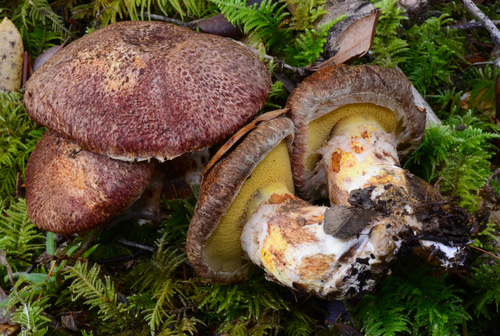
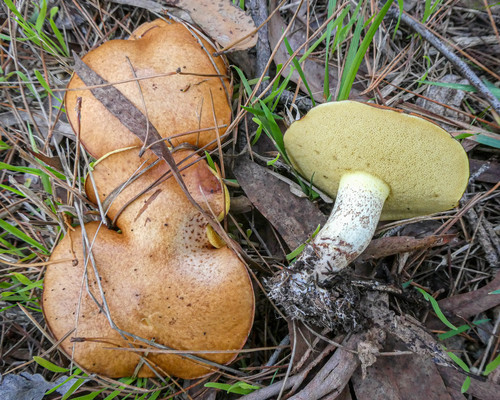
The fruit body cap of Suillus spraguei is 3 to 12 cm (1+1⁄4 to 4+3⁄4 in) in diameter. Its shape changes with age: it starts conic to convex, becoming somewhat flattened when mature. The cap margin is initially rolled downward before straightening, and often retains hanging remnants of the partial veil (a condition called appendiculate). The cap surface is covered in densely matted, rough, scale-like filaments. The scales are pink to brownish red, fading to pale brown-gray or dull yellow as the mushroom matures. Under the scales, the cap surface is yellow to pale yellow-orange. Unlike many other Suillus species that have a sticky or slimy cap, S. spraguei has a dry cap. The cap flesh is yellow. On the underside of the cap, the pores are yellowish and angular, 0.5 to 5 mm (1⁄32 to 3⁄16 in) wide, formed by tubes that extend 4 to 8 mm (1⁄8 to 3⁄8 in) deep. These pores attach slightly decurrently to the stem, meaning they extend partway down the stem’s length. Young specimens have a whitish fibrous partial veil that protects developing pores; as the cap expands, the veil tears, leaving a grayish ring on the stem. The stem is 4 to 12 cm (1+5⁄8 to 4+3⁄4 in) long and 1 to 2.5 cm (3⁄8 to 1 in) thick. It is roughly cylindrical, or sometimes somewhat club-shaped with a bulbous base. The stem surface is covered in short dense hairs (tomentose), has scales near the top, and bears the ring on its upper half. Below the ring, the stem is fibrillose, covered with a mat of soft hairs. The top of the stem is yellow, with wine-red to reddish-brown scales over a pale yellow to grayish base below the ring. The stem is usually solid, and rarely hollow. All tissues of the fruit body—cap, pores, and stem—turn brownish shortly after being bruised or injured. When collected as a spore print, S. spraguei spores are olive-brown, changing to clay or tawny-olive after drying. Microscopically, the spores have smooth surfaces, and measure 9–11 by 3–4.5 μm. In side profile, they have asymmetrical sides and a suprahilar depression (a surface indentation where the spore attaches to the basidia), while they appear oblong when viewed face-on. The spores are not amyloid, so they do not absorb iodine when stained with Melzer's reagent. The basidia (spore-bearing cells in the hymenium) are thin-walled, four-spored, and measure 17–19 by 5–7.8 μm. When treated with potassium hydroxide, basidia appear hyaline (translucent), and they turn pale yellow to nearly hyaline in Melzer's reagent. Different parts of the mushroom show characteristic color reactions to chemical tests used for mushroom identification. The cap cuticle turns blackish when treated with a drop of potassium hydroxide (KOH), iron sulfate (FeSO4) solution, or ammonia solution. The mushroom flesh turns grayish-green to greenish black with a drop of FeSO4, and turns olive to greenish black with KOH or NH4OH. In nature, S. spraguei forms ectomycorrhizal relationships with five-needled pine species. This mutually beneficial relationship sees the fungus’s hyphae grow around tree roots, allowing the fungus to receive moisture, protection, and nutritive byproducts from the tree, while giving the tree greater access to soil nutrients. S. spraguei produces tuberculate ectomycorrhizae (covered with wart-like projections) described as aggregates of ectomycorrhizal roots encased in a fungal rind, plus rhizomorphs: tubular fungal cords with a hard outer sheath. The fungus has ecological host specificity, and can only associate with white pine (a group of trees classified in Pinus subgenus Strobus) in natural soils. Under controlled laboratory pure culture conditions, S. spraguei has also been shown to form associations with red pine, pitch pine, and loblolly pine. Asian populations associate with Korean pine, Chinese white pine, Siberian dwarf pine and Japanese white pine. In North America, fruit bodies appear as early as June, which is earlier than most other boletes that generally begin to appear between July and September, but can be found as late as October. The mushrooms can be parasitized by the fungus Hypomyces completus. In the asexual stage of H. completus, it first appears as patches of whitish mold on the surface of the cap or stem that spread rapidly to cover the entire mushroom surface and produce conidia (asexual spores). In the sexual stage, the mold changes color, progressing from yellow-brown to brown, greenish-brown and eventually black as it develops perithecia: ascus-containing sexual structures that produce ascospores. The perithecia are pimply and give the infected mushroom surface a roughened texture. A Japanese field study found that S. spraguei was the dominant fungus in a 21-year-old stand of Korean pine, measured both by ectomycorrhizal biomass percentage in soil samples and by fruit body production, making up over 90% of the total dry weight of collected fruit bodies across all species. Average S. spraguei fruit body production was about one per square meter, with little variation over the four-year study period. The mushrooms mostly appeared from August to November, tended to grow in clumps, and the spatial distribution of clumps was random—clump locations did not correlate with appearances in previous years. Mushroom density along a forest road was higher than the study average, suggesting S. spraguei prefers disturbed habitats. The study also found the fungus prefers to produce fruit bodies in areas with low litter accumulation, a finding that was later confirmed by another publication. This study additionally determined that the fungus propagates mainly by vegetative growth, that is, extension of underground mycelia, rather than through colonization by spores. Suillus spraguei has a disjunct distribution, and is known from several localities in Asia including China, Japan, Korea, and Taiwan. In North America, its range extends from eastern Canada (Nova Scotia) south to the Carolinas, and west to Minnesota. It has also been collected in Mexico (Coahuila and Durango). Additionally, the species has been introduced to Europe, specifically Germany (Lower Saxony) and the Netherlands. Suillus spraguei is an edible mushroom. It does not have a distinctive taste, and its odor has been described as "slightly fruity". It turns a blackish color when cooked. Some sources consider it a choice edible and "among the better edibles in the genus Suillus". In contrast, a source about Québec mushrooms describes it as a poor edible (French: comestible médiocre), and warns of a slightly acidic taste and disagreeable flavor. Michael Kuo’s 2007 book 100 Edible Mushrooms rates the taste as mediocre, noting "its sluglike consistency has all the palatability of unflavored gelatin". The book recommends frying thinly sliced S. spraguei in butter or oil until it develops a crispy texture.