About Suillus pungens Thiers & A.H.Sm.
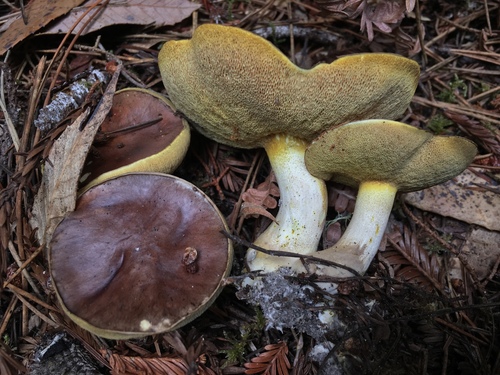
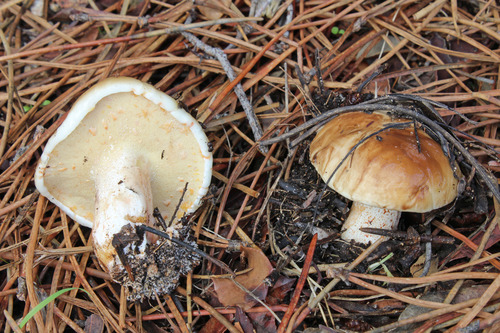
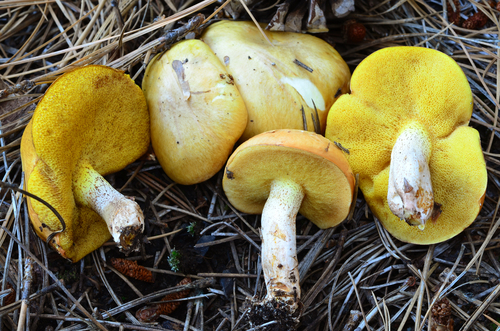
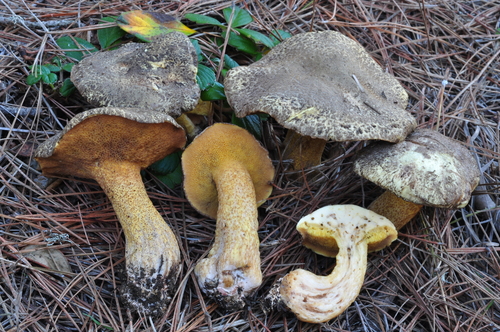
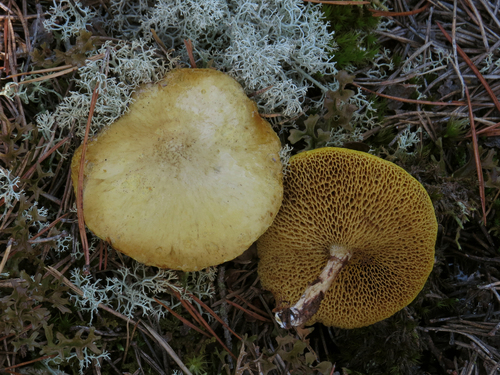
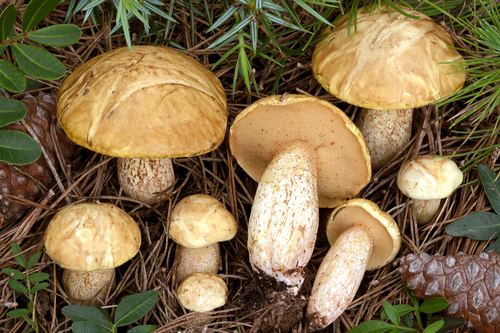
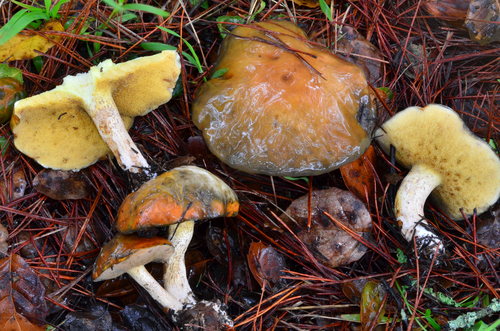
Suillus pungens Thiers & A.H.Sm. has a cap that is roughly convex when young, maturing to plano-convex or somewhat flat, with diameters ranging from 4 to 14 cm (1+1⁄2 to 5+1⁄2 in). When moist, the cap surface is sticky to slimy, and it becomes shiny when dry. The surface is smooth, though older specimens may sometimes show streaks from sticky, glue-like cap slime. Cap color varies widely in this species, and caps are often variegated with a mix of light and dark tones. Young caps are dirty-white to olive with pale olive splotches. Maturing caps may retain their juvenile color, or turn tawny, orange-yellow, reddish-brown, or a mix of these shades. The cap margin is initially rolled inward with a cottony roll of white tissue, becoming naked and curved downward as the mushroom ages. The flesh is 1–2 cm (3⁄8–3⁄4 in) thick; it is white and does not change color in young fruit bodies, and often turns yellow as it ages. The tubes that make up the spore-bearing hymenium on the underside of the cap grow up to 1 cm (3⁄8 in) long. They are adnate when young, becoming decurrent or nearly decurrent with age. Young tubes are whitish to pale buff, covered in milky droplets that turn brown to ochraceous when dry. As specimens mature, the pore surface changes to yellowish, and finally to dark yellow. The angular pores, which measure 1–1.5 mm in diameter, are not radially arranged and do not change color when bruised. The stipe is solid (not hollow), 3–7 cm (1+1⁄4–2+3⁄4 in) long, and 1–2 cm (3⁄8–3⁄4 in) thick near the top. Its shape is variable, and can be roughly equal in width along its length, thicker at the base, or somewhat thicker in the middle. The stipe surface is dry and smooth, covered in irregularly shaped glandular dots—minute clumps of pigmented cells that start reddish before turning brownish. The background stipe color is initially whitish, matching the color of young tubes, and becomes more yellow with age. The stipe does not change color when bruised, and has no ring. The stipe flesh is white and does not change color when exposed to air. The spore print of Suillus pungens is olive-brown to pale cinnamon-brown. Individual spores are thin-walled, hyaline (translucent), smooth, and shaped ellipsoid to roughly cylindrical when viewed from the face, or inequilateral when viewed in profile. They measure 9.5–10 by 2.8–3.5 μm. The spore-bearing basidia in the hymenium are hyaline, club-shaped, four-spored, and measure 33–36 by 8–10 μm. Thin-walled cystidia are rare to scattered on the tube surface but abundant on pores, where they usually grow in large clusters. When mounted in dilute 3% potassium hydroxide (KOH), cystidia appear dark brown; they are cylindric to roughly club-shaped, measuring 43–79 by 7–10 μm. Cystidia are usually encrusted with pigment, though some may be hyaline. The tissue that makes up the tubes is hyaline, formed of divergent to nearly parallel hyphae that are 3–5 μm wide. The pileipellis (cap cuticle) is an ixotrichodermium, made of interwoven gelatinized hyphae. It stains brown in KOH, and its hyphae are 4–5 μm wide. The stipe cuticle is made of clusters of cystidia similar to those found in the hymenium. Clamp connections are absent from the hyphae of S. pungens. Several chemical field tests can help identify S. pungens. When a drop of KOH is applied, the flesh turns vinaceous (red wine-colored), the tubes turn red, the cap cuticle turns black, and the stipe cuticle turns pale vinaceous. With ammonium hydroxide (NH4OH), the flesh becomes very pale vinaceous, and the tubes turn bright red. Iron(II) sulfate (FeSO4) turns the flesh gray, the tubes dark gray to black, and the stipe cuticle light gray. Suillus pungens is an ectomycorrhizal basidiomycete that forms symbiotic relationships almost exclusively with Monterey pine (Pinus radiata) and bishop pine (Pinus muricata). A small number of collections have been made under knobcone pine (Pinus attenuata) and ponderosa pine (Pinus ponderosa), but only within the native range of Monterey pine. According to the IUCN Red List assessment, within California the species also grows in planted and naturalized stands of its native hosts, and with introduced pines including P. pinea, P. pinaster, and P. halepensis, particularly in urban areas. The IUCN assessment also records introduced populations in New Zealand, where it is commonly found growing with introduced P. radiata, and Australia, likely introduced via imported pine stock. The primary native hosts of S. pungens, Monterey pine and bishop pine, have small scattered natural ranges largely restricted to coastal California. Fruit bodies of S. pungens grow singly, scattered, or in groups in humus. They are often found growing near fruit bodies of Chroogomphus vinicolor and Helvella lacunosa. Suillus pungens is often the most abundant Suillus species in the San Francisco Bay Area. The type collection was made on the campus of San Francisco State University, where the species grows abundantly during the fall and winter seasons. Although it fruits most often in autumn and winter, it is one of the few Suillus species that continues to fruit sporadically throughout the year, especially in wet weather. It has also been identified in the southeastern Sierra Nevada and on Santa Cruz Island. Outside its native range, S. pungens has been reported as an ectomycorrhizal fungus associated with introduced pines in the Hawaiian Islands, with additional introduced occurrences in New Zealand and Australia confirmed by an IUCN assessment. In a 1996 study, mycologists Monique Gardes and Thomas Bruns hypothesized that S. pungens, which fruits abundantly in pine forests, would be dominant on pine tree roots. However, after sampling both underground ectomycorrhizae and above-ground fruit bodies, they found that the fungus can produce prolific fruit while occupying only a small fraction of the ectomycorrhizal root assemblage, which was otherwise dominated by Russula species and Tomentella sublilacina. Gardes and Bruns hypothesized that the mismatch between above-ground and below-ground abundance may occur because the fungus invests less energy in vegetative growth and long-term persistence and more energy in fruiting. An alternative explanation is that the species is particularly efficient at acquiring carbon from its hosts, so it only needs to colonize a small number of rootlets to get enough energy to support abundant fruiting. A genet is a group of genetically identical individuals that have grown in a single location, all originating vegetatively from a single ancestor. In field studies, the approximate size of fungal genets is typically estimated by collecting and mapping fruit bodies at a site, determining which fruit bodies are genetically identical using either somatic incompatibility or various molecular techniques, then calculating the distance between identical fruit bodies. A 1998 study by Pierluigi Bonello and colleagues used single-strand conformation polymorphism analysis to detect small genetic differences among S. pungens genets, and found that most fruiting came from a single large genet. This result indicates that the fungus persists through extensive vegetative growth, rather than frequent establishment of new genets from spores, and that it uses carbon resources efficiently. The study also documented an S. pungens genet covering an area of approximately 300 m2 (3,200 sq ft) and spanning more than 40 m (130 ft) across, which was the largest ectomycorrhizal fungal genet reported at that time. The large S. pungens genet was not detected after a wildfire, showing that it did not survive the loss of its host, and suggesting that spores are the primary means by which the fungus recolonizes an area after fire. While most ectomycorrhizal fungi disperse spores mainly over short distances, Suillus species can disperse over kilometer scales. In a native forest study, S. pungens was reported as the only ectomycorrhizal fungus able to colonize pine seedlings more than 1 km (0.62 mi) from native pine forests. Its spore production was estimated at about 8×10¹² spores per km2. Other ectomycorrhizal fungi in the same system produced far fewer spores and did not successfully colonize seedlings away from the forest edge. In a soil-burial experiment at Point Reyes, researchers buried non-sterile soil collected beneath bishop pine in an area with little ectomycorrhizal inoculum. They later tested the soil for viable ectomycorrhizal propagules by baiting it with bishop pine seedlings. Suillus pungens was detected among the fungi recovered in year 1 bioassays, but was not recovered when the same buried soil was assayed after 6 years. Because S. pungens was already rare in the year 1 sample, and sampling intensity differed between the two years, the authors cautioned that its absence at year 6 is not on its own strong evidence that its spores cannot persist for years in soil. They instead argue that S. pungens is an effective disperser and spore colonizer, and patterns such as its reappearance after stand-replacing fires can be explained without assuming a long-lived soil spore bank—meaning establishment comes from spores rather than hyphal survival, and potentially from recent dispersal. In growth-chamber experiments with bishop pine, Suillus pungens showed a strong short-term acute response to drying, but little sustained chronic change in gene expression after prolonged low watering. After 5–15 days without watering, roughly one fifth of genes changed expression in the soil-foraging mycelium, and substantial shifts were also detected in the fungus growing on ectomycorrhizal root tips. By contrast, after 10 weeks of reduced watering, pine seedling growth and fungal root colonization were both reduced by about half, yet only a small number of fungal genes differed from well-watered controls, a pattern consistent with acclimation to longer drought. During acute drying, both root-associated and soil mycelium showed coordinated expression changes that align with reduced protein synthesis alongside increased investment in osmotic protection and hyphal maintenance, for example in trehalose-related and cell wall-associated functions.