About Suillus americanus (Peck) Snell
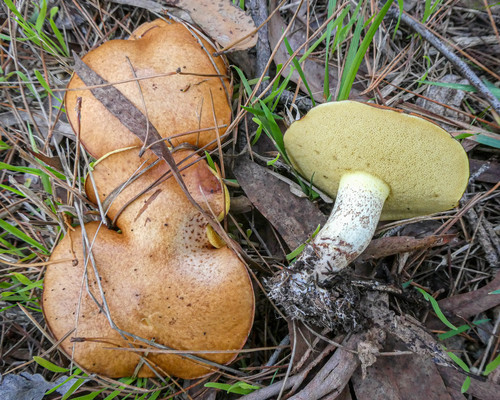
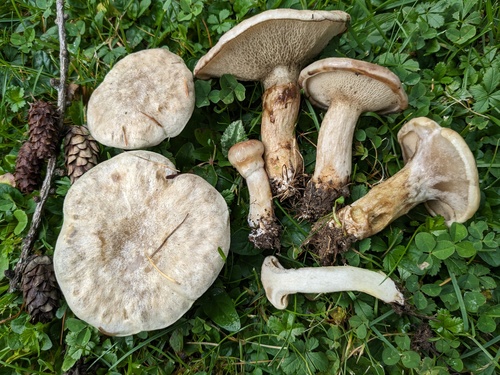
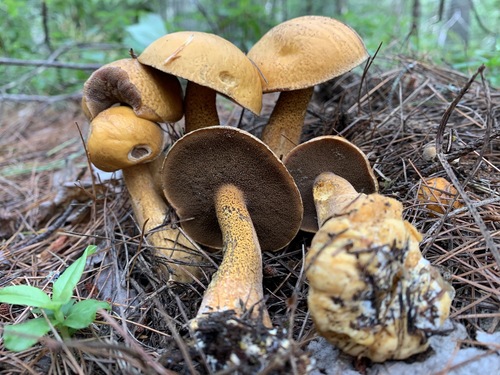
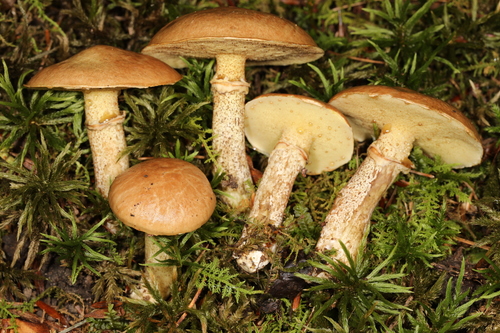
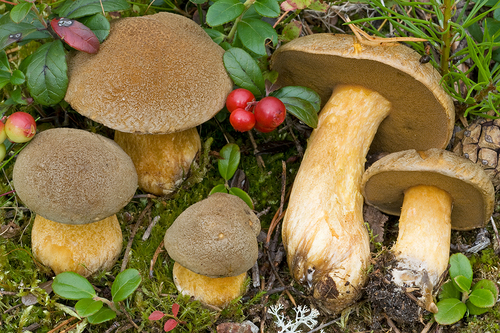
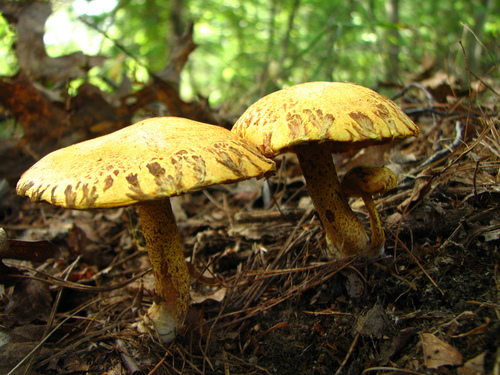
Suillus americanus (Peck) Snell has a cap that typically ranges 3–10 cm (1+1⁄4–4 in) in diameter. It is broadly convex with a small umbo when young, flattening out as it ages. Young specimens have an inward-curved margin that may hold remnants of a yellowish, cottony veil. The cap surface is bright yellow, marked with red or brownish streaks and hairy patches. When young and moist, the cap surface is slimy; as the cap matures and dries, it becomes sticky or tacky. The tubes that form the pore layer on the underside of the cap are 0.4 to 0.6 cm (1⁄8 to 1⁄4 in) deep, and attach to the stipe in an adnate (broadly attached) to decurrent (running down the stipe) arrangement. The tubes are yellow, and stain reddish-brown when bruised. The yellow pores are large (1–2 mm diameter), angular, and darken as they age. Pores are slightly wider than they are long: there are 9–10 pores per centimeter measured radially, and 12 to 13 pores per centimeter measured tangentially, about halfway to the cap edge. Like all boletes, spores develop on the inner surfaces of the tubes, then exit through the pore openings to be dispersed by air currents. The stipe measures 3–9 cm (1+1⁄8–3+1⁄2 in) long by 0.4–1 cm (1⁄8–3⁄8 in) thick, is roughly equal in width along its length, is often crooked, and becomes hollow with age. The stipe surface is lemon yellow, covered in glandular dots that bruise when handled. The partial veil is not attached to the stipe, and usually does not leave a ring on the stipe. Whitish mycelium at the base of the stipe helps anchor the fruit body to its substrate. The flesh is mustard yellow, and stains pinkish-brown when cut or bruised. In spore deposits, spores are cinnamon-colored. When viewed under a microscope, spores are pale yellow, smooth, roughly elliptical, and measure 8–9.5 by 3.5–5 μm. The spore-bearing cells, called basidia, are club-shaped, 4-spored, and measure 21–25 by 5.5 to 6 μm. Pleurocystidia, cystidia found on the sides of tubes, range in shape from cylindrical to club-shaped and are grouped in bundles. Brown pigment particles may cover both the bases of the bundles and the surface of the cystidia. Cheilocystidia are cystidia located on the pore faces. In S. americanus, cheilocystidia are mostly club-shaped, often with an expanded apex, and like pleurocystidia, they are arranged in bundles with brown pigment particles at the bundle bases. Bundles of cystidia near the tube openings can sometimes be seen with a hand lens. Like all Suillus species, the cystidia of S. americanus turn orange-brown when exposed to a 3% potassium hydroxide solution. The slimy layer on the cap surface forms from an interwoven layer of gelatinous hyphae that are typically 3–5 μm thick. Suillus americanus produces fruit bodies on the ground, growing singly or in clusters. Originally recorded across northeastern North America extending north into Canada, it fruits typically in late summer and autumn, with its North American range extending south to Guerrero, Mexico. It was also first reported from Guangdong, China, an occurrence once considered a disjunct population, but broader sampling of ITS DNA sequences has since suggested the species has a much wider distribution across the Northern Hemisphere than older records indicated. Fruit bodies may appear during relatively dry weather when other mushroom species are scarce. In South Korea, voucher specimens collected between 1988 and 2013 held in several national collections were confirmed as S. americanus using ITS sequencing. Specimens previously recorded or filed under other names, including S. sibiricus, S. tomentosus, and S. subluteus, were re-identified as S. americanus, leading researchers to conclude that Korean records of those original taxa could not be verified with the available material. In a global compilation of ITS sequences, S. americanus was represented from both North America and a broad Eurasian range that extends from Eastern Europe through Pakistan and India to Russia and Japan, leading to the interpretation that it is the most naturally widespread species in the genus. In southeastern Europe, the species has been recorded in high-altitude forests of Macedonian pine (Pinus peuce) in Montenegro. A DNA metabarcoding survey of fungi living in P. peuce rootlets and rhizosphere soil detected S. americanus (treated in that study as the same species as S. sibiricus) repeatedly, and it was among the more frequently recovered ectomycorrhizal taxa in rootlet samples; the same study also reported the species is listed as protected in several Balkan countries, including North Macedonia, Bulgaria, and Montenegro. Additional Balkan field records from Montenegro, including Prokletije National Park, have mostly come from montane to subalpine conifer forests with P. peuce at approximately 1,400–1,900 m elevation, with fruiting recorded from early summer into late autumn. In Bulgaria, a three-year survey of macrofungi in P. peuce forests and plantations combined morphological analysis with nrITS barcoding, and deposited sequences of Bulgarian collections in GenBank. Suillus americanus is a mycorrhizal species: it forms an ectomycorrhizal sheath around pine roots and a Hartig net between the outer root cells, exchanging nutrients absorbed from soil for carbohydrates produced by the host tree. In North America, it is best known for associating with eastern white pine (Pinus strobus). South Korean collections were also linked to P. strobus, with fruiting recorded from late summer into autumn. Greenhouse bioassays indicate that host identity strongly constrains the earliest stage of symbiosis for Suillus americanus. In spore inoculation trials, the fungus readily formed ectomycorrhizas on eastern white pine (Pinus strobus), colonizing roughly one-third of all examined root tips, but it failed to form ectomycorrhizas on tamarack (Larix laricina) or northern red oak (Quercus rubra). When seedlings were co-planted, S. americanus still consistently colonized Pinus, and only occasionally formed ectomycorrhizas on Larix, a pattern interpreted as mycelial spread from nearby already colonized pine roots, while oak roots remained uncolonized. Researchers interpreted this pattern as strong host specificity during spore germination, with a limited capacity for secondary associations via established mycelial networks. In a controlled seedling bioassay using eastern white pine (Pinus strobus), Suillus americanus readily colonized seedlings from spores and tended to be the dominant species when competing with other Suillus species associated with white pine. When seedlings were inoculated with S. americanus spores alone, or in paired combinations with S. subaureus or S. spraguei, researchers found a consistent competitive ranking (S. americanus > S. subaureus > S. spraguei), and interpreted the outcome largely as a timing effect: earlier and more consistent colonization gave S. americanus an advantage. In single-species treatments, seedling dry biomass did not differ significantly among the three fungi, but some two-species inoculations reduced biomass compared to single-fungus treatments. This matches the idea that competition among ectomycorrhizal fungi can influence both host performance and which fungi dominate colonized root tips. Field observations from Macedonian pine stands in Bulgaria suggest tree age may influence how often S. americanus produces fruit bodies. Although it only occurred in some monitored plots, it was frequently observed fruiting beneath P. peuce seedlings outside plot boundaries; researchers suggested this pattern aligns with the observation that suilloid fungi are important during pine establishment and regeneration.