About Sugomel niger (Gould, 1838)
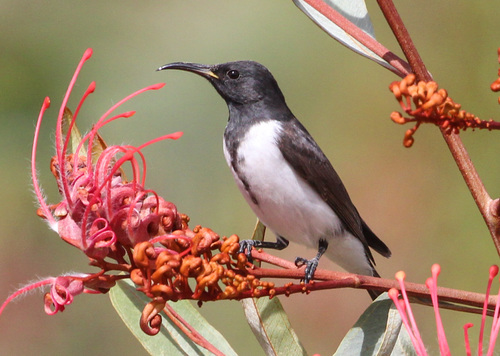
The black honeyeater, scientifically named Sugomel niger (Gould, 1838), has a long, slender, down-curved bill, a small rounded head, a slender neck, a plump body, and a short, slightly cleft tail. It measures 10 to 13 cm (3.9 to 5.1 in) in length, with an average wingspan of around 19 cm (7.5 in) and an average weight of 9.5 g (0.34 oz). It has relatively long, pointed wings for a honeyeater, and very long wings for such a small bird; this wing development is linked to its feeding behavior of flying between shrubs and hovering over flowers.
This species shows strong sexual dimorphism. Adult males have black and white plumage: their head, neck, wings, and upperparts are black, a black stripe runs from the center of the chest down to the abdomen, and their belly, flanks, and under-tail coverts are white. Adult females have buff brown scalloped pale crowns, ear coverts, and upperparts, a pale eyebrow, grey-brown speckled chests that fade to dull white bellies. Both adult males and females have dark brown irises and blackish brown bills and legs. Immature birds resemble adult females, but their upper breast and throat are typically more uniform grey-brown and the base of their bill is paler; they cannot be told apart from adult females from a distance.
The black honeyeater is quiet when not breeding, but calls before and during the nesting season, often early in the morning. Its calls include a soft metallic "chwit, chwit"; a louder, monotonously even-pitched "tieee" spaced several seconds apart; and a weak "peeee" usually produced by breeding males. After their young hatch, both sexes give a soft scolding call, which likely alerts the young that food has arrived. The species is also recorded making a bill snap when hawking insects. It is constantly on the move, hovering and hawking while feeding, and chasing intruders at food sources. John Gould described its flight as "remarkably quick, and performed with zigzag starts".
The black honeyeater inhabits the dry inland of Australia. It is generally widespread but scattered in western Queensland and New South Wales as far as the South Australian border, and is occasionally recorded in the Victorian Mallee and Wimmera regions. In South Australia, it occurs in the southeast, it is widespread in central and northern Western Australia, and there are rare sightings in the south near Kalgoorlie. In the Northern Territory, it is widespread around Alice Springs, with some vagrants reaching the Top End.
This species is dependent on the berrigan emu bush (Eremophila longifolia) and related species. It is found in open woodlands and shrublands of arid and semi-arid regions, as well as mulga or mallee woodlands, and also occurs in spinifex savanna that hosts flowering shrubs such as grevilleas and paperbarks. The black honeyeater can locate emu bushes even when clumps consist of only two or three plants separated by many kilometres of open land, confirming how important this plant-bird association is.
The black honeyeater is considered migratory rather than strictly nomadic, with regular seasonal movements tied to the flowering of its food plants, especially emu bush. Some individuals move south in Southern Hemisphere spring and summer, and return north in autumn and winter. It has been recorded south of Bendigo and in the Hunter Region during severe droughts. Sudden population irruptions can occur in some areas after rain or the movement of floodwaters. Breeding has generally been recorded in the drainage basins of Cooper Creek and the Darling River in southwestern Queensland and northwestern New South Wales, as well as in the Pilbara and Gascoyne regions of Western Australia. However, the species may breed anywhere during an irruption if conditions are favourable.
The black honeyeater feeds on nectar, probing flowers and foliage with its long, fine bill. It is mainly found in the crowns of eucalypts, at clumps of mistletoe, or in shrubs, especially emu bushes (Eremophila). A 12-month observation in South Australia recorded black honeyeaters visiting flowers of berrigan emu bush, twin-leaf emu bush (Eremophila oppositifolia), lerp mallee (Eucalyptus incrassata), and holly grevillea (Grevillea ilicifolia). The species was also frequently observed hawking small insects. It hovers around flowers, feeding for only a short time at each flower. It may sometimes form large mixed flocks at food sources, associating with other bird species such as pied honeyeaters and white-browed woodswallows (Artamus superciliosus).
Like many other honeyeaters, the black honeyeater catches insects in flight. Males, in particular, fly up to 15 metres (50 ft) high to seize an insect mid-air, then drop back to a regularly used perch. A study of black honeyeaters at seven sites in Western Australia regularly recorded breeding females eating ash from remote campsite fires, and often making repeated visits over a short period. Around six birds at a time were observed hovering around and landing beside campfires, with activity described as similar to "bees buzzing around a honeypot". After pecking at the ash, some females foraged for insects, sallying from foliage of nearby Wheatbelt wandoos (Eucalyptus capillosa) before returning for more ash. Females engaged in this activity anywhere from a single peck to sustained feeding for a minute or more. Male birds occasionally landed near fires, but none were observed eating ash. Well-developed brood patches on birds mist-netted near fires suggest that females eat ash around the time of egg-laying, and throughout incubation and chick feeding. Wood ash is rich in calcium, so researchers hypothesise that females eat ash to form medullary bone before egg-laying or to repair calcium deficit after laying. This aligns with earlier observations of calcium intake in other small birds, such as American hummingbirds, which eat calcium-rich ash, bones or shell; this behaviour is thought to exist because the small skeletons of these species cannot store enough calcium for egg production.