About Sufflamen bursa (Bloch & Schneider, 1801)
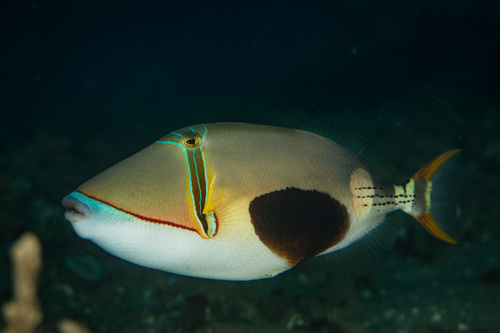
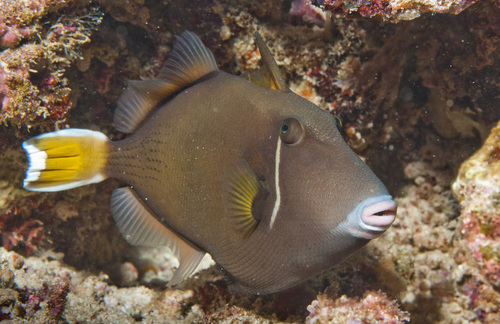
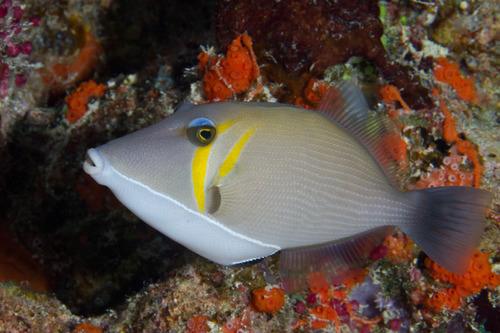
Sufflamen bursa is a triggerfish species in the Balistidae family that shares the characteristic body plan of other triggerfish: a rectangular body, pectoral, anal, caudal, dorsal, and pelvic fins, and a toothy snout that resembles a beak. This species reaches a maximum length of 25 cm. S. bursa is usually pale in base color, but can darken to a brown shade, with subtle purple tones on its anal, ventral, and caudal fins. One white stripe runs from its mouth down to the base of the pectoral fin, and two vertical brown or yellow stripes (their color changes with the fish's mood) run along each side of its body; one passes through the eye, and the other runs behind the eye along the gills. Like other triggerfish, S. bursa has locking spines at the base of its caudal fin that it uses for self-defense against predators, and it will use these spines when provoked. It also shares the family's characteristic tough, beak-like teeth. Tiny barbs on the species' scales repel urchin spines, making S. bursa unaffected by urchin venom. S. bursa lives in warm shallow tropical and subtropical waters of the Pacific and Indo-Pacific, across a range of reef systems. It occupies coral reef areas just before the surge zone, to avoid the turbulent movement of water where waves break. It prefers habitats with sandy and reefy bottoms. When threatened by predators, and especially at night, S. bursa hides in reef crevices. This species is edible, and is reported to have a sweet flavor similar to crab or grouper. It is typically eaten cooked or raw; many people do not add extra seasoning, as the fish is already flavorful on its own. It is used as an ingredient in larger prepared dishes, including sushi, and can also be served grilled, raw, or seared.