About Succisa pratensis Moench
Devil's-bit scabious (Succisa pratensis Moench) is a perennial herbaceous plant. It sometimes reaches 1 m (3 ft) or more in height, but is often much smaller – it may grow to just a few centimetres tall in montane heathland or Scottish machair. Its stem is erect to ascending, often somewhat arched, roughly hairy, and unbranched.
Leaves are arranged in opposite pairs. Basal leaves are 2–15 cm long (exceptionally up to 30 cm), ovate, and sometimes slightly toothed. Stem leaves are smaller and narrower, lanceolate, connate, and shortly sheathing around the stem. All leaves are roughly hairy, and have winged petioles up to 2 cm long. A distinctive feature of this species is its taproot: it grows to about 5 mm thick in its first year, then becomes woody and dies back at the tip, leaving a premorse stump that produces shallower lateral roots in the second year.
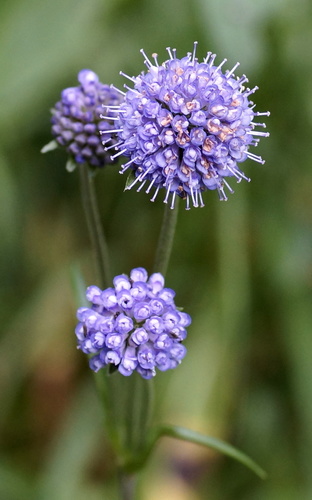
Inflorescences grow either terminally or in leaf axils, and consist of one, three, or sometimes more compound capitula (flower heads). Each capitulum holds 30–50 bluish to violet flowers, occasionally pink or white, packed tightly into an almost hemispherical dome 15–25 mm across. Below the flower head are two rows of green involucral bracts up to 10 mm long. The receptacle is up to 10 mm across and slightly elongated. Within the flower head, there are as many ciliate bracts as flowers. Each flower has an epicalyx (or "involucel") formed from 4 fused bracteoles, a calyx tube with 4 lobes tipped by 4–5 black bristles, and a corolla up to 7 mm long that also has 4 lobes. All flowers are similar, and are not separated into ray and disc florets.
All flowers are bisexual (hermaphroditic), but a majority of anthers may be abortive in most flowers on some flower heads, giving the impression of gynodioecy. The flowers are also protandrous: male parts mature first, followed by female parts, which further contributes to the false appearance of dioecy. In reality, all flowers produce 4 stamens with very long filaments and purple anthers, plus one style with a cream-coloured stigma. The fruit is a small achene around 0.5 mm long.
Devil's-bit scabious can easily be confused with field scabious, greater knapweed, and small scabious, but all of these species have enlarged ray florets and lobed leaves. Sheep's-bit may look like a small devil's-bit scabious, but it has 5-lobed flowers and club-shaped anthers. A white midrib allows overwintering devil's-bit scabious rosettes to be distinguished from knapweed rosettes.
Devil's-bit scabious is common across most of the British Isles, western and central Europe, extending east into central Asia, and has been introduced to eastern North America. It grows from sea level up to high mountain pastures, reaching 2,400 m in elevation in Hungary. Its overall range in Britain has not changed since the 1950s, but it is thought to have decreased in abundance and declined locally due to agricultural intensification in the late 20th century. In northern and western British counties, it is considered ubiquitous across all soils and all altitudes, while in the south and east it is highly restricted to areas with suitable soils. Adams (1955) recorded that it is more common on disturbed ground and ditch sides, such as Stone Age ditches at Avebury and Roman workings at Hadrian's Wall. While the IUCN has not assessed its global conservation status, most countries classify devil's-bit scabious as not threatened, with a status of LC (least concern). Its overall status in Britain is also LC, but it is thought to be in long-term decline across most English counties. It is classified as an axiophyte in most counties of England, Wales, and Scotland.
Devil's-bit scabious grows in a wide variety of habitats, but in many regions it is restricted to small, localised areas with specific soil types. Adams (1955) listed its British habitats as "deciduous woods (except beech), rides in coniferous plantations, poor pastures, fens, bogs roadsides, sea-cliffs and... sandy or marshy ground near the seashore." Despite this wide range of occupied situations, all are nutrient-poor and reasonably open to sunlight. It may therefore be abundant along a woodland ride but absent from closed canopy woodland, or common in chalk downland but completely eliminated from surrounding farmland. Its Ellenberg values in Britain are L = 7, F = 7, R = 5, N = 2, and S = 0, which reflect its preference for damp, reasonably sunny locations with neutral soils and very low fertility, and that it cannot tolerate salt.
A wide range of insects visit its flowers, especially hoverflies of the genus Eristalis. Devil's-bit scabious is a good source of nectar, and is the larval food plant of the marsh fritillary, which lays its eggs in groups on the undersides of leaves, and the narrow-bordered bee hawk-moth (Hemaris tityus). Its flowers are galled by the gall midge Contarinia dipsacearum, its leaves by the triozid bug Trioza munda, and its roots by the nematode Meloidogyne hapla. Its leaves are parasitized by the chytrid fungus Synchytrium succisae, the powdery mildew Erysiphe knautiae, the rust fungus Aecidium succisae, and the leaf spot fungi Fusicladium consors, Ramularia succisae, Septoria succisicola, and Septoria scabiosicola. Its flowers are parasitised by the smut fungi Microbotryum succisae and Microbotryum flosculorum, and the downy mildew Peronospora violacea.