About Subcoccinella vigintiquatuorpunctata (Linnaeus, 1758)
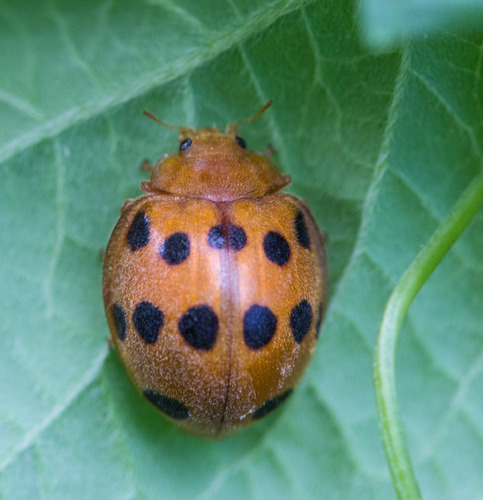
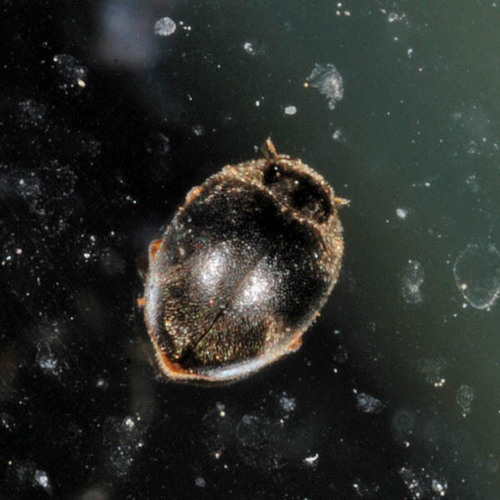
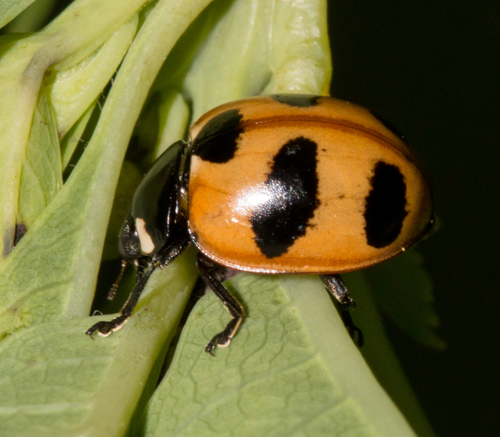
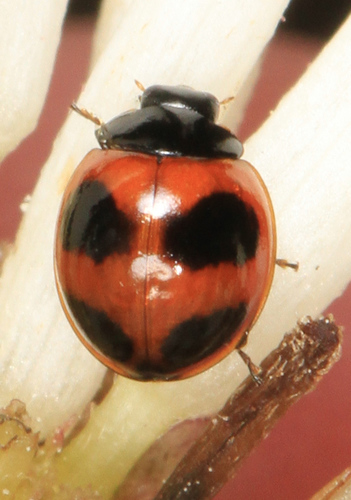
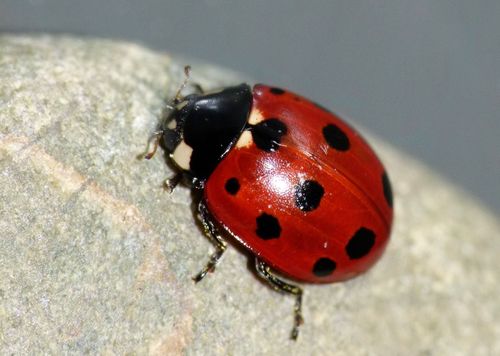
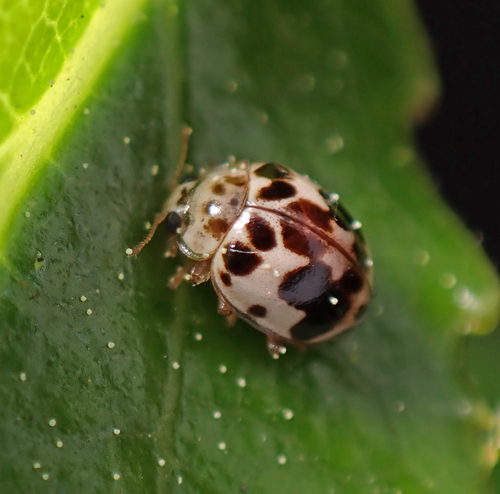
Adults of the 24-spot ladybird, Subcoccinella vigintiquatuorpunctata, are small ladybirds, typically measuring 3 to 4 mm in length. They have the characteristic classic ladybird shape: distinctly domed, with smooth curves running continuously from the head through the pronotum to the wing cases. The wing cases are covered in short, pale hairs; while these hairs are difficult to see without a hand lens, they give the ladybird a unique matte appearance. The entire insect, including legs and antennae, is dark orange, with black spots on the wing cases. The number and size of these spots vary, but most individuals have around 20 to 24 spots, and the total count rarely exceeds 26. Sometimes spots merge together, or can be completely absent. Dark melanic forms are very rare, and another extremely rare form has yellow spots. Mature larvae are 4 to 6 mm long, pale grey-green with darker speckles, and covered in branched spines. These spines are also retained in the pupal stage, allowing the pupa to secrete noxious alkaloids for defense against predators. There are five European species in the subfamily Epilachninae, all of which are herbivorous and somewhat hairy. The 24-spot ladybird can be told apart from the similarly patterned Bryony Ladybird (Henosepilachna argus, which measures 6 to 8 mm) by its smaller 3 to 4 mm size. Another small related species, Cynegetis impunctata, is browner, lacks spots entirely, and has a black head — this black head easily distinguishes it from spotless forms of the 24-spot ladybird. Most individuals of this ladybird have no functional wings beneath their elytra (wing cases), and these wingless individuals cannot fly. One study recorded no winged specimens in a UK sample, while 40% of specimens from Hungary and Romania had wings. Even the winged specimens carry the gene that causes wing atrophy, so researchers think the trend toward complete winglessness will continue over time. This is an Old World species found across Europe, North Africa, European Russia, the Caucasus, Siberia, the Russian Far East, Belarus, Ukraine, Moldova, Transcaucasia, Kazakhstan, Middle Asia, Western Asia, Afghanistan, Mongolia, China, and North and South Korea. It was introduced to North America in the 20th century, with the first confirmed records coming from Pennsylvania in 1972. In Britain, it is more common in the south of the country. Subcoccinella vigintiquatuorpunctata occurs in a wide range of habitats, including Pontic–Caspian steppe, Pannonian Steppe, unimproved grassland, quarries, wasteland, ruderal areas, Western European broadleaf forests, mixed forests, and areas alongside rivers, as well as other central European life zones.