About Styrax officinalis L.
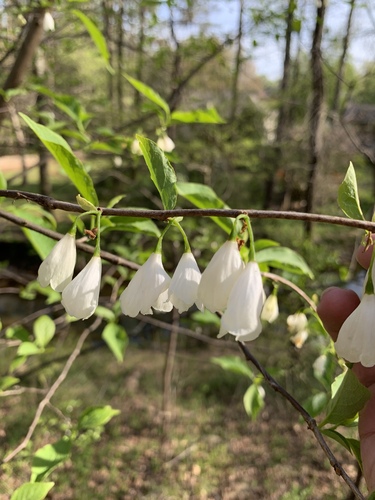
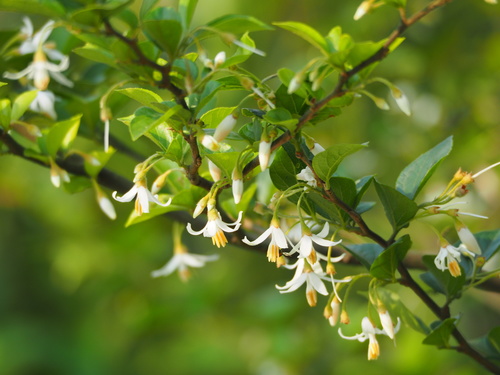
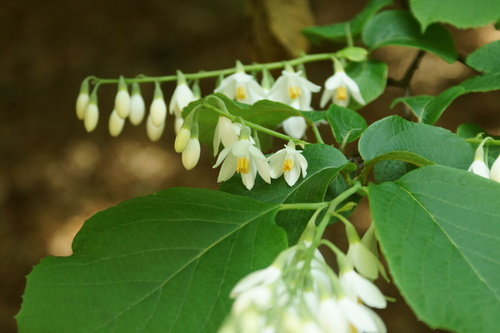
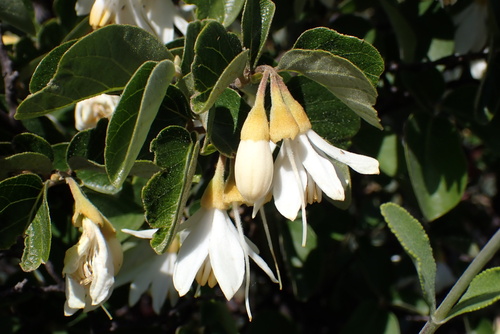
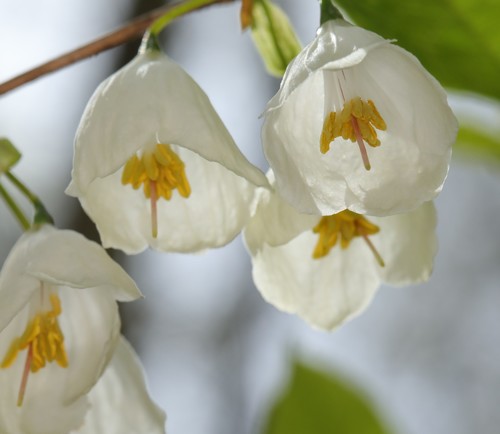
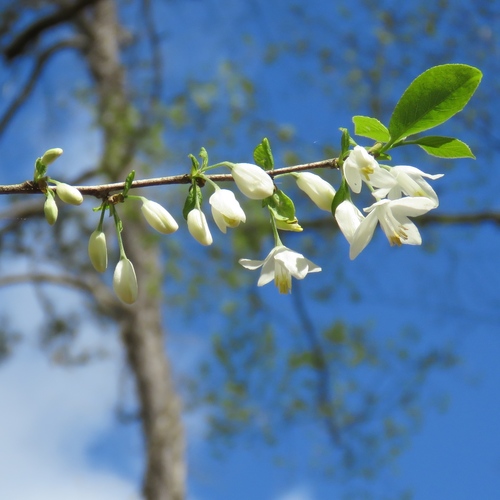
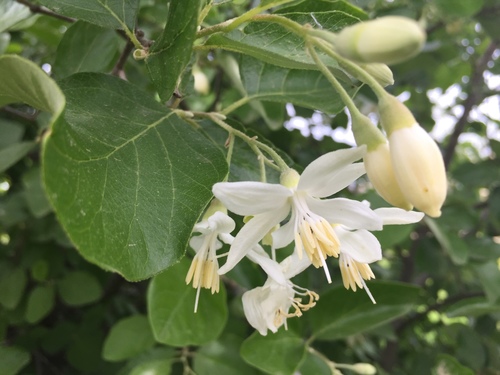
Styrax officinalis L. is a deciduous shrub that grows to 2–5 metres (6 ft 7 in – 16 ft 5 in) in height. It has a simple, open growth form. Its leaves are very thin and elliptical, 5–10 cm (2–4 in) long and 3.5–5.5 cm (1+1⁄2–2 in) wide; leaves are alternate and widely spaced along thin, reddish stems, while older basal stems are covered in tight, dark bark. A small, very light green, stalked axillary bud occurs with each leaf. Its inflorescence is short and bears few flowers. The flowers grow from leaf axils, are bell-shaped, white and fragrant, and measure about 2 cm (1 in) long. The corolla has 5–7 petals and many yellow anthers, and the calyx is 5-lobed. It flowers from spring to summer, between May and June. Three previously recognized subspecies of this taxon—Styrax officinalis subsp. redidivus and Styrax officinalis subsp. fulvescens, both native to California, and Styrax officinalis subsp. jaliscana, native to Mexico—are included here, but recent molecular analysis suggests these lineages have diverged enough to be classified as separate species. This species is native to southern Europe and the Middle East. It grows best on dry rocky slopes, in open woods, and in thickets, at elevations up to 1,500 metres (4,900 ft) above sea level. This plant is the 'official' source of styrax, also called storax, an ancient herbal medicine, and Linnaeus formally identified it as this source. Some sources believe its oleoresin was the stacte that was combined with frankincense, galbanum, and onycha to make Ketoret, the incense for the Tabernacle described in the Old Testament. The medieval scholar Averroës referenced the reddish-brown oleoresin exudate obtained from the storax tree (Styrax officinalis). Ibn Ǧanāḥ, who lived approximately 990–1050 CE, discussed the biblical incense galbanum in his work Sefer Ha-Shorashim, entry for the root ח-ל-ב at the end: "And then there is ḥelbanah (galbanum) which is called in Arabic lūbnī," which he states refers to the resin of the storax tree. Some scholars speculate that the storax referenced by ancient peoples was likely extracted from a different tree, Liquidambar orientalis, which grows wild in northern Syria. This species may be the biblical balm, though other sources conclude that the biblical balm is instead balsam, also called opobalsamum.