About Styrax grandifolius Aiton
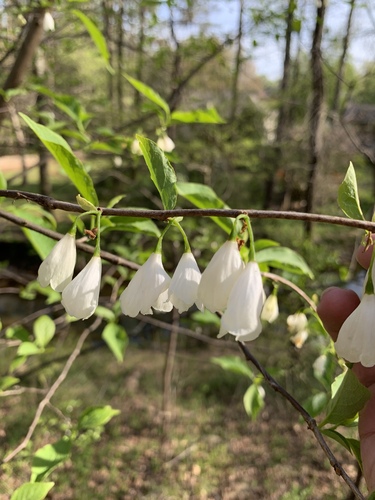
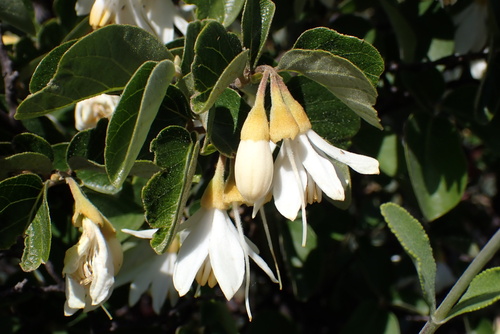
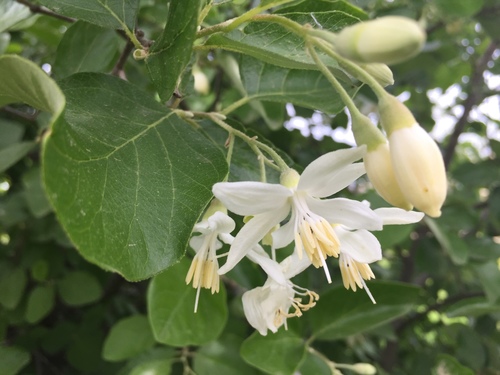
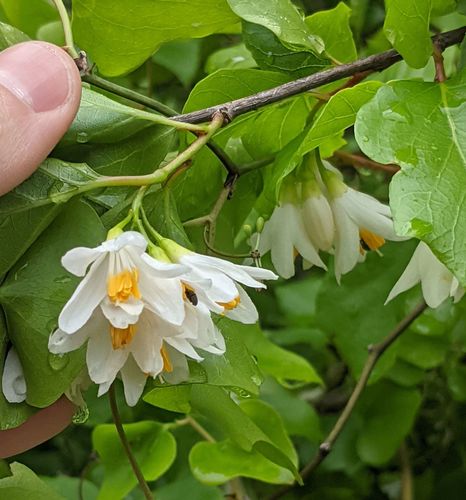
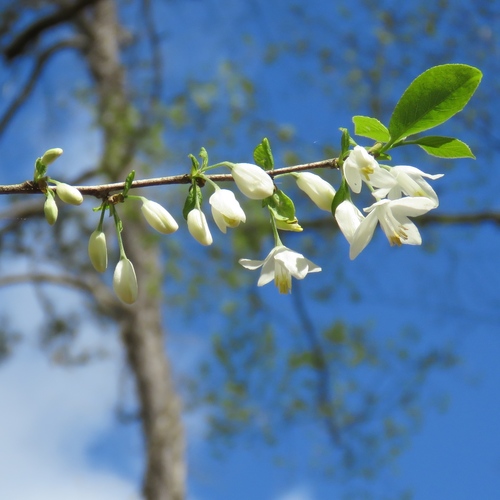
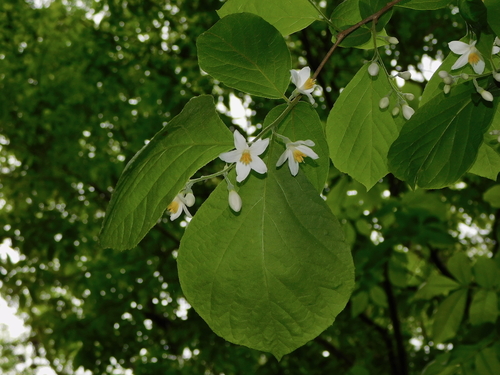
Bigleaf snowbell, Styrax grandifolius Aiton, is a deciduous shrub or tree that grows up to 6 m (20 ft) tall. It has dark, streaky bark. As its specific epithet grandifolius indicates, this species has larger leaves than other sympatric Styracaceae. Its leaves are alternate and obovate, growing up to 14 cm long and 10 cm wide, and are densely pubescent on the underside. This dense pubescence gives the leaf underside a whitish grey appearance, while the leaf top is dark green. The simple leaves range from broadly obovate to suborbicular in shape, with bases that are broadly tapered to rounded, and petioles 2–10 mm long. Compared to other species in the genus Styrax, Styrax grandifolius produces flowers in larger clusters, with up to 20 flowers arranged in a single raceme. Flowers open in early summer and are white. Each flower has 5 fused sepals, 5 petals that are fused at the base and unfused above the base, 10 stamens with yellow or orangish anthers at their tips, and a partly inferior ovary. Nut-like drupe fruits, 7–9 mm in diameter, develop from June to October. The brownish green fruit holds up to 3 seeds. This species is very similar in appearance to American snowbell (Styrax americanus), which differs by having smaller leaves and fewer flowers per cluster. Styrax grandifolius is native to the southeastern United States, with a range extending from Virginia south to Florida, and west to Texas and Missouri. It is most commonly found in upland forests of the southeast piedmont. Bigleaf snowbell grows in shaded areas, open mesic upland forests, or near floodplains, most often on well-drained slopes. It can grow in a wide variety of soil conditions, including rocky clay, hillside sandy soil, and gravelly soil. It also has a broad soil pH tolerance, growing in soils with a pH between 5 and 7, and is found across an elevation range from approximately 90 ft to 1,300 ft. While Styrax grandifolius can grow in multiple soil types and conditions, and tolerate moderate disturbance and some types of forest fire, it has low tolerance for saturated soil and direct sunlight. For this reason, it most often grows as an understory plant. It occurs in a variety of community types across the southeastern United States, including mixed-mesic and upland deciduous forests. Bigleaf snowbell attracts a range of pollinators; the most common visitors are honeybees and bumblebees. Additional pollinators that visit this species include swallowtail butterflies, syrphid flies, sphingid moths, wasps, and solitary bees. Bigleaf snowbell can be easily propagated through leaf cuttings. It can be grown as an ornamental plant for its showy, abundant flowers, but ornamental use of the species is limited almost exclusively to botanical gardens.