About Styphelia woodsii (F.Muell.) F.Muell.
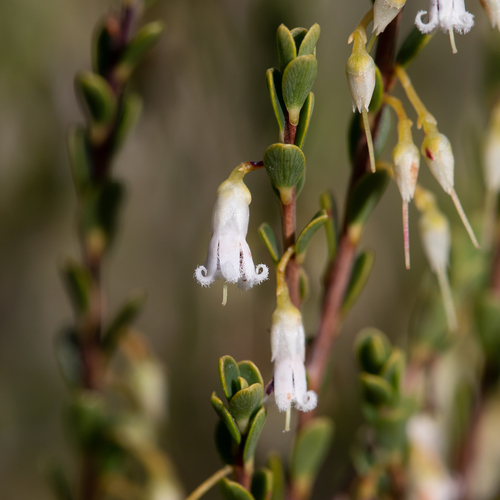
Styphelia woodsii is a slender shrub that usually reaches 20 to 40 centimetres (7.9 to 15.7 inches) in height. Its branchlets are greyish-brown and covered in tiny, soft hairs. The leaves are more or less erect and egg-shaped, sometimes with the narrower end at the base; they measure 3 to 5 millimetres (0.12 to 0.20 inches) long, 1.1 to 1.9 millimetres (0.043 to 0.075 inches) wide, and are more or less glabrous.
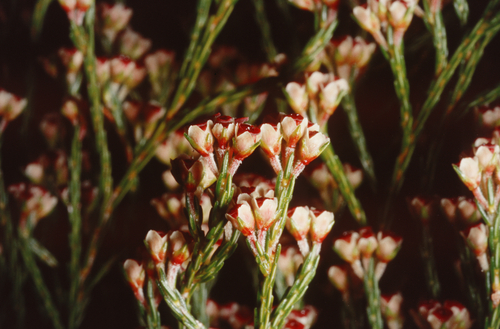
Flowers of this species are arranged singly or in pairs in leaf axils, growing on a hanging peduncle that is up to 1.8 millimetres (0.071 inches) long. Egg-shaped bracteoles 1.0 to 1.5 millimetres (0.039 to 0.059 inches) long are present at the base of the flower structure. The sepals are egg-shaped and measure 1.5 to 2.2 millimetres (0.059 to 0.087 inches) long. The petals are white, 4.5 to 8 millimetres (0.18 to 0.31 inches) long, and joined at the base to form a cylindrical tube. The petal lobes are much longer than the tube, and are densely bearded on the inside. Flowering takes place from February to June, and the fruit is an oval drupe 4 to 6 millimetres (0.16 to 0.24 inches) long.
This species grows in shrubland, mallee scrub and heath, in deep sand or on sand dune crests. It occurs in the Little Desert and southern Big Desert of western Victoria, in south-eastern South Australia, and in the Avon Wheatbelt, Esperance Plains, Jarrah Forest and Mallee bioregions of southern Western Australia.