About Styphelia exarrhena (F.Muell.) F.Muell.
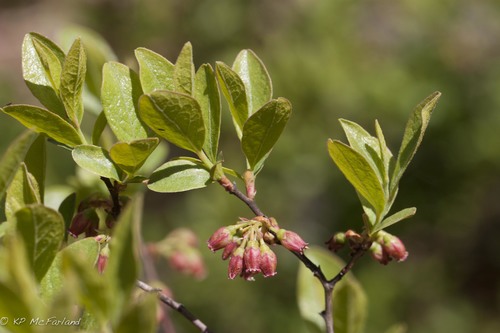
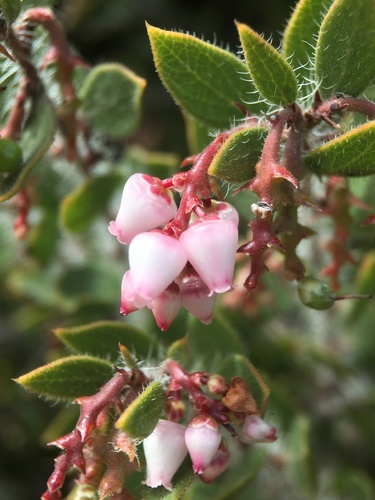
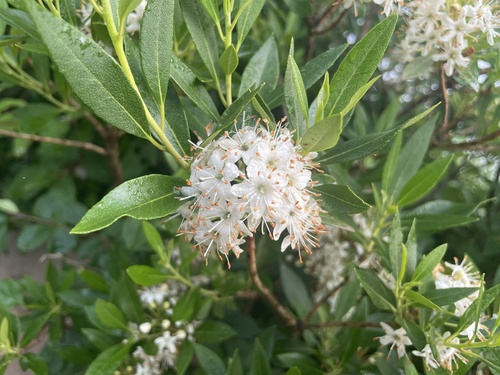
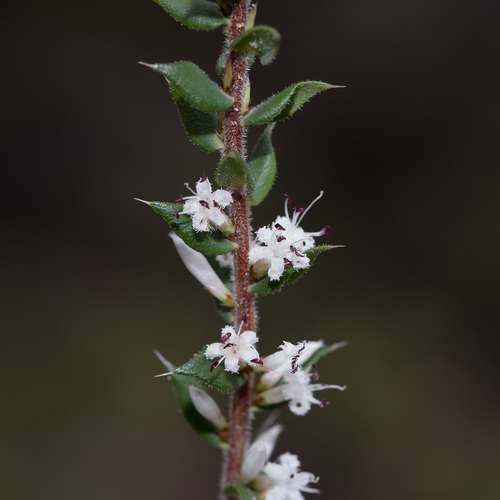
Styphelia exarrhena is an erect shrub that typically reaches 30 to 60 centimeters (12 to 24 inches) in height, and has downy branchlets. Its leaves are either erect or spreading, egg-shaped, 3.2 to 9 millimeters (0.13 to 0.35 inches) long and 1.4 to 4.5 millimeters (0.055 to 0.177 inches) wide. The leaves are usually glabrous, with a small sharp point at the tip. Flowers are arranged singly or in pairs in upper leaf axils. They have egg-shaped bracts 0.7 to 1.2 millimeters (0.028 to 0.047 inches) long, and bracteoles 1.3 to 2 millimeters (0.051 to 0.079 inches) long. The sepals are egg-shaped and 2.4 to 3.2 millimeters (0.094 to 0.126 inches) long. The petal tube is cream-coloured, 3.0 to 4.3 millimeters (0.12 to 0.17 inches) long, with lobes 3.2 to 5 millimeters (0.13 to 0.20 inches) long that are covered in bearded hairs. Flowering occurs between April and August. The fruit is a narrowly elliptic drupe, approximately 2.5 millimeters (0.098 inches) long. This species, commonly called desert styphelia, grows in sandy soil in mallee scrub, coastal shrublands and heath. It is found in the south-east of South Australia, including Eyre Peninsula and Kangaroo Island, and in the Big Desert area of Victoria.