About Stymphalornis acutirostris Bornschein, Reinert & Teixeira, 1995
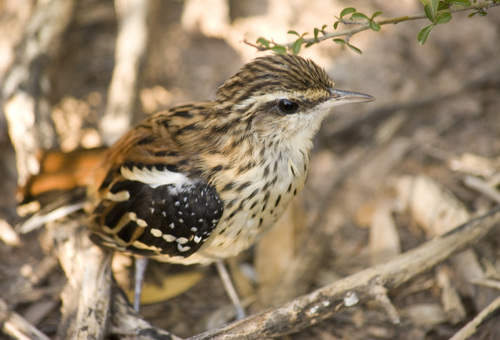
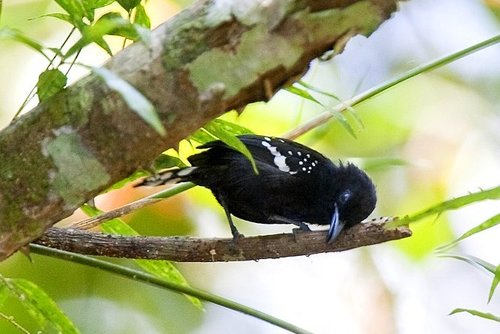
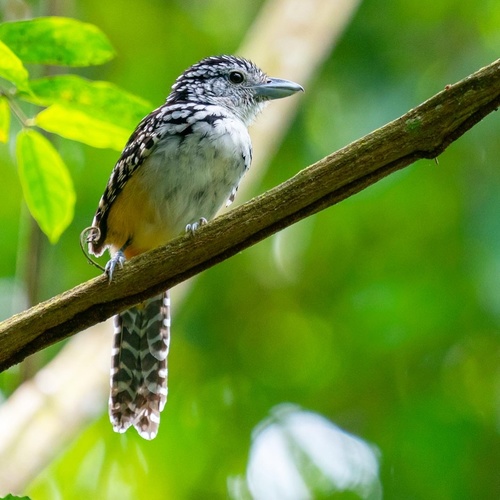
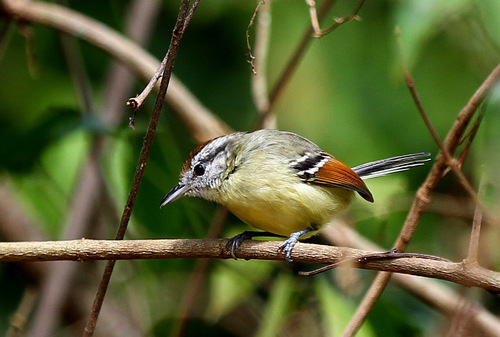
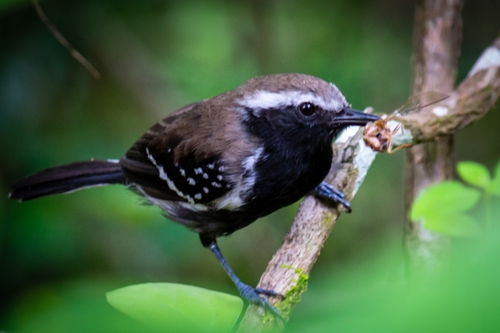
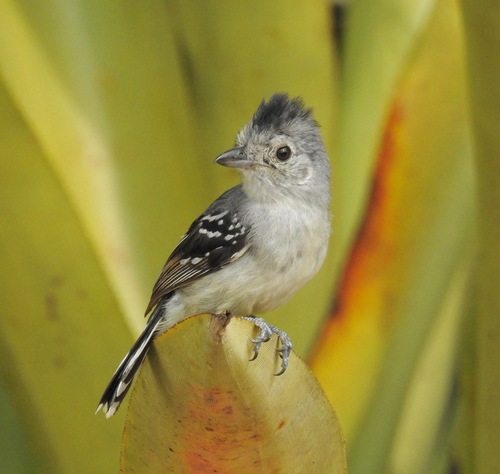
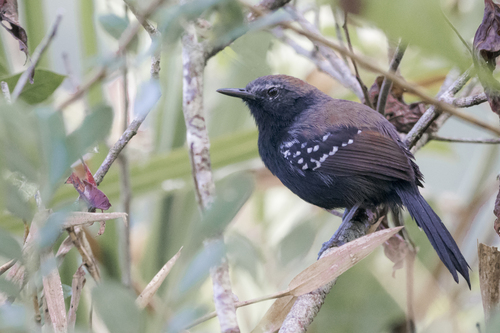
The marsh antwren, scientifically named Stymphalornis acutirostris, measures 13 to 15 cm (5.1 to 5.9 in) in length and weighs 8 to 12 g (0.28 to 0.42 oz). Adult males of the nominate subspecies have an otherwise lead gray face, marked by an ill-defined pale supercilium and a whitish crescent below the eye. Their forehead is grayish white, while their crown and upperparts are dark chestnut-olive. Their wings are blackish, with chestnut-olive edges along the flight feathers. The wing coverts are darker than the flight feathers and have bright white tips. Their tail is black, sometimes with white or cream tips on the outer feathers. Their throat, breast, and belly are lead gray, and their flanks and crissum are dark olive brown. Adult females share the male's ill-defined pale supercilium and whitish crescent below the eye, but their face is otherwise streaked in black and white. They have a grayish white forehead, an olive-brown crown, and brown to grayish brown upperparts. Their wings match the male's. Their tail is entirely black. Their throat and underparts are white, with heavy black streaks on the breast that become paler on the belly. Immature males resemble adult females. Immature females have brownish spotting on their wings and less underpart streaking than adult females. Males of the subspecies paludicola have a white supercilium on a black face. They have a gray forehead and dark grayish brown crown and upperparts. Their flight feathers are very dark brown with white inner edges, and their wing coverts are mostly black with white tips. Their tail is black with white tips on the outermost two pairs of feathers. Their throat, underparts, and thighs are black, with underwing coverts that are white with black tips. Females of this subspecies have a white supercilium on a gray face. Their forehead is gray, and their crown and upperparts are dark grayish brown. Their wings are similar to the subspecies male's, but their coverts are mostly dark grayish brown. Their throat and underparts are white with black spots, and their thighs are black with white tips. This species has a disjunct distribution in southeastern Brazil. The nominate subspecies occurs mostly in coastal Paraná and extreme northeastern Santa Catarina, and also ranges locally south into northeastern Rio Grande do Sul. Subspecies paludicola is found further north, at fewer than 20 sites in the upper reaches of the Tietê and Paraíba do Sul rivers in São Paulo state near the city of São Paulo. As its common name suggests, the marsh antwren primarily lives in coastal and riverine marshes. It occurs less often in flooded plains and in the transition zone between mangroves and drier land. All of these habitats have fluctuating water levels. Across all habitats, the species favors dense vegetation that is less than 1 m (3 ft) high. In terms of elevation, the nominate subspecies is found from sea level to about 25 m (80 ft) above sea level, while paludicola occurs between 600 and 760 m (2,000 and 2,500 ft).