About Styloxus fulleri (Horn, 1880)
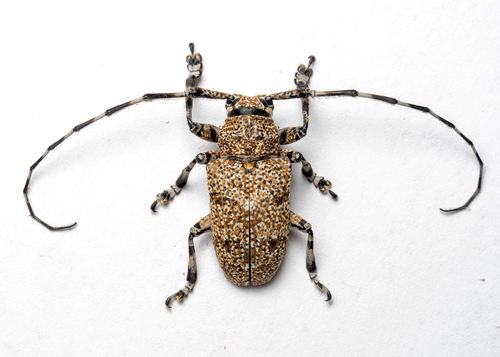
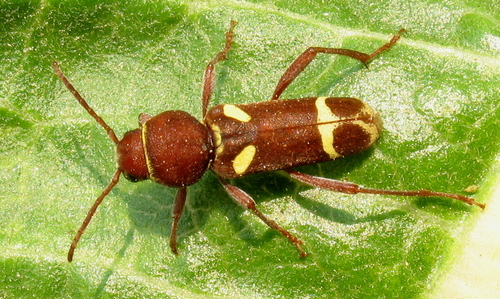
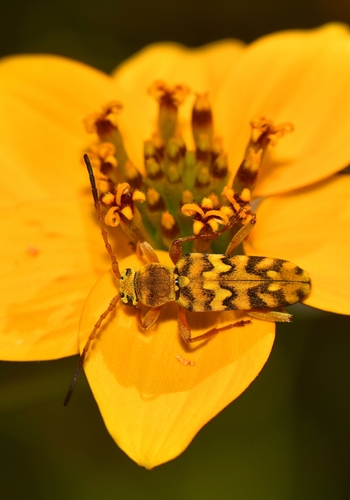
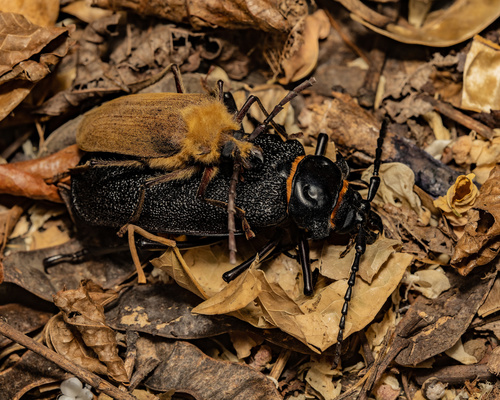
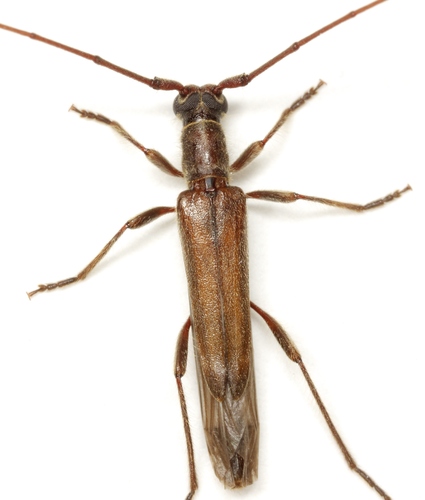
The Cerambycidae family, commonly known as Longhorn Beetles, gets its name from the long antennae that its members have, which can sometimes be extremely long. Male longhorn beetles usually have longer antennae than females, and in many cases, the antennae attach to the head within a distinct notch at the front of the eye. Styloxus fulleri is a relatively small longhorn beetle species, with adults reaching roughly 12–13 mm in body length. Its elytra, the hardened front wings, do not fully cover the second pair of wings; instead, they end approximately two-thirds of the way down the body length. This species has exceptionally long antennae made up of very long, thin segments, and it has very large eyes positioned on a comparably small head. Longhorn beetle larvae are referred to as round-headed borers. Most larvae feed on dead and decaying wood, though some species feed on living plants. Because larvae tunnel inside wood, they are rarely seen, and only the adult form emerges from the wood. Most longhorn beetle species have a narrow window of flight time when adults can be observed. Adult longhorn beetles feed on flower nectar, plant sap, leaves, or bark. They are typically strong fliers, and adults are sometimes attracted to artificial lights at night. While individuals of some longhorn beetle species are almost always a consistent size, other species can show quite noticeable size variation: this variation can occur within the same sex, as well as between males and females, with males often being much smaller than females.