About Styela plicata (Lesueur, 1823)
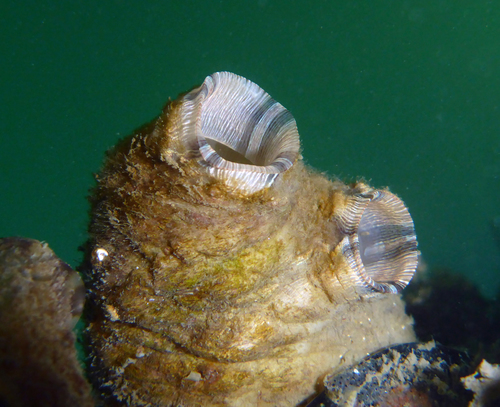
Styela plicata is a solitary tunicate. Its tadpole larvae measure around 1.3 millimetres (0.051 in). Adults become sexually mature at around 40 millimetres (1.6 in); observations show this stage is reached in approximately 2 months during summer and 5 months during winter when grown in a laboratory. After reaching sexual maturity, individuals live an additional 3 to 4 months, regardless of seasonal changes, and grow to a maximum size of 60 to 80 millimetres (2.4 to 3.1 in). Adult S. plicata are grayish or tannish-white, with red or purple stripes on their siphon. Unlike related species in the same genus, such as Styela clava and Styela montereyensis, adult S. plicata do not have a stalk.
Despite S. plicata having a very broad geographical distribution, its native range remains unclear. In 2021, an analysis was conducted on 368 individuals tested for COI marker genes, and 315 individuals tested for the ANT marker gene, from 17 locations across the world. This analysis confirmed that S. plicata has existed in all studied oceans for a long time. Repeated colonization events and occasional mixing between populations have shaped the current genetic structure of this species. While the native range is unclear, the most widely accepted hypothesis is that S. plicata originated in the Northwest Pacific Ocean, then spread to other warm and tropical water bodies via ship fouling. As of 2021, genetic analyses are still inconclusive and do not confirm or reject this hypothesis.
The range of Styela plicata has expanded greatly due to its ability to attach to and travel on ships' hulls. Long-distance dispersal of this species most often occurs through international shipping, while short-distance local dispersal happens through recreational boating and local maritime traffic. Preventative measures to limit its spread include anti-fouling paints, wood preservation, and slime control treatments that contain tributyltin.
This species can survive in a wide range of environmental conditions, tolerating water temperatures from 10° to 30°C and salinities between 22% and 34%. It can also tolerate pollution and brackish water. Different life cycle stages of S. plicata have different habitat requirements for survival. Larval and juvenile S. plicata live on marinas, docks, oyster reefs, rocks, and coarse woody debris. Adults prefer marinas, docks, and hard rocky substrates. S. plicata can also inhabit coral reef habitats, and is found from the low intertidal zone down to depths of 30 metres.