About Styela montereyensis (Dall, 1872)
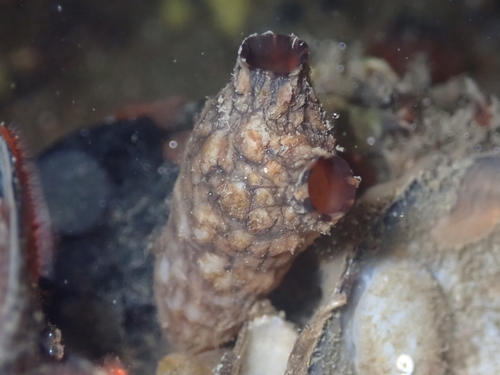
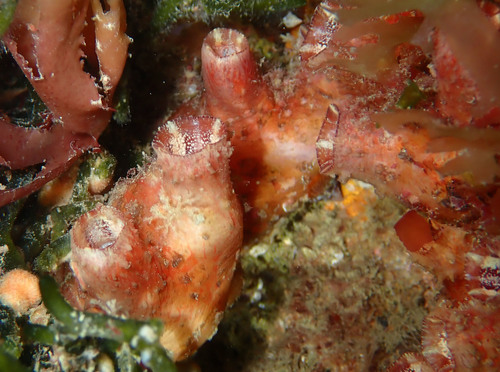
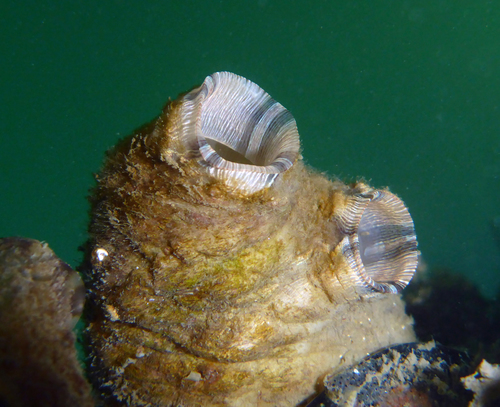
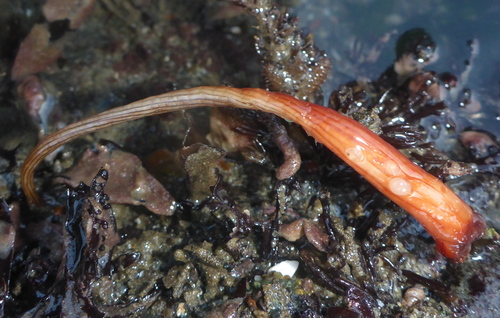
Styela montereyensis (Dall, 1872) ranges in color from yellow to dark red-brown. It is a solitary tunicate species that often grows in loose groups. In exposed sites, it normally reaches 8–15 cm (3–6 in) in length; in the rarer calm habitats it can grow up to around 25 cm (10 in). Its body is elongated and cylindrical, attached to a thinner stalk that is roughly the same length as the body. Its two siphons sit close together at the distal end: the oral siphon points to the side or downward, while the atrial siphon points straight upward. It has a leathery tunic marked with distinct longitudinal grooves and ridges that run the full length of the body. When growing in harbors, this species is commonly covered in foreign debris and small organisms like algae and hydroids, but it stays clean in wave-swept habitats. The feeding mechanism of S. montereyensis uses force generated by underwater currents to push water through its feeding apparatus. Its flexible stalk lets current passively adjust the organism's position and optimize the orientation of its siphons, making foraging a relatively low-energy activity. Because it has limited hyperosmotic capacity, S. montereyensis typically conforms osmotically to its environment, which lets it adapt to changing environmental salinities. The maximum lifespan of this species is not confirmed, but one recorded individual lived for three years and reached a length of 23 cm (9.1 in). This species is distributed from Vancouver Island and Hope Island south to Baja California. It inhabits the low intertidal zone down to approximately 30 m (100 ft) in depth. It is fairly common across its range, and can be found firmly attached to natural substrates, pilings, jetties, and subtidal reefs in waters from calm to extremely rough. In the Pacific Northwest, specimens rarely occur in inland waters, and are normally found on outer straits and the open coast. Populations along the west coasts of Vancouver Island and Washington host the copepod crustacean species Pygodelphys aquilonaris inside their branchial sacs.