About Styela clava Herdman, 1881
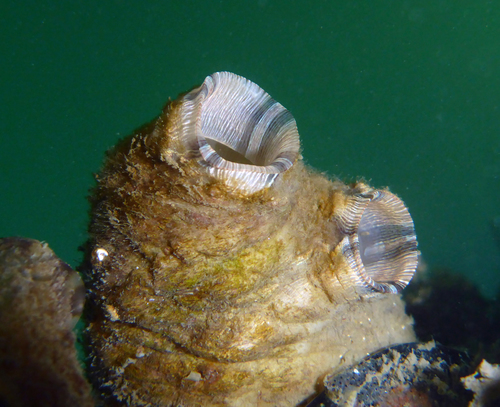
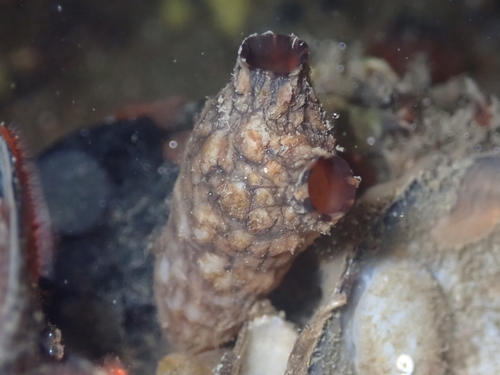
Styela clava Herdman, 1881 is a solitary tunicate. When including both the club-shaped body and peduncle, larger specimens can reach a maximum total length of around 130 mm (5.1 in), while smaller specimens only grow to 30 mm (1.2 in) in length. Smaller specimens generally do not have a distinct peduncle. Matching its common names, this species has a tough, wrinkled or irregularly grooved outer skin. Its color varies by size: larger specimens have a light brown body and darker brown peduncle, while smaller specimens are yellow-brown. S. clava is a sessile marine invertebrate. Adult individuals attach permanently to hard subtidal substrata, found at depths up to 25 meters (82 ft). It can grow on nearly any hard surface, including rocks, buoys, pilings, and mussel shells. This species is most common in the littoral zone, and prefers sheltered locations with no strong wave action or floating objects. As a result, artificial surfaces in harbors and marinas make excellent habitat for it. It is a hardy species that can survive a wide range of water temperatures, from -2 °C to 27 °C. It can also tolerate high salinity levels (26% - 28%) that are lethal to other tunicate species. The native range of S. clava is the northwestern Pacific Ocean, covering the seas and coasts of Japan, Korea, and Siberia, extending south as far as the coasts off Shanghai, China. Since the mid-1900s, S. clava has been unintentionally introduced to temperate coastal waters outside its native range across the globe. It has successfully established stable populations on both coasts of North America, Europe, New Zealand, Australia, and Argentina. The earliest recorded sighting of S. clava outside its native range was on the west coast of the United States, in Californian coastal waters, in the early 1900s. Since then, this invasive tunicate has spread as far south as Baja, Mexico and as far north as Vancouver Island, Canada. S. clava populations in North America's Atlantic waters are thought to have been introduced around the 1970s. The next recorded sighting of S. clava outside its native range was in mid-1900s in British waters, Europe. Over 25 years, S. clava populations expanded their range across the coastal waters of the United Kingdom and into mainland Europe. Today, established populations are found in England, Ireland, Belgium, Netherlands, Denmark, France, Portugal and Spain. Like most tunicates, S. clava is hermaphroditic, and produces short-lived pelagic lecithotrophic larvae. It reproduces externally through broadcast spawning. Its reproductive period depends heavily on sea surface temperatures reaching a critical threshold between 16 °C and 20 °C. The overall length of the reproductive period ranges from 4 to 10 months, depending on location. On the Californian coast of the United States, reproduction occurs for 4 months from June to September. In Denmark and England, reproduction also occurs for 4 months, but runs from July to October instead.