About Sturnus unicolor Temminck, 1820
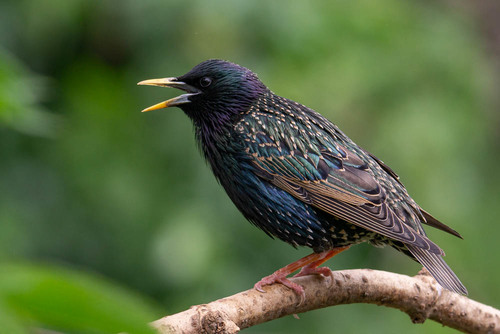
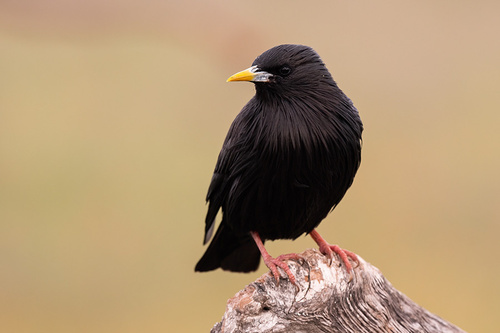
Adult spotless starlings (Sturnus unicolor) are very similar to common starlings, but are slightly larger, measuring 21–23 cm in length and weighing 70–100 g. They have darker, oily-looking black plumage with a subtle purple or green gloss visible in bright light. This plumage is completely spotless in spring and summer, and only shows very small pale spots in winter, formed by the pale tips of feathers. A key difference from common starlings is conspicuously longer throat feathers – twice the length of those found on common starlings – which form a shaggy "beard" that is especially noticeable when the bird sings. Spotless starlings have bright pink legs. In summer, the bill is yellow, with a bluish base in males and a pinkish base in females; in winter, the bill is duller, and often blackish. Young spotless starlings are dull brown, darker than young common starlings, and have a black bill and brown legs. Confusion with common starlings is especially easy during winter, when common starlings are abundant throughout the spotless starling's range. Confusion is also possible in summer, where the two species' breeding ranges overlap in northeastern Spain and far southwestern France. Spotless starlings can also be confused with common blackbirds (Turdus merula), which most obviously differ in having a longer tail and no gloss on their plumage. Like common starlings, spotless starlings walk rather than hop, and have a strong, direct flight that appears triangular-winged and short-tailed. They are noisy birds and good mimics; their calls are similar to common starlings', but louder. Spotless starlings use a wide range of habitats, and can be found in any reasonably open environment, from farmland and olive groves to human settlements. The highest population densities occur in open grazed holm oak woods, and in urban habitats such as Gibraltar, where the species is common. The spotless starling population has grown in recent decades, accompanied by a northward range expansion. It spread to the whole of Spain – where it was previously absent from the northeast – between 1950 and 1980, and has colonised local areas along the southern coast of mainland France since 1983. Like its more common relative the common starling, the spotless starling is an omnivore. It eats a wide variety of invertebrates, berries, and scraps provided by humans. It is gregarious, and forms large flocks, often mixed with common starlings, that can reach up to 100,000 individuals in winter. Like most starlings, it is a cavity-nesting species, breeding in tree holes, buildings, and cliff crevices. It typically lays three to five eggs per clutch.