About Sturnella superciliaris (Bonaparte, 1850)
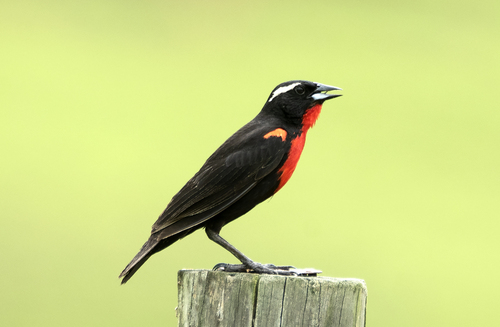
The white-browed meadowlark, a species currently classified as Leistes superciliaris, is a passerine bird that belongs to the New World family Icteridae. It was previously called the white-browed blackbird, but is not closely related to the red-winged blackbird group. This meadowlark breeds in two main regions of South America: northeastern Brazil, and southern South America ranging from southwestern Brazil through Paraguay, Uruguay, and Argentina. Populations in the southern part of the species' range are partially migratory. Similar to other meadowlarks, this species is associated with open habitats, which include moist grasslands, pastures, and cultivated areas. It prefers sites that have scattered bushes or fence posts that males can use as songposts. During courtship display, a male will fly up to 10 meters into the air, then parachute back down with folded wings while singing. Its song begins with a buzzing sound, followed by a sequence of notes: TZZZZZZ-teee-chu-chu-chak-chak. Its typical call is a short chuck. The white-browed meadowlark builds its nest as a deep, open cup lined with grass, placed on the ground among tall grasses. Multiple nests of this species are often built close to one another. A normal clutch contains three to five greenish eggs marked with reddish brown blotches. This species is frequently parasitized by the shiny cowbird; on one recorded occasion, a single nest held 19 cowbird eggs alongside just one white-browed meadowlark egg. The white-browed meadowlark is a small icterid. Adult males have mostly black plumage, with the exception of a bright red throat, belly, and wing epaulets, plus a distinct white supercilium. Adult females have dark brown upperpart feathers with buff-colored edges, buff-colored underparts, and pale streaks running through the crown and eye. Juvenile birds look similar to adult females, but have paler overall plumage. This species is very closely related to the red-breasted meadowlark, L. militaris, which breeds further north than the white-browed meadowlark. The white-browed meadowlark was formerly treated as a subspecies of the red-breasted meadowlark. Males of the white-browed meadowlark can be easily told apart from male red-breasted meadowlarks by the white-browed's bright white supercilium, but females of the two species are almost identical in appearance. Compared to the female white-browed meadowlark, the female red-breasted meadowlark has a longer bill, smaller body size, shorter wings, more red coloration on the underparts, and less streaking on the underparts. This gregarious species feeds mainly on insects, alongside a smaller amount of seeds including rice. It forages on the ground in a manner similar to a bobolink. The white-browed meadowlark has benefited from the more open habitat created by forest clearance and ranching, and is currently expanding its geographic range.